Local News Links:... .........................

Tuesday, 29 April 2014

The Bay Downtown's secret basement tunnels ?


Winnipeggers love a good tunnel story. While researching the now missing elevator lobby mural at the Bay Downtown, I came across this from a November 27, 1976 Free Press !


The Blackwood Bros. plant was located at Portage Avenue and Colony street starting around 1890. It was a factory and warehouse NOT for booze but for soft drinks ! There was a Blackwoods Brewery, but it was located much further south at Osborne and Mulvey and lasted from about 1900 to 1912 or so.

The Blackwood home, designed by George Creeford Brown, was constructed in 1896 and demolished in 1937.


Mr. Sewell was Leslie (Jimmy) Sewell who spent 42 years working at the store, (1928 - 1970). He died in 1991.

Above are the old furnaces in the store's sub-basement that he once shoveled coal into.

Sunday, 27 April 2014

The Radio Edition for April 27, 2014

Arlington Bridge text Cassidy2
After a late winter hiatus, West End Dumplings - The Radio Edition is back ! Tune in tonight at 7 p.m. on 101.5 UMFM or, when the show is done, check here for the podcast. Past episodes can be found here.

Tonight, I will have two guests in the studio:

Matt Carreau, the Winnipeg organizer of Jane's Walk 2014, talks about some of the more than 20 walks on offer May 3 and 4, 2014.

Susan Algie from the Winnipeg Architecture Foundation tells us about the lineup for the 2014 Art+Architecture Fim Festival that will take place at Cinematheque from April 30 - May 4, 2014. we'll also talk about some of the other events the WAF has planned for the summer.

I'll also take a look ahead at some events coming up this week in Manitoba history. You can find these, and more, each morning at my blog This Was Manitoba. Here are a few bonus links that I will mention in the show:

- the first ship to pass through the one-of-a-kind St. Andrews Lock and Dam;

- the dismantling of Brandon's streetcar system, (the last known Brandon streetcar is awaiting restoration in Edmonton.);

- how Peter Mansbridge got his broadcasting start in Manitoba, (photo spoiler);

- Expo '67 opens in Montreal. here's a photo of the pavilion shared by the four Western provinces;

- Manitoba's name is explained on the floor of the House of Commons by Georges Etienne Cartier as he introduces the Manitoba Act, 1870. (More about Manitoba's name.)

- happy 50th birthday to Brandon's Ron Hextall, a member of the Hockey Hall of Fame !

Here's the play list:

Walking Song by Kate and Anna McGarrigle
Thru These Architect's Eyes by David Bowie
Canada by Bobby Gimby
Manitoba by fifth
Jours de plaine Daniel Lavoie

Thursday, 24 April 2014

A history of the Park Theatre

© 2014, Christian Cassidy. Please respect my research.
Park Theatre, Osborne Street, Winnipeg
In the past few decades, all of Winnipeg's neighbourhood theatres have been demolished or "repurposed" into bowling alleys, churches or commercial spaces. The Park managed to hold out for 73 years before fate caught up with it.

After sitting vacant for nearly a decade it was revived into what is now one of Winnipeg's most popular live music venues.

Here is a look back at the history of the Park Theatre.

ca. 1930 (Source: Fort Rouge Through The Years)

The origins of the Park Theatre at 698 Osborne Street are a bit of a mystery.

The building is first listed in the 1915 Henderson Directory and was certainly open by July as that is when it is first mentioned in local newspapers. That first small announcement indicated that the theatre's manager allowed the Riverview Red Cross Society to host a picture show as a war-time fundraiser. The following week, the “Riverview Workers” were given the receipts for the day as a fundraiser of their own.

The first manager was Alexander McKinney who lived three doors down at the Oakwood Block. It is likely that he was the owner as well.

Listed as employees in the 1915 Henderson Directory were: Hubert McKinney, Alexander's son and the theatre's pianist; George Hollings, projectionist, of Logan Avenue; and Phyllis Dobson, musician, of 547 Rathgar.


The Park may have struggled under the McKinneys. Aside from the two small notices July 1915, the theatre was not mentioned in either newspaper again under their management.

Above: September 4, 1915, Winnipeg Free Press
Below: September 11, 1915, Winnipeg Tribune

In September 1915, a consortium of new owners, Messrs. Salvage, Davis, Watson and Little, took over the Park and reopened it under the same name on Labour Day 1915, boasting that it was “under new management and showing better pictures.” In October 1916, the same group took over the Star Theatre on Main Street.


The Henderson Directory lists E. Parrington Salvage as the working manager of the new Park Theatre. He was also the choirmaster and organist at St. Luke's Church.

The initial week’s offering was five nights of entertainment. On Monday and Tuesday it was episode number one of the serial “The Black Box”, Thursday was episode one of the serial “Who Pays”. Live entertainment consisted of a few performances by the Orpheus Glee Singers, a male quartet. The first weekend's feature film was Maurice Tourneur’s 1914 French film "Le puits mitoyen" (Secret of the Well).

The lineup for the weeks that followed were very similar. Subsequent episodes of each series played on their respective nights and the Orpheus Glee Singers were the house entertainment.

The Park enjoyed a quiet run as a combination cinema and community theatre until Christmas 1918 when it appears that movies were dropped from the lineup. The 1918 Henderson Directory lists only one employee for the Park and none in 1919.


The fortunes of the Park improved in 1926 when it was purchased by Harry Hurwitz. Just 25-years-old, he had already worked for his uncle Harry Morton in the theatre industry for half a dozen years. His brother, Bob Hurwitz, moved from their native Boston to help run things.

At the time, Morton Theatres owned at least two large Winnipeg theatres, the Monarch and Garrick. In 1941 they formed a partnership with Ontario's Odeon Theatres and took over the Walker, which had been closed for nearly a decade, converting it into the Odeon Cinema.

Hurwitz only owned the Park until 1930 but it was a time of stability, regularly showing second-run silent movies, while still home to a number of live community events and fundraisers. He also invested in some renovations. 

When it came time to sell up so that he could move to Saskatoon to look after Morton's investments there, Hurwitz attracted Rudolph Besler of Besler Bros. who for many years had operated theatres in Yorkton and Melville, Saskatchewan.

August 10, 1933, Winnipeg Free Press

Besler closed the Park for a couple of months for extensive renovations, which included lengthening the building by twenty-seven feet to allow for more seating and raising the roof by four feet for acoustics. As for the interior, a new air-cooling system was installed and the seats, flooring and carpeting replaced.

The most important change, however, was the addition of a Northern Electric Sound System to make it a "talking picture" house.


The talkie Park Theatre reopened at 6:00 p.m. on August 10, 1933 with the film 42nd Street. With this upgrade, its regular fare became second-run feature films, bringing stars like Cagney, Garbo and Barrymore to the neighbourhood.

Top: Ca. 1937 (Fort Rouge Through the Years). Bottom: Aug. 29, 1936, Winnipeg Tribune

In 1936, Besler invested further in the building. He hired architects Green, Blankstein and Russell to "practically rebuild" the Park inside and out. This included a twenty-five foot wide by one hundred twenty-five foot long extension and the replacement of the facade. Inside, new seating, air conditioning and electrical systems were installed.

The $20,000 worth of renovations took two months to complete. The Park reopened on August 31, 1936 at 1:00 pm with the Astaire - Rogers film Follow the Fleet.

 October 20, 1937, Winnipeg Tribune

The Park's existence was a quiet one. There were no fires, robberies or other major mishaps that made the newspapers. The one exception was in October 1937 when it was the scene of protests. 

When the contract for Besler's projectionist, a member of the International Alliance of Theatrical Employees Local 299, ended in June 1937, he hired a new projectionist from Projectionists Union No. 1 of the One Big Union. This angered Local 299 and in October they staged three protests outside the theatre. 


Besler called the police and fourteen men were charged with intimidation and later acquitted when the protests were considered "information pickets" by the judge. Because the dispute was primarily between the two unions, Besler did win an injunction preventing future pickets and $1,000 settlement for lost earnings which the union never paid.

July 26, 1940, Winnipeg Tribune

The Park continued in its role as a community space hosting lectures, church services and fundraising nights for places like the Riverview Community Club and area schools. It was a particularly active place during World War II, (Besler was a Veteran of World War I), participating in numerous fundraising events for the Red Cross and related charities.

December 5, 1942, Winnipeg Tribune

In the 1940s, the Beslers also owned the DeLuxe, (later known as the Hyland), on Main Street. The exact years of ownership are unclear, but the two were advertised jointly from 1942 to 1947. From 1951 to 1954, they also owned the Garry Theatre on Pembina Highway before selling it to Oscar Weinstein.

The 1950s were tough on the theatre industry. People were moving further into the suburbs and television had become the main form of nightly entertainment. Many neighbourhood theatre chains crumbled and their properties were sold off for demolition or repurposed uses such as bowling alleys.

The Park remained independent and held out until 1965 when the Beslers retired. According to Rudolph's obituary, he was the oldest theatre operator in Western Canada at the time.

December 21, 1946, Winnipeg Free Press

The Beslers kept a low profile. They did not appear in the society or church pages and, unfortunately, I cannot find a picture of either of them. 

What can be pieced together from a vital statistics search and their obituaries is that Rudolph of Melville SK and Mary (Schultz) of Winnipeg were married in Winnipeg in 1925. When they moved to Winnipeg in 1930, they lived at the Oakwood Block at 692 Osborne Street, for the first few years before settling into a home at 345 Baltimore Road.

Molly Schultz, Mary's sister, worked for the Beslers for nearly twenty-five years at the DeLuxe, Garry and Park. She was manager of the Park Theatre when she died in 1954 at the age of forty.

The couple had no children but the Park Theatre was a family affair. As described by Melinda McCracken in Memories are Made of this: What it was Like to Grow Up in the Fifties:

We bought our tickets, green admission tickets, off a roll for twenty-five cents from Mrs Besler, who sat behind the ticket window. Inside Mr. Besler, with his grey suit, round black-rimmed glasses and broad beaming face would tear them in half. 

By all accounts the couple ran a friendly, family-oriented theatre. On top of McCracken's account, Frank Morriss, the Free Press’ long-time entertainment editor, wrote in one of his columns that “It’s a pleasure to go to Rudy’s theatre, where you will always find courtesy and a real spirit of friendliness.

Rudolph Besler, 83, died on August 24, 1974 at his Baltimore Road home and is buried in Elmwood Cemetery. Mary, 88, died on May 8, 1991 at Princess Elizabeth Hospital and is also buried in Elmwood Cemetery.


The Beslers' retirement coincided with Odeon-Morton's expansion outside the downtown. They had already purchased the King's Theatre on Portage and opened the Odeon Drive-In (1963) when they bought the Park in 1965. They added the DeLuxe in 1966, renaming it the Hyland.

February 22, 1972, Winnipeg Free Press

Under Odean Morton, the Park hosted a film festival that focused on international cinema. These were so successful that in 1972 it became a full-time "art cinema" showing international, foreign language and independent films.

The manager through much of the 60s and 70s was Dave Robertson. He had worked for over twenty years in the theatre business and was manager of Odeon-Morton's Osborne and (old) Garrick before being appointed to run the Park.

In 1984, Odeon bought out Odeon-Morton and the Park Theatre returned to more mainstream fare.

April 22, 1988, Winnipeg Free Press

On April 21, 1988, the Park showed the George Burns film 18 Again. In the following day's cinema listings the above notice appeared: The Park Theatre is Now Closed. A spokesperson for Odeon Cinemas told the Free Press that the closure would facilitate an expansion of their Grant Park cinemas. (On January 18, 1990 Odeon closed the Kings, the final stand-alone nieghbourhood cinema in the city.)

The Park Theatre sat vacant until 1994, then reopened for about 18 months showing discounted second-run films. It reopened again briefly in 1996 as a music venue that featured midnight showings of Phantom of the Paradise and Rocky Horror Picture Show. In 1999, the vacant building was seized by the city for being three years in arrears on its property taxes.

August 25, 2005, Winnipeg Free Press

In 2005, Erick and Melanie Casselman bought the empty theatre and spent over $350,00 to convert it into a movie rental store, cafe and cinema. 

Over time, the movie rental store disappeared and the cinema gave way to a performance venue specializing in live music. At the 2012 Western Canadian Music Industry Awards Casselman won Talent Buyer of the Year and the Park Theatre was a finalist for Live Music Venue of the Year.

UPDATE 2019: Renovations are underway for a new Park Theatre !


Related:
Park Theatre homepage
ca. 1970s history pamphlet Fort Rouge Then and Now

Sunday, 20 April 2014

Rosser Avenue, Brandon - Then and Now

https://blogger.googleusercontent.com/img/b/R29vZ2xl/AVvXsEjYJsq7NxZ_I6bNmrIEWWDYiRPPTkjiA2L_V7gy2d3-LfyyPUt_F8urHR0YX6HyI-564ORoMTqUNronfofNKLMfHPvLj8yHK99FXEYLnz1SDcgxcpKgVp2PGoS1TbttO62hlizF4GnVkRjr/s1600/Brandon+Then+and+Now+-+Rosser.png

Above is a photo of Rosser Avenue, Brandon, from a 1950s Travel Manitoba brochure and 2013 Google Street View.

Wednesday, 16 April 2014

Did Bob Hope really play his first game of golf in Winnipeg ?


An often-repeated connection between Bob Hope and Winnipeg is that it was here, back in his vaudeville days, that he played his first game of golf. Some accounts go so far as to specify the location as the Kildonan Golf Course.

That is an impressive bit of sports trivia, so I thought I would look back and see if there was any truth to it.

Source: eBay

Hope was an avid golfer, a proponent of the game, and host of the long-running Bob Hope Classic golf tournament. In the book My Best Day in Golf: Celebrity Stories of the Game They Love, Hope wrote: "I consider golf my profession and comedy just a way of paying my green fees."Hope wrote numerous times about his introduction to the game of golf and over the course of 40 years the account remained essentially the same:

In early 1930, Hope was on the northern vaudeville circuit with the Orpheum theatre chain which included Minneapolis, Winnipeg, Calgary, Seattle, Tacoma and Vancouver. Among the travelling troupe of entertainers were the Diamond Brothers who were avid golfers. With their nights busy but nothing to do in the mornings, they went golfing and bugged Hope to join them. Eventually, Hope did and the rest, as they say, is history. 

February 1, 1930, Winnipeg Free Press

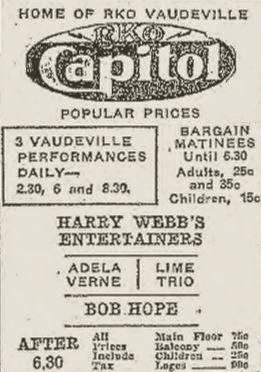
The dates and general circumstances of a Winnipeg golf game do do hold up. Bob Hope DID come through Winnipeg in early 1930 as part of a travelling Orpheum show. The above ad shows him here at the RKO Capitol Theatre, part of the Orpheum chain. (In 1929, RKO, which stands for Radio-Keith-Orpheum, took over the Capitol Theatre and after some renovations relocated all of its Winnipeg vaudeville shows there starting in September.)

The Orpheum Theatre on Fort Street then underwent renovations of its own. It reopened in late October as the "RKO Winnipeg" motion picture house. When Bob Hope asked about playing "at the Orpheum", he was actually referring to the Capitol.)


You may have already noticed the main flaw with the 1930 "golfing in Winnipeg" story. Winnipeg was an early stop on the tour and Hope's show played here during the first week of February before moving west. The daytime high forecast for February 5, 1930 was minus 13 degrees Celsius - hardly golf weather. The Kildonan Golf Course was the first course in the city to open that year at 7 a.m. on April 16, 1930.

 February 1, 1930, Winnipeg Tribune

Hope was already making a name for himself in the world of entertainment and his February 1930 appearance was written about in newspapers. I read through every detailed show description for the Orpheum published in both the Tribune and Free Press from late February to mid-July 1930 to see if the show, or just Hope himself, doubled back through Winnipeg. He didn't. 

I also scanned the archives for subsequent visits by Hope and the next one appears to be in 1953, which you can read about here.


How did this story get its start, then ? 

Most claims, if they reference a source at all, refer to a generic Hope "autobiography". (Hope wrote and co-wrote numerous memoirs and biographies.)

The first mention of the golf claim that includes any detail appears to be a 1988 article in Manitoba History magazine about early theatre in Winnipeg. The author credits a biography called "My Love Affair with Golf", (he likely meant the 1985 book Bob Hope's Confessions of a Hooker: My Lifelong Love Affair with Golf):


"My Love Affair With Golf acknowledges that he learned to play golf in Winnipeg while appearing at the Walker Theatre with a juggling act called the Diamond Brothers. While on the David Letterman Show about a year ago, Bob went into great detail about his first contact with golf in Winnipeg."

Unfortunately, I cannot find an online version of the book and the Winnipeg Public Library doesn't have it. There is a Google snippet view version and the term "Winnipeg" only appears once, as a stop on the Orpheum circuit.

http://sturf.lib.msu.edu/article/1990nov25.pdf

In the 1990 edition of Golf and Sports Turf, Hope penned an article entitled My Diamond Anniversary in Golf and wrote about his first game of golf "...as I confessed to Dwayne Netland in our book for Doubleday, Bob Hope's Confessions of a Hooker: My Lifelong Love Affair with Golf..." He continued:

"Then in 1930, my real love affair with golf began. I was in vaudeville, playing the Orpheum circuit, the northern route. I was doing afternoon and evening shows in Winnipeg and Calgary up in Canada, in Minneapolis MN, and in Seattle and Tacoma WA…. Then, one day in Seattle, they invited me to come along. I borrowed a set of clubs and started hitting the ball pretty well, to my surprise. I got hooked on Golf that day, and I’ve been addicted to it ever since."

July 4, 1986, Winnipeg Free Press

As for the Letterman appearance, which was part of a publicity tour for Confessions of a Hooker, I could only find this brief 1985 clip. Hope, though, appeared as a guest again in 1986 after which the above item appeared in the Winnipeg Free Press. 

It's hard to tell without seeing the Letterman footage if Hope actually came out and said "he played his first game of golf in Winnipeg". It seems more likely that, as is written in the book he was promoting, he said Winnipeg was one stop on the circuit of the 1930 show during which he learned to play golf and someone jumbled the facts.

Hope in Winnipeg, 1953

Given the fact that Hope was here in early February, a couple of months before golfing season began, and his reference to Seattle in his own article, I have to conclude that the claim that Bob Hope played his first game of golf in Winnipeg - much less Kildonan Golf Course - is not true.

I'd love to be proven wrong, though. If someone knows of another book or has that 1986 Letterman appearance handy please let me know !

Hope's accounts of his first golf games:

In Have Tux Will Travel: Bob Hope's Own Story, (Pete Martin, Bob Hope, Ted Sally - 1954), Hope explains how he caddied in the 1920s in Cleveland but just couldn't get the hang of the game, (p. 227):

"I didn't touch the game again until I landed in the bigtime in vaudeville and a couple of lads on the bill persuaded me to play. After that, I couldn't leave it alone, and vice versa."

In the biography Bob Hope: A Life In Comedy, (William Robert Faith - 2003), the author describes the 1930 tour then quotes Hope, (p. 43):

… they moved up to the Twin Cities for a split week at the St. Paul Orpheum, and then on to the Orpehum in Winnipeg. Up to this point they had been travelling in winter wind and snow but by the time they reached Calgary the weather was springlike. Hope was restless for some physical activity, and he began talking about learning to play golf….

“But during the Spring of  1930 on the Orpheum circuit, I’d be waiting around the hotel lobby in the late morning when the Diamond Brothers, another act, would come down with their golf clubs…. One day I said, “Oh, hell, I’ll go out there with you."

As mentioned above, in the 1990 edition of Golf and Sports Turf  Hope wrote My Diamond Anniversary in Golf and relates the story his first game of golf as originally told in his book Bob Hope's Confessions of a Hooker: My Lifelong Love Affair with Golf, (Dwayne Netland, Bob Hope - 1985):

"Then in 1930, my real love affair with golf began. I was in vaudeville, playing the Orpheum circuit, the northern route. I was doing afternoon and evening shows in Winnipeg and Calgary up in Canada, in Minneapolis MN, and in Seattle and Tacoma WA…. Then, one day in Seattle, they invited me to come along. I borrowed a set of clubs and started hitting the ball pretty well, to my surprise. I got hooked on Golf that day, and I’ve been addicted to it ever since."

Related:
My post about Bob Hope's 1953 return to Winnipeg
Bob Hope Biography American National Biography
Bob Hope official web site
Bob Hope 2003 World Golf Hall of Fame Induction Ceremony Video
Stories of later Bob Hope visits to Winnipeg can be found here and here.

Monday, 14 April 2014

Behind The Photo: Bob Hope Invades Winnipeg (1953)

© 2014, Christian Cassidy

Often I will see an old photo and spend some time digging into its back story. Sometimes I find a great story, sometimes not. Either way, I learn a few things about the city's history. Here's my latest attempt:

What a Hope: Gag Virtuoso Invades Winnipeg
April 29, 1953, Winnipeg Free Press

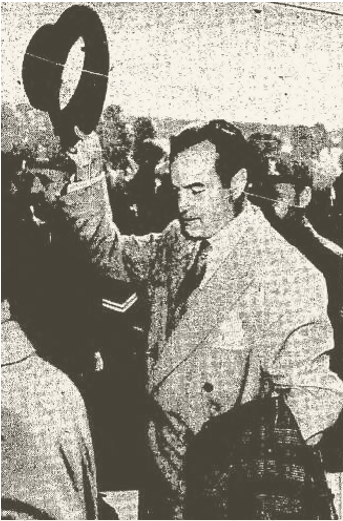
This photo from the April 29, 1953 Winnipeg Free Press shows Bob Hope on the tarmac of Stevenson Airfield. He had just arrived on a Northwest Airlines flight from Minneapolis to do a show.

Hope was a well-known entertainer by this point as the star of
his own hit U.S. radio show, several television specials and a string of "Road to" movies co-starring Bing Crosby and Dorothy Lamour. The previous month, he had hosted the first-ever televised Academy Awards ceremony.

February 1, 1930, Winnipeg Free Press

This wasn't Hope's first time in Winnipeg. He appeared on stage at least once during his vaudeville days, in early February 1930 as part of Harry Webb and his Entertainers who were travelling the Orpheum circuit. He shared the stage of the comedic show with a jazz band, pianist Adele Verne, and a trio of gymnasts, among others.  

Hope asked Winnipeg Free Press entertainment reporter, Fred Morriss, who was part of his entourage from the airport:

Hope: I once played the Orpheum Theatre here, but that was years ago. By the way, where is the Orpheum?

Morriss: It was torn down.


Hope: They were thinking about doing that the night I played there.

Interestingly, it was not the original Orpheum Theatre that Hope was asking about as is 1930 show was at the RKO (Radio-Keith-Orpheum) Capitol Theatre which stood until 2003. RKO bought the Capitol in 1929, spent $75,000 on renovations, and reopened it in September as the new home for its vaudeville shows. The original Orpheum was then closed, renovated, and reopened as RKO Winnipeg, a movie house that could also host live concerts.

Winnipeg's 1950 flood relief fundraising efforts got an unexpected boost when Hope put aside the jokes for a moment on one of his May 1950 radio shows to say, "The great city of Winnipeg tonight is fighting a life-to-death battle to hold back the rampaging Red River. Winnipeg is going to win that battle. If Winnipeg should lose that battle Uncle Sam would open his heart and his pocket book because Uncle Sam lives by that line in the Good Book: love thy neighbour."

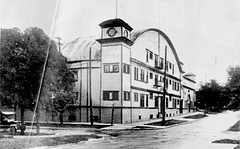
Amphitheatre, Winnipeg

After being greeted by fans and media at the airport, Hope had a Provost Guard motorcycle escort him straight to The Amphitheatre where he was to perform. There, he took time to talk to the press, sign autographs and pose for photos with fans, including the St. James Canadiens hockey team, before his show.

As for his impression of the old Amphitheatre, he opened his show with the line, "I can't tell you how thrilled I am to be playing this lovely garage". From there, it was a combination of comedy, dance skits, a roller skating duo, and a local orchestra accompanying singer Betsy Duncan who co-starred on his radio show. 


Hope was likely the last big entertainer to play "the Amp". It was torn down in 1955 after the Winnipeg Arena opened.


Hope's visit only lasted a few hours as he was on a plane again at 9:30 p.m.. It was long enough for him to get a very special invitation that he recounted in his 1954 biography Have Tux Will Travel, (p. 230):

"Of the memorable things which have happened to me on a golf course, the round I played with Ike Eisenhower in 1953 is the topper. In 1953, I was in Winnipeg, Canada when Stu Symington called me long distance and asked, 'Can you be in Washington on Derby Day?'

'I was planning to be in Churchill Downs with Bill Corum that day,' I told him.

'Better switch it,' he said. 'You're going to play golf with the man in the White House.'"

Hope ca. 1953

This brings up another Winnipeg/Bob Hope/golf connection: the claim that he played his first game of golf here in Winnipeg. You can read more about this urban myth at this blog post!

Related:
Bob Hope official site (including jokes !)
Subsequent Bob Hope visits to Winnipeg
Did Bob Hope really play his first game of golf in Winnipeg?

Friday, 11 April 2014

The West End's big bank heist of 1962


The nondescript building at 810 Notre Dame Avenue at Beverley Street, now home to Rebel Waltz Tattoo, was once a Bank of Montreal that was the scene of one of the largest and boldest holdups in the city's history.

June 16, 1961, Free Press

Home to a Safeway store from 1933 to 1959, the following year the Bank of Montreal purchased the land and began construction on a new branch, its 23rd in the Greater Winnipeg area. What was of particular interest to the company was its proximity to the large number of employees working at the collection of medical facilities across the street that we know call the Health Sciences Centre.

The branch opened on June 19, 1961. It featured air conditioning and a night deposit slot to allow for "24 hour banking". The first manager was Norman C. Munson who had been manager of the Carberry, Manitoba branch for a couple of years and prior to that worked at branches in Saskatchewan.

The bank was barely open a year when on Thursday, June 14, 1962 it was the scene of a daring daylight robbery that saw gunmen flee with $42,706 cash (about $330,000 in 2014 dollars). Newspapers said it was Winnipeg's largest bank heist in at least a decade.

June 14, 1962, Free Press

It wasn't a typical holdup. Bandits broke into the bank the night before and stayed in the basement overnight. They waited until nearly a half hour after the bank had opened before appearing in the upstairs doorway. Dressend in green work overalls and train engineer caps, their faces were concealed with stocking masks. One was armed with a  sawed-off shotgun, the other a pistol.

They demanded the money from each wicket then led manager Munsen to the vault at gunpoint. He opened it and the men loaded up the stash on-hand for the General Hospital's payday the following day into a suitcase. Munsen and his three staff, two men and one woman, were then led into the vault. The bandits tried to shut them in but could not close the door properly. Seconds after they left, at 9:34 a.m., Munsen tripped an alarm.

June 14 1962, Free Press

At first, police had few leads. The bank staff couldn't see the faces of the men or the type of car that they were driving.

Reports soon came in of a car speeding through the West End from the direction of the bank. It was a blue and white 1956 Meteor that had been reported stolen from St. Boniface the night before. That car was soon found abandoned at Sargent Avenue, (what the thieves didn't know is that the car was being repaired and its radiator was sitting in the trunk !) Reports soon came in of another car, this one a green 1950s Pontiac, speeding and driving recklessly. Police went on the assumption that this was the car they were looking for.

June 16, 1962, Free Press

Despite the manhunt and a blockade at the city limits, the men slipped through. The Canadian Bankers Association tried to ensure that leads kept coming by offering a reward, standard practice in those days.

The following day a farmer near Anola, Manitoba noticed two men walking down a lonely rural road with a large black suitcase. RCMP investigated and found that green Pontiac off the side of the road. It has been trashed. Winnipeg police and RCMP converged on the site with tracker dogs. In the bush nearby they found a pile of used toiletries and abandoned clothes but no bandits.

Police assumed that the men were headed east and notified RCMP and OPP along the way.

June 16, 1962, Winnipeg Free Press

The crewmen of an east-bound CPR train radioed their dispatch that there were two men aboard their train that seemed suspicious. OPP boarded when it pulled into Fort William (Thunder Bay) the next day and arrested the pair on suspicion of robbery but found no money.

Police retraced their steps to Kenora, Ontario, where the men got on the train. They found that the pair spent the night in a hotel and went on a shopping spree for new clothes, one bought a teddy bear for his child. After dinner they went to the CP station to purchase train tickets and each shipped a parcel to different Montreal addresses.

June 18, 1962, Ottawa Citizen

The CPR traced the packages and found that they had already reached Sudbury. Police there intercepted them and found that they contained the missing money, minus about $500 spent in Kenora. Once the money was recovered, the thieves were done for. Real Pierre Ouimet, 24, and Jean Forest, 26, both from Montreal, confessed to the crime.

It turns out that Ouimet arrived in Winnipeg first and had been watching the bank for about a month to find when the hospital's payroll arrived. He also purchased the green Pontiac.

The night before the robbery they stole the Meteor in St. Boniface and parked the Pontiac on near Sargent and Beverley. They broke into the bank's basement and lay in wait for it to open the next day. After the crime, they drove the Meteor to the stashed Pontiac but had to abandon it near Anola when the engine seized. From there, they hitched a ride in a truck to Kenora where they divvied up the money and sent it to relatives in Montreal.

The two men were sentenced to ten years each in Stoney Mountain for the robbery plus two years for the car theft. The long prison sentences imposed by the judge were meant to discourage other outsiders from coming to town and pulling jobs here.

December 14, 1967, Winnipeg Free Press

This wasn’t the only big holdup at this branch. 

In December 1967 three armed men held it up just as staff were loading $50,000 into a car for transportation to a mini-branch located inside the Health Sciences Centre. The staff of five were forced to crouch down on the boulevard at gunpoint as the trio finished loading the loot and stole the car. The vehicle, along with empty cash boxes, were recovered a few days later but a newspaper search in the year that followed turns up no stories of any arrests. 

There were also smaller robberies in September 1975, July 1982, May 1984 and October 1990.