Local News Links:... .........................
Showing posts with label urban myths. Show all posts

Saturday, 29 April 2023

Urban Legends: Is Portage and Main Winnipeg's windiest corner?

© 2023, Christian Cassidy


Portage and Main by Frank Arbuckle, Macleans, May 1, 1947

I was asked on Twitter about Portage and Main's reputation as Winnipeg's (or the country's, or North America's, or the British Empire's) windiest corner. When did it get that title and was it backed by scientific research?

The first mention I can find of "the windiest" intersection comes in a brief Tribune article from April 1946 during a particularly windy spring. A great deal of debris had built up at the intersection and was creating a vortex of trash that swirled around whenever a storm hit. The story starts: "'The windiest spot in Canada', the corner of Portage Avenue and Main Street, has the city's scavenging and street cleaning division worried."

This suggests to me that the 'windiest corner' moniker was already in use and the quotation marks around it indicate that it wasn't a statement of fact. For decades, many stories that referenced the windiest intersection title are preceded by things like "generally known as", “the old joke about”, "its reputation as", or "dubbed as."


January 5, 1954, Winnipeg Free Press

What probably helped reinforce the intersection's reputation was media coverage. Just as a reporters today will head to the Forks to help illustrate a story about high water levels in spring, reporters used to head to Portage and Main to get photos to help illustrate a wind or snow storm.

Over time, particularly from the mid 1970s into the 1980s, newspaper stories largely dropped the "old joke about" and began calling the intersection Winnipeg's (or Canada's) windiest as if it was fact.


January 28, 1980, Winnipeg Tribune

There have been some stories that looked into the merits of the windiest corner reputation.

In January 1980, Environment Canada set up a series of wind measuring devices in Winnipeg for a general wind study, not specifically to prove or disprove the Portage and Main theory.

It found that on average Portage and Smith was the windiest place downtown with an average wind speed of 0.1 kilometres more than Portage and Main. The latter did, however, record the largest single wind gust that month and did have the highest overall wind speeds when there was a northerly wind blowing.

A 1987 Free Press story interviewed a supervising climatologist with Environment Canada to look into the claim.

According to its data, Winnipeg was unofficially the third windiest city in Canada behind Regina and St. John's, Newfoundland. The scientist said that it made sense that Winnipeg ranked as one of the windiest downtowns because of its design: "The wind rushes in from the West down Portage Avenue kind of like a garden hose. When it gets to the nozzle or opening (Portage and Main) the nozzle is released and it comes out with greater force."

An architecture professor from the U of M also interviewed for the 1987 story said that what made Portage and Main a particularly windy place was this steady flow of air from the West swirling and churning when it hit the Richardson Building. He noted that his students had done some wind tests around buildings in the downtown and found by far the windiest place encountered was at the base of that tower.


February 17, 1968, Winnipeg Tribune

For the most part, people had fun with the reputation of Portage and Main even if there wasn't scientific evidence to back it up.

It appeared in a series of cheeky ads in 1968 run by the provincial Department of Industry and Commerce to promote investment the province that proclaimed the Richardson Building / Lombard Place development to be the "World's only $40m windbreak". (Another ad featured piles of ore outside the INCO mine at Thompson with the caption "Dig our Manitoba mountains".)

When a U of W prof released data in 1971 to show Portage and Main didn't record the coldest temperatures in the city over the winter, a Free Press editorial replied tongue-in-cheek: "No longer can we pose as hardy types who take winter in their stride with hardly a thought for frozen noses. The impression will quickly be abroad that palm trees and hula girls flourish at our most famous corner."

In December 1975, a 19-year-old from West Kildonan raised over $500 for the Christmas Cheer Board by walking around Portage and Main in a bathing suite and snow boots.

As one Winnipeg Tribune editorial noted, even if Portage and Maiin, records or not: "However frigid or blustery, we love it and respect it as a vital and essential feature of our city".

Other urban legends I explore:
Did Charlie Chaplin really stay at the Windsor Hotel?
Did Bob Hope really play his first game of golf in Winnipeg?
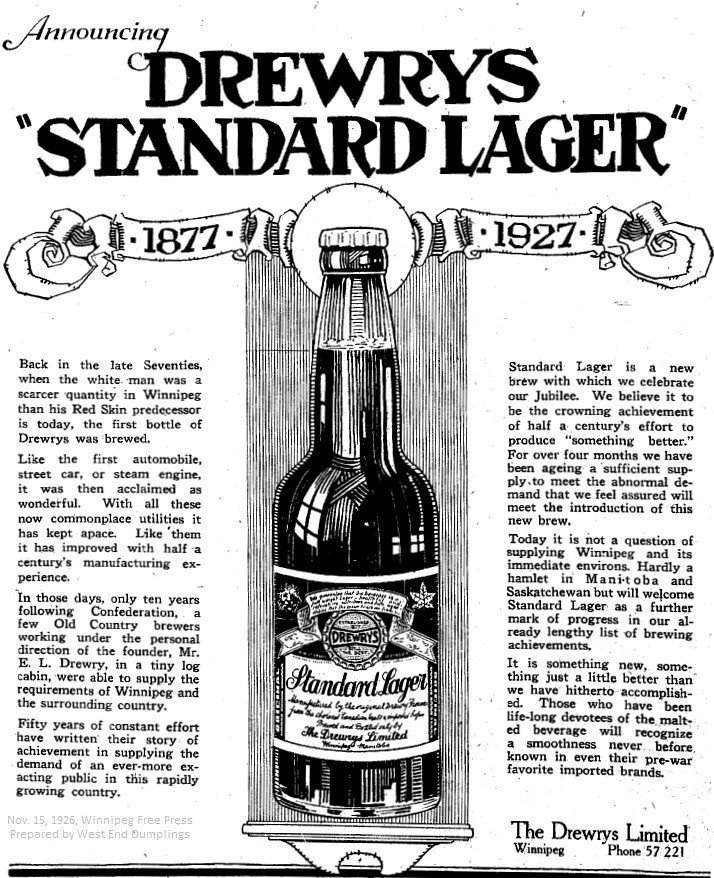
Who had the label longer - Standard or Budweiser?
Was the Arlington Bridge really built to span the Nile?

Sunday, 5 March 2023

Urban Legends: Charlie Chaplin's time in Winnipeg

© 2023, Christian Cassidy


Chaplin at the Windsor!

With news that the Windsor Hotel is set to close at the end of April, I wrote a history of the building for my Winnipeg Places blog. A part of Windsor Hotel lore is that Charlie Chaplin once stayed there back in its day as the LaClaire Hotel.

Chaplin's name also appears in a number of other stories about Winnipeg's history. It seems he played at many of the city's older theatres, may have signed his movie contract here, and Groucho Marx is said to have first set eyes on the comedian on a stage here.

How much of this is fact and how much of it is urban legend? Here's a deep-dive into Charlie Chaplin's Winnipeg connections.


DID CHAPLIN COME TO WINNIPEG?

Yes, Charlie Chaplin came to Winnipeg at least four times as part of Fred Karno's travelling vaudeville show of British actors that toured North America. According to the website fredkarnocompany.com, Chaplin was with the troupe from October 1910 to December 1913.

Chaplin's first trip to Canada in 1910, at the age of 21, involves an anecdote about Winnipeg, (see above). It was published as part of a wire story about the actor and was picked up in the August 2, 1913 edition of the Winnipeg Tribune.


The Dominion / Empress Theatre (Rob McInnis Postcard Collection)

The Karno company always played the Empress / Dominion Theatre which was located at 175 Portage Avenue East and operated by the American-based Sullivan-Considine theatre circuit. This contradicts the histories of many old theatres in the city, such as the Playhouse and Walker, that claim Charlie Chaplin played there.

Actors did not "freelance" when they got to town. They arrived under contract as part of a larger touring show and only played theatres owned by, or otherwise associated with, that specific circuit. They would not have been allowed to jump off and go do shows for Pantages (Playhouse), Walker or any other competing vaudeville circuits when passing through.

Reading various biographical articles about Chaplin, there's no evidence that he came to Canada prior to 1910 with any other travelling shows and any newspaper mentions of him playing live in Winnipeg were always as part of the Karno company in Sullivan-Considine's Empress / Dominion Theatre.

Some theatres histories even claim that Chaplin performed there live after 1913 which is not true as he was already in the movie business churning out dozens of shorts per year starting in March 1914 and by the end of the decade was making million-dollar feature films.

Thousands of ads do appear in local papers starting in 1914 proclaiming "Charlie Chaplin at the X theatre tonight" but that was a film showing, not a live show.


April 1, 1911, Winnipeg Tribune

The first newspaper mention of "the Karnos" coming to Winnipeg was for a rare two-week stint in January 1910. Locals were treated to the final week's run of "A Night in an English Movie Hall" and then the troupe changed over to a new play called "A Night in the Slums of London".

If Chaplin joined the troupe in October 1910 he would not have been part of this show and there is no mention of him in any of the newspaper coverage.

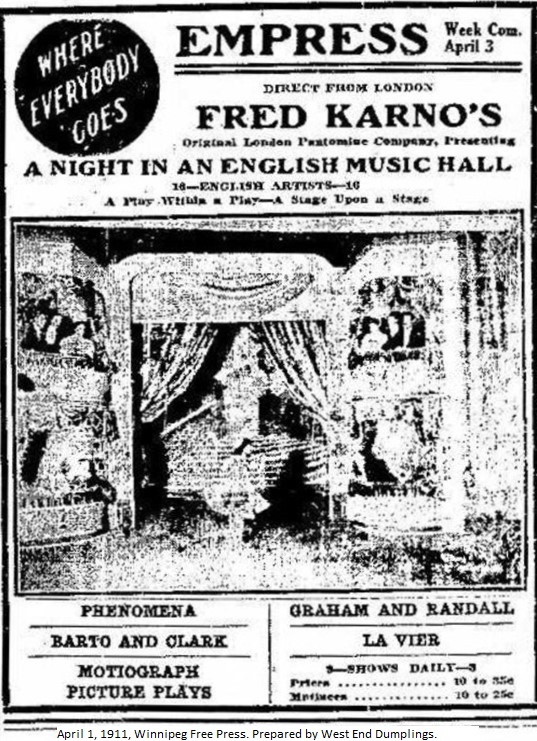
April 1911: The next time the Karnos came to Winnipeg was in April 1911 with "A Night in an English Music Hall". This time around, Chaplin would have been in the cast but was still fairly unknown and didn't get separate billing in ads for the show.

A brief Free Press review noted that the play was good, if not a bit vulgar in places, and that "The chief amusement is furnished by the diverting antics of a small boy and the old roué." That old man was most likely Chaplin.


September 8, 1911, Winnipeg Tribune

September 1911: The Karno company was back at the Empress for the week of September 4, 1911 with "A Night in a London Club". This appears to have been a smaller show than the "English Music Hall" with just a cast of ten. Sullivan and Considine had to pack in more "filler" acts than usual around the headliner.

The show received a lot less attention in the papers than other Karno visits and none of the small newspaper write-ups or ads for the show mention Chaplin by name.

The Free Press wrote in its September 5th edition that "Hundreds were turned away from each performance" on opening day. (Sometimes reporting in the theatre section of the papers has to be taken with a grain of salt as they were more "advertorials" promoting the shows as they were news stories.)


March 2, 1912, Winnipeg Tribune

March 1912: The Karno company's "A Night in an English Music Hall" with Chaplin was back at Winnipeg's Empress Theatre in March 1912.

The ability of the show to run for years on tour likely had to do with its setup as a play within a play.  The cast, ranging from fourteen to twenty five members depending on the run, were divided into a handful of actors playing audience members sitting on stage getting up to antics whilst watching the rest of the cast perform music hall-style skits in front of them.

The "audience" antics and the music hall numbers could be changed up to keep the show fresh and promote the talents of new members as they joined the troupe.


March 5, 1912, Winnipeg Tribune

By this time, Chaplin had become a well-known member of the cast. A line under the preview ads for this Winnipeg run read "25 comedians and Charles Chaplin as the inebriated swell."

The Tribune ran the above photo showing what is said to be the overflow crowd waiting to get into the Monday matinee performance. The C & S Empress Theatre can be seen in the background.


Source: August 2, 1913, Winnipeg Tribune

August 1913: The Karnos were back in Winnipeg in August 1913 with a new show called "A Night in London". It featured a cast of fourteen and there was no mistake who the star of the troupe was this time around.

A number of preview stories, no doubt provided by Karno's publicity team, were sent to local newspapers in advance of the show's arrival. One published in the Tribune noted that the cast included: "Charles Chaplin who is the celebrated inebriate with Karno's London comedians.... He is a small, dapper little fellow with quite a serious face and an earnest desire to study everything he sees."

A Winnipeg Tribune reviewer said of the opening night performance: "(it is) just as funny - as screamingly funny - as the previous Karno acts and Chaplin assuredly improves each year."


November 23, 1912, Winnipeg Tribune

November 1913: A sign of how gruelling life on the road for a vaudeville actor could be is that the Karnos were back in Winnipeg for the week of November 25, 1912 with another play at the Empress entitled "The Wow Wows".

This time around, Chaplin wasn't a drunk and the role contained some spoken lines. He is a camper who annoys fellow campers around him. They get their own back by inviting him to join a secret society called "The Wow Wows" and make him do ridiculous things.


November 23, 1912, Winnipeg Tribune

A Tribune reviewer wrote that on opening night there was "a feeling of suppressed excitement" and that "... basing their expectations on past experiences, the huge audience anticipated something exceptionally good." He concluded that Chaplin delivered "...with his remarkable ability as a comedian, it is impossible for him not to be funny and he gets roars of laughter out of every line, out of every look, and out of every gesture"

A Free Press reviewer noted that "...Charles Chaplin is as good as ever. It is impossible to describe the scene more than to say it is a scream from start to finish."

This was the last time Chaplin came to Winnipeg.


GROUCHO AND CHAPLIN IN WINNIPEG

Another bit of Winnipeg / Chaplin lore is that Groucho Marx first saw Chaplin perform in Winnipeg. This did happen, most likely during the August 1913 run of "A Night in London".

Marx explains in his autobiography Groucho and Me (Marx, 1959) that "We were on our way from Duluth to Calgary and had a three-hour layover in Winnipeg." His brothers found a pool room in which to kill time while Groucho decided to walk up Main Street, (the layover was likely at Union Station on Main Street at Broadway). He wrote:

"A half-block away from a frowzy-looking theatre I heard roars of laughter. I decided I had better go in and see who could possibly be that funny. On the stage were eight or ten assorted characters in an act called “A Night at the Club.” One of these actors wore a very small moustache and very large shoes, and while a big, buxom soprano was singing one of Schubert’s lieder, he was alternately spitting a fountain of dry cracker crumbs in the air and beaning her with overripe oranges. By the end of the act the stage was a shambles.

Leaving the theatre, I went back to the depot to meet my brothers. I told them I had just seen a great comic. I described him . . . a slight man with a tiny moustache, a cane, a derby and a large pair of shoes. I then penguin-walked around the depot, imitating him as best I could. By the time I finished raving about his antics my brothers could hardly wait to see him."

To read a longer transcript from this section of the book check out this blog post.


December 20, 1912, Vancouver Sun

The brothers caught up with Chaplin in December 1913 when their Pantages circuit show and the Karnos circuit show overlapped in Vancouver and they went to see him backstage. (Newspaper research indicates that this would have been at the Orpheum Theatre in the last week of December.)

Marx writes that Chaplin told them that he had been offered $500 a week to go to Hollywood and make pictures but said that he did not think he would take it. Marx replied, “Why not?... Don’t you like money?


CHAPLIN AND THE LA CLAIRE / WINDSOR HOTEL


Chaplin at the Windsor!

There is, indeed a direct connection between Charlie Chaplin and the Windsor Hotel, or the LaClaire Hotel as it was known in those days. His tramp character can be seen peeking from the top balcony and its south wall sports a mural showing a still from the 1918 film "A Dog's Life".

The connection comes thanks to a ten-page letter that Charles wrote to his older half-brother and business manager Sydney Chaplin on LaClaire Hotel letterhead. He starts out by saying that "I have a lot of good news this time" and he goes on to explain that he had received an offer from Keystone Pictures Studio, run by Quebec-born Mack Sennett, to come to California to make films.

The full letter is part of the Charlie Chaplin archives and there is no doubt that he wrote it from Winnipeg's LaClaire Hotel as the address in on the letterhead.


The letter itself is not dated and the Chaplin archives notes only that it is from 1913, which is when Chaplin came to Winnipeg in both August and November. Some sources say this letter is from the November "The Wow Wow's" visit, but that isn't the case for a couple of reasons.

During the November 1913 visit, a Tribune reporter wrote about hanging out with Chaplin and other members of the Karno show who "gathered in Charles Chaplin's suite at the Oxford at midnight last night". The Oxford Hotel is located on Notre Dame Avenue near Portage Avenue and today hosts the Solid Gold strip club on the main floor.

The timing of the August visit also makes more sense if Chaplin honestly wanted to let his brother (and sometimes business manager) know of the offer from Sennett. There's no way he could have written it the week of November 25th with the expectation that it would arrive in London by the time he had already departed vaudeville for a movie career.

Some have speculated that the letter means that Chaplin also signed a contract with Sennett while he was here or that he left Winnipeg to go directly to Hollywood. You will see below that neither of these are true.


Ca. 1912 Karno publicity still for the 1912-13 tour

Source: University of Washington Library

A matter not directly related to Chaplin and Winnipeg is the fact that there appears to be a timeline discrepancy between some sources for the latter part of 1913.

In this excerpt from Chaplin: Genius of the Cinema (2003), Vance provides a more detailed account about Sennett's pursuit of Chaplin. Initial contact appears to have taken place in May 1913 and their contract was signed on September 25, 1913 to take effect on December 13, 1913. (Vance cites the signed contract, which is part of the Chaplin archives, for these dates.)

If this is the case, it supports the August run as the Winnipeg visit when Chaplin wrote the LaClaire letter to Sydney as the contract with Keystone had already been signed by the time he came in November.

If Marx's recollection that he met Chaplin in Vancouver in December is correct, it shows that Chaplin was not truthful when he told Marx that he might not sign with Sennett. Perhaps he didn't want to jinx things, or there was a confidentiality clause in the contract, or he was simply playing his cards close to his chest with fellow performers.

Strangely, Chaplin DID perform for Karno after December 13, 1913 when the contract was to take effect. Newspaper ads show that The Wow Wows with Chaplin in the cast played Spokane, Washington the week of December 16 and Vancouver the first week of January. This may have been due to a contractual obligation to Karno that Chaplin and Sennett decided to let play out.

After the show's run ended in Vancouver in early January, Chaplin likely returned home for a stint. This archival photo is said to show Sennett in the U.K. with Charles and Sydney Chaplin signing the contract. It is dated sometime in January 1914 so it was likely a staged photo op of the actual signing that took place back in September.


August 2, 1919, Winnipeg Tribune

Chaplin did not set foot again in Winnipeg after November 1913 but he continued to thrill audiences in local theatres for decades to come through antics on the big screen.

Other urban legends I explore:
Did Bob Hope really play his first game of golf in Winnipeg?
Who had the label longer - Standard or Budweiser?
Was the Arlington Bridge really built to span the Nile?

Thursday, 11 November 2021

The Valour Road Boys: Where did they live and when?

© 2021, Christian Cassidy

Most Winnipeggers are familiar with the story of the three Victoria Cross recipients from Pine Street (733, 778 and 785) in Winnipeg which led it to be renamed Valour Road in 1925. (Here's the Heritage Minute version.)

In some accounts of the story there is a misconception that these were three buddies who grew up together and decided to head over and fight. In fact, it is unlikely that the three ever set eyes on each other.

Who were these men and where did they live?


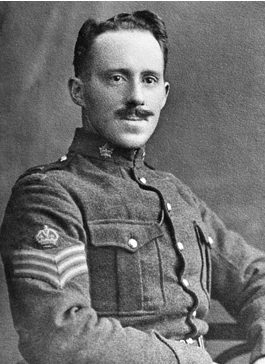
Leo Clarke enlisted February 25, 1915, age 22, and lived at 785 Pine Street from 1907 to ca. 1912. He was killed in action on October 19, 1916.


1911 Census of Canada, Library and Archives Canada

Clarke has the strongest connection to Pine Street of any of the three men as the Clarke family moved into the newly-built 785 Pine Street in 1907.

The 1911 census captures Henry and Rosetta and their six children, including an 18-year-old Lionel (Leo) who was working as a railway surveyor.

The 1913 street directory shows Henry was a deputy superintendent at Metropolitan Life Insurance Company. Leo and brother Harry worked at Lemon and Co., a stable that sold horses on Henry Avenue near Princess Street. They lived together at 702 Alexander Avenue which was likely a rooming house.

Where Clarke was living when he enlisted in February 1915 is unclear. He gave his parents' address as his next of kin but listed his occupation as "resident engineer" which suggests that he likely lived on-site at a factory, warehouse, or apartment block looking after the mechanical systems.

Clarke certainly would have had to give up the residence after enlisting and likely moved back with his parents awaiting his orders to ship out.


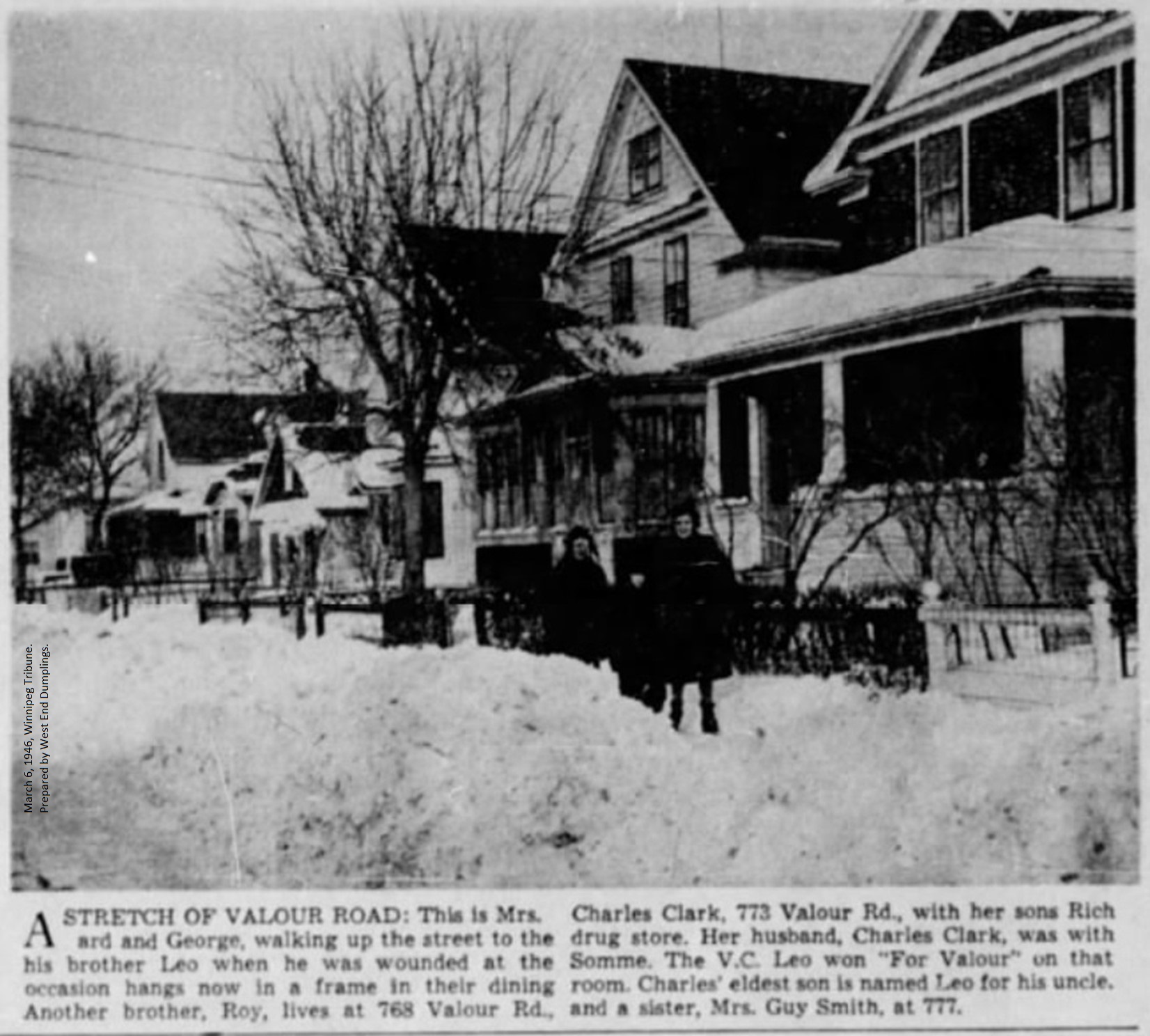
March 6, 1946, Winnipeg Tribune

Winnipeg Tribune journalist Lillian Gibbons visited members of the Clarke family in March 1946.

She found that the family home at 785 was sold in 1923 but that two of Clarke's brothers and one sister still lived on what was then Valour Road at separate addresses ranging from numbers 768 to 777. (See above photo.)

More on Clarke: Canadian Encyclopedia, Military File, VC citation.


Robert Shankland enlisted December 18, 1914, age 27, and lived at 733 Pine Street in 1914. He died in Vancouver on January 20, 1968.


Eastern Dairies Ltd. 1928-29 Annual Report

Shankland was a bookkeeper at the Crescent Creamery Company which was headquartered on Sherburn Street

The 1913 street directory lists him a lodger at 328 Ellice Avenue. The 1915 directory, which would have been compiled before he enlisted in December 1914, shows him as one of two lodgers at 733 Pine Street along with Eaton's clerk Jean Wilson.  


Pay record for Robert Shankland. Library and Archives Canada

This address was home to George J. Ritchie and family. He was the cashier for Crescent Creamery, so the two men obviously knew each other from working in the finance office together.

Having come to Canada from Ayr, Scotland just two years before he enlisted, Shankland did not have deep roots in the city. He listed his father in Ayr as his next-of-kin and requested that his pay be sent to Ritchie, which indicates he kept ties to Pine Street even after arriving overseas.


December 28, 1928, Winnipeg Tribune

Upon his return to Winnipeg after the war, Shankland was an accountant for the land department of the Soldiers Resettlement Board renting a house at 717 Goulding Street.

Shankland must have returned to Scotland for a time as he married Anna Stobo Haining in Prestwick, Ayrshire, Scotland in 1920. They had two children, William born in 1921 in Winnipeg, and David, born in 1927 in Winnipeg.

In 1922, Shankland was appointed accountant for the Winnipeg Board of Trade and a couple of years later the family settled at a home at 507 Beresford. He left the board in 1928 to work at a stock brokerage.

As you would imagine, Shankland was a military cause célèbre.

He was there at the tablet unveiling when Pine Street was renamed Valour Road in 1925. In 1929, he was summoned to England to attend a dinner hosted by the Prince of Wales to honour Canadian Victoria Cross recipients. When the Valour Road Legion got its charter in 1932, Shankland presented it to the members and in 1934 was made a lifetime member. He attended countless luncheons, military marches and Remembrance events.

In 1937, the Shankland family moved to Vancouver. A farewell luncheon was held by members of the Valour Road Legion in late August.

Shankland remained associated with the military and in World War II was the camp commandant for the Canadian Corps in England.

More on Shankland: Canadian Encyclopedia, Military file, VC citation, more on his life in Scotland.

Frederick Hall enlisted September 26, 1914 at Valcartier, PQ, age 29. His family lived at 778 Pine Street in late 1914. He was killed in action on April 24, 1915.

Hall is the hardest of the men to pin down to Pine Street.

From Kilkenny Ireland, Hall came to Canada in 1910 at the age of 25. He enlisted in Quebec and declared his mother, Mrs. Mary Hall of 260 Young Street, Winnipeg, as his next of kin. Hall's military file makes no mention of Pine Street.

A brief newspaper story about his death states he was a clerk at the stockyard giant Gordon Ironside Fares and, according to the 1914 street directory, he rented a room on Maryland Street while working there.

A clue about the Pine Street connection comes in the 1946 Lillian Gibbons column mentioned above.

Mrs. Guy Smith, Leo Clarke's sister, said she thought the family lived at number 778. Sure enough, in the 1915 directory, which would have been complied in late 1914 for publication early the next year, there is Joseph Hall, carpenter, along with Annie and Sadie who were clerks at Eaton's, Mary, and William. No mention of Frederick.

If Frederick was a bit of a drifter, so was his family. Assuming his mother and father were not separated, they would have moved in after he enlisted in October and since he departed from the war from Quebec, if he saw the Pine Street house at all it was likely on a brief, final visit home.

Hall's military file shows his mother's address changed two or three times during his short time in the war, (he was dead six months after enlisting), with the final address listed as Leystone, Essex, England.
 
More on Hall: Canadian Encyclopedia, Military File, VC citation.

Wednesday, 31 July 2019

Who had the lable longer: Budweiser or Standard Lager?

© 2019, Christian Cassidy
This is one in a series of posts exploring the truth behind local history urban myths!

Most Manitoba beer drinkers have noticed the striking similarity between the beer bottle labels for Anheuser-Busch's Budweiser and Molson's Standard Lager, but which came first?

I find that many people think it was Standard, but after some digging I found out that Budweiser's 'script' label precedes it by some 40 years ! Despite this, the two brewing giants have been in and out of court fighting about their respective labels since 1980 and there's likely more to come.

Here's a look back at the Manitoba history of the two iconic beer brands.

St. Louis-based Anheuser-Busch introduced its Budweiser brand lager in 1876 and trademarked its 'script' beer bottle label in the U.S. in February 1886. The first ads selling Budweiser in Manitoba appeared in local papers in 1893 with the Hudson's Bay Company as its local distributor.

Manitobans voted in favour of prohibition in 1916 and the legal sale of alcohol in the province ceased. When it resumed in 1924 Budweiser did not return to shelves due to restrictions on imported beer.

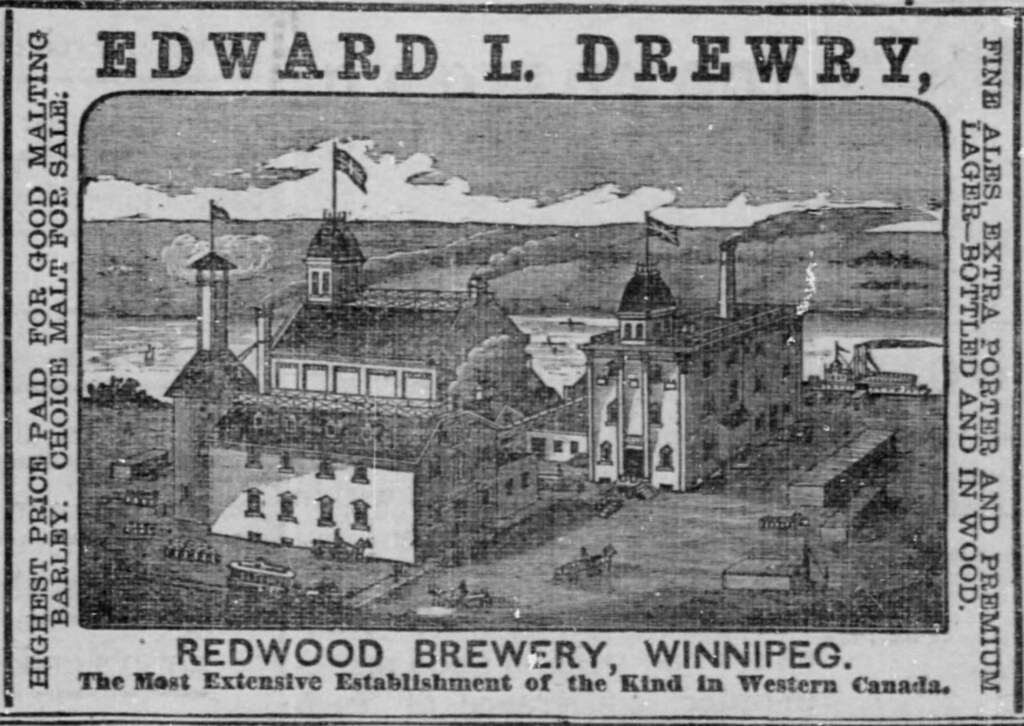
As for Standard Lager, in 1877 Edward L. Drewry took over the old Redwood Brewery on the bank of the Red River at what is now Redwood Avenue. Drewry's had numerous brands on the go at any one time, but the basic three in the 1910s were Redwood Lager, Drewry's Extra Stout and Drewry's Old Ale.

The brewery survived the prohibition years by manufacturing soft drinks such as ginger ale and selling distilled water. Just before before beer sales resumed in 1924, E. L. Drewry sold off his share of the business, though the company kept his name.

Drewry's post-prohibition lineup included the return of its Old Ale and Extra Stout brands along with something called "American Style Beer".

In November 1926, Drewry's introduced a new brand to the market called Standard Lager to celebrate its 50th anniversary which took place the following year.

Standard's script bottle label was trademarked in Canada in November 1926. It bore a striking resemblance to the label of what had become the U.S.'s top selling beer, but since Budweiser was not sold in Manitoba at the time there was no apparent controversy.

Standard Lager became Drewry's signature brand and has survived over ninety years of corporate mergers as Drewry's became part of Western Canada Breweries, then Carling's, Carling O'Keefe's, Molson's and Molson/Coors.

In 1980, Carling O'Keefe was the smallest of Canada's "big three" national brewers along with Molson's and Labatt's. That was also the year that Labatt's signed a deal with Anheuser-Busch to manufacture and sell Budweiser in the Canadian market. After a trial sales period in Alberta it began selling Budweiser in Ontario in April 1981 and soon rolled it out in Quebec.

When asked when Budweiser would arrive in Manitoba, a Labatt's spokesperson told the Free Press that it wouldn't until a legal dispute with Carling O'Keefe over the Standard Lager beer label was settled.

It appears that Carling O'Keefe that initiated the legal proceedings in 1980 against the American brewing giant claiming that its Budweiser label, which was eventually registered as a trademark in Canada around 1970 when the American firm began thinking about a move into Canada, infringed on their Standard Lager label.

After years of legal wrangling the Federal Court of Appeal released its landmark ruling still used in copyright law today,  "Carling O’Keefe Breweries of Canada Ltd. v. Anheuser-Busch  Inc. (1986)", on July 3, 1986 .

The court found that: a. the labels were similar enough in appearance to be confusing; b. Drewry's would have had knowledge of what the Budweiser label looked like when it designed its Standard Lager label; and c. the Standard Lager label likely shouldn't have been registered back in 1926.

Despite this, the court ruled the case a "draw". It said both breweries had legally used their script labels for so long that each was strongly identified with their respective brands and neither would have to stop using it.

Budweiser finally hit the Manitoba market in May 1988.

The following year, Carling O'Keefe merged with Molson's to become Molson's Brewery of Canada.

https://www.molsoncoors.com/en/brands#?n=standard%20lager
The legal fighting didn't end with the 1986 ruling.

In 1991, Anheuser-Busch applied for a new trade mark registration to allow it to use the Budweiser script logo on clothing, hats, cups and other promotional items in Canada. Molson's registered its opposition to the Trade Mark Opposition Board (TMOB). In 1995, the board ruled that Molson's opposition be rejected.

In 2001, Anheuser-Busch resubmitted an application to use the Budweiser script logo on clothing and other promotional items in Canada. Again, Molson's objected and in 2008 the TMOB again ruled against Molson's.

The issue ended up back in Federal Court which ruled in 2010 that the TMOB overstepped its bounds and should not have rejected Molson's opposition. (For more on the TMOB situation see: Trade Mark Blog and Robic.ca.) 

The legal battle between the Standard Lager and Budweiser brands is likely not over.

It is interesting to see the amount of time and money that has been spent over the decades defending a small, regional beer brand's label. Perhaps the fact that Standard Lager provides its owners with a sharp stick with which to poke one of its largest competitors from time to time is the reason the brand has remained alive to this day.

Molson's did not respond to a request asking for information about its Standard Lager brand.

An aside:

As the 1980s legal action was winding its way through the courts the sales of Standard Lager dropped off drastically.

Carling O'Keefe had arranged to brew Miller beer under license for the Canadian market starting in the summer of 1983. Thanks to an unusually hot summer and better than expected demand for Miller, its Winnipeg brewery had to add weekend shifts and curtail the production of some of its own brands. Production of Standard Lager ceased altogether for a few weeks until the brewery got caught up.

When summer was over, the brewery was afraid it may have lost some of its 'traditional beer' drinkers, so they applied to the Public Utilities Board (!) and received permission to reduce the price of Standard Lager six pack by 50 cents down to $3.50 and a case of twelve by $1.00 down to $6.70.

Labatt's soon followed suit by obtaining permission for a similar price reduction of its "old school Manitoba brew, Shea's Select.

Wednesday, 16 April 2014

Did Bob Hope really play his first game of golf in Winnipeg ?


An often-repeated connection between Bob Hope and Winnipeg is that it was here, back in his vaudeville days, that he played his first game of golf. Some accounts go so far as to specify the location as the Kildonan Golf Course.

That is an impressive bit of sports trivia, so I thought I would look back and see if there was any truth to it.

Source: eBay

Hope was an avid golfer, a proponent of the game, and host of the long-running Bob Hope Classic golf tournament. In the book My Best Day in Golf: Celebrity Stories of the Game They Love, Hope wrote: "I consider golf my profession and comedy just a way of paying my green fees."Hope wrote numerous times about his introduction to the game of golf and over the course of 40 years the account remained essentially the same:

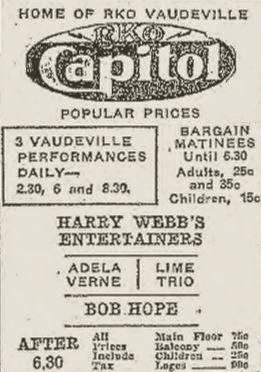
In early 1930, Hope was on the northern vaudeville circuit with the Orpheum theatre chain which included Minneapolis, Winnipeg, Calgary, Seattle, Tacoma and Vancouver. Among the travelling troupe of entertainers were the Diamond Brothers who were avid golfers. With their nights busy but nothing to do in the mornings, they went golfing and bugged Hope to join them. Eventually, Hope did and the rest, as they say, is history. 

February 1, 1930, Winnipeg Free Press

The dates and general circumstances of a Winnipeg golf game do do hold up. Bob Hope DID come through Winnipeg in early 1930 as part of a travelling Orpheum show. The above ad shows him here at the RKO Capitol Theatre, part of the Orpheum chain. (In 1929, RKO, which stands for Radio-Keith-Orpheum, took over the Capitol Theatre and after some renovations relocated all of its Winnipeg vaudeville shows there starting in September.)

The Orpheum Theatre on Fort Street then underwent renovations of its own. It reopened in late October as the "RKO Winnipeg" motion picture house. When Bob Hope asked about playing "at the Orpheum", he was actually referring to the Capitol.)


You may have already noticed the main flaw with the 1930 "golfing in Winnipeg" story. Winnipeg was an early stop on the tour and Hope's show played here during the first week of February before moving west. The daytime high forecast for February 5, 1930 was minus 13 degrees Celsius - hardly golf weather. The Kildonan Golf Course was the first course in the city to open that year at 7 a.m. on April 16, 1930.

 February 1, 1930, Winnipeg Tribune

Hope was already making a name for himself in the world of entertainment and his February 1930 appearance was written about in newspapers. I read through every detailed show description for the Orpheum published in both the Tribune and Free Press from late February to mid-July 1930 to see if the show, or just Hope himself, doubled back through Winnipeg. He didn't. 

I also scanned the archives for subsequent visits by Hope and the next one appears to be in 1953, which you can read about here.


How did this story get its start, then ? 

Most claims, if they reference a source at all, refer to a generic Hope "autobiography". (Hope wrote and co-wrote numerous memoirs and biographies.)

The first mention of the golf claim that includes any detail appears to be a 1988 article in Manitoba History magazine about early theatre in Winnipeg. The author credits a biography called "My Love Affair with Golf", (he likely meant the 1985 book Bob Hope's Confessions of a Hooker: My Lifelong Love Affair with Golf):


"My Love Affair With Golf acknowledges that he learned to play golf in Winnipeg while appearing at the Walker Theatre with a juggling act called the Diamond Brothers. While on the David Letterman Show about a year ago, Bob went into great detail about his first contact with golf in Winnipeg."

Unfortunately, I cannot find an online version of the book and the Winnipeg Public Library doesn't have it. There is a Google snippet view version and the term "Winnipeg" only appears once, as a stop on the Orpheum circuit.

http://sturf.lib.msu.edu/article/1990nov25.pdf

In the 1990 edition of Golf and Sports Turf, Hope penned an article entitled My Diamond Anniversary in Golf and wrote about his first game of golf "...as I confessed to Dwayne Netland in our book for Doubleday, Bob Hope's Confessions of a Hooker: My Lifelong Love Affair with Golf..." He continued:

"Then in 1930, my real love affair with golf began. I was in vaudeville, playing the Orpheum circuit, the northern route. I was doing afternoon and evening shows in Winnipeg and Calgary up in Canada, in Minneapolis MN, and in Seattle and Tacoma WA…. Then, one day in Seattle, they invited me to come along. I borrowed a set of clubs and started hitting the ball pretty well, to my surprise. I got hooked on Golf that day, and I’ve been addicted to it ever since."

July 4, 1986, Winnipeg Free Press

As for the Letterman appearance, which was part of a publicity tour for Confessions of a Hooker, I could only find this brief 1985 clip. Hope, though, appeared as a guest again in 1986 after which the above item appeared in the Winnipeg Free Press. 

It's hard to tell without seeing the Letterman footage if Hope actually came out and said "he played his first game of golf in Winnipeg". It seems more likely that, as is written in the book he was promoting, he said Winnipeg was one stop on the circuit of the 1930 show during which he learned to play golf and someone jumbled the facts.

Hope in Winnipeg, 1953

Given the fact that Hope was here in early February, a couple of months before golfing season began, and his reference to Seattle in his own article, I have to conclude that the claim that Bob Hope played his first game of golf in Winnipeg - much less Kildonan Golf Course - is not true.

I'd love to be proven wrong, though. If someone knows of another book or has that 1986 Letterman appearance handy please let me know !

Hope's accounts of his first golf games:

In Have Tux Will Travel: Bob Hope's Own Story, (Pete Martin, Bob Hope, Ted Sally - 1954), Hope explains how he caddied in the 1920s in Cleveland but just couldn't get the hang of the game, (p. 227):

"I didn't touch the game again until I landed in the bigtime in vaudeville and a couple of lads on the bill persuaded me to play. After that, I couldn't leave it alone, and vice versa."

In the biography Bob Hope: A Life In Comedy, (William Robert Faith - 2003), the author describes the 1930 tour then quotes Hope, (p. 43):

… they moved up to the Twin Cities for a split week at the St. Paul Orpheum, and then on to the Orpehum in Winnipeg. Up to this point they had been travelling in winter wind and snow but by the time they reached Calgary the weather was springlike. Hope was restless for some physical activity, and he began talking about learning to play golf….

“But during the Spring of  1930 on the Orpheum circuit, I’d be waiting around the hotel lobby in the late morning when the Diamond Brothers, another act, would come down with their golf clubs…. One day I said, “Oh, hell, I’ll go out there with you."

As mentioned above, in the 1990 edition of Golf and Sports Turf  Hope wrote My Diamond Anniversary in Golf and relates the story his first game of golf as originally told in his book Bob Hope's Confessions of a Hooker: My Lifelong Love Affair with Golf, (Dwayne Netland, Bob Hope - 1985):

"Then in 1930, my real love affair with golf began. I was in vaudeville, playing the Orpheum circuit, the northern route. I was doing afternoon and evening shows in Winnipeg and Calgary up in Canada, in Minneapolis MN, and in Seattle and Tacoma WA…. Then, one day in Seattle, they invited me to come along. I borrowed a set of clubs and started hitting the ball pretty well, to my surprise. I got hooked on Golf that day, and I’ve been addicted to it ever since."

Related:
My post about Bob Hope's 1953 return to Winnipeg
Bob Hope Biography American National Biography
Bob Hope official web site
Bob Hope 2003 World Golf Hall of Fame Induction Ceremony Video
Stories of later Bob Hope visits to Winnipeg can be found here and here.

Friday, 3 February 2012

Arlington Bridge: What about that Nile connection ?

This is a five part series on the history of Winnipeg's Arlington Street Bridge to commemorate the centenary of its opening on February 5, 1912.


Part 4: What about the Nile River connection?


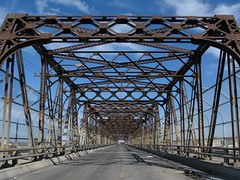
Many Winnipeggers are familiar with the story that the Arlington Bridge was originally built to cross the Nile River. Details vary but the core of the story said that it was built by Cleveland Bridge and Iron Works in the U.K. but left unclaimed and sold to Winnipeg on the cheap. The story has since been dismissed as "urban legend" for the fact that no city documents or media reports of the day make mention of it, which is true.

How did this legend get started and could there be something to it?

The Origins of the Story
 

To find how this story got started, I've searched the Free Press archives, select periods from the Tribune archives and have gone through years of city council minutes and city bylaws at the Winnipeg Archives.


The first mention of the Arlington Bridge / Nile connection that I can find comes in a July 30, 1946 Winnipeg Free Press story. Alderman Bloomberg, a member of council's bridge committee, was speaking to yet another unexpected series of urgent repairs that needed to be done to the Arlington Bridge. In exasperation, he said on the floor of council:

"The Arlington street bridge will always be a bugbear. It was built to go across the Nile river, but it was peddled off to the city of Winnipeg. The sooner the bridge comes down and a modern one goes up, the sooner will the city maintain expenses."
July 30, 1946. Winnipeg Free Press.

This, and subsequent references to the Nile, were not done in a boastful or romantic way, bit rather as a warning to fellow city officials not to buy something on the cheap thinking that it will save money.


On January 16, 1952, an unnamed Free Press reporter decided to have some fun with a news story about a big British contract to construct a new bridge over the Nile River in Egypt. He wrote:

But for a whim of fate, the old Arlington Bridge, instead of being covered with snow and ice, would have had crocodiles playfully nipping at its piers."

The reporter went to see the city's chief engineer William D. Hurst to ask if the city would consider buying this new bridge should the contract go bad. Hurst confirmed that the Arlington Bridge was originally intended for the Nile and that purchasing a pre-existing superstructure was the reason for the bridge's steep grade and other shortcomings which had caused numerous headaches for the city.


The next reference comes on February 18, 1955. A classified ad in a New York newspaper offering a used bridge superstructure for sale was spotted by Free Press reporter Archie Snow. He went to Hurst to ask about the feasibility of buying this bargain bridge for the upcoming Disraeli Freeway project. Hurst reportedly 'belly-laughed' and told Snow:

“That (Arlington) bridge was scheduled to cross the Nile or Euphrates River in Egypt, I don’t know which. It was built by an English firm. Then the Egyptians didn’t want it.”


The first article I can find that attempts to investigate the Nile connection appears in the January 11, 1969 Winnipeg Free Press.

Reporter Carmen-Litta Magnus looked through newspaper stories from the 1909 - 1912 era and found no reference to it being a previously built structure.
She contacted Cleveland Bridge who informed her that they had no corporate records showing the construction of an Arlington Street Bridge (or any bridge) in Winnipeg during that period.

She followed up with city engineer Hurst, who said that when he began working in the city engineering department in the 1930s the Nile connection was well known and spoken about, but admitted that he had never seen anything in writing that could prove it. He said that the story of a pre-existing structure didn't seem odd to him considering how low Cleveland's bid price was.


From that point onward, any reporting of the Nile connection was considered unlikely and by the 1980s was deemed to be nothing more than urban legend.

The Arlington Street Overpass

The Nile Connection Examined


After researching the story, I have to admit that I haven't come across any "smoking gun" that points directly at a Nile connection. There is, however a lot of circumstntialare some
questions that I've not been able to find answers for, though.

1. Why the Nile ?

If "the Nile" reference was something pulled out of thin air, it was certainly a good guess as there was a strong connection between north Africa and Cleveland Bridge.

In the period between 1903 and 1913, four decades before the 1946 Nile claim by Hurst and in the lead up to the opening of the Arlington Bridge, the British were busy colonizing North Africa. This meant constructing thousands of kilometres of rail lines and roadways and dozens of bridges.A main player in the construction of the bridges was none other than Cleveland Bridge. In fact, they hired F. W. Stephen, an engineer who was originally posted to the region as part of the British military, to be their key man from 1907 - 1910. Another military engineer, George Ronald Storrar, was sometimes subcontracted to Cleveland Bridge during this same period.


Blue Nile Bridge, Khartoum, Sudan (built in 1909) Source.

Around the time that the Arlington Bridge was put to tender, the British and Cleveland Bridge were heavily involved not so much in Egypt and the Nile River proper, but in Sudan and two of the Nile's tributaries, the White Nile and Blue Nile rivers.

The Blue Nile Bridge in Khartoum (above) is one project built around the same time as the Arlington and still in use today, (and the story there is that it, too, was not originally intended for that site!) Another area brige built at the time is the
Omdurmn Bridge in Sudan.

Note that these bridges were all meant to go over water, not rail yards. A repair that had to repeated numerous times to the Arlington Bridge in the 1930s and 1940s was replacing iron that was corroded by the acrid smoke from locomotive engines. It wasn't until 1948 that the city finally solved the problem by spending $50,000 to install 'blast plates' to shield the bridge's undercarriage from the smoke.

2. Were Any Bridges Unused ?

I can't find a direct reference to a British bridge going unused, but there likely were.

Histories of the region during this period speak of warring locals, political interference and bad planning which all interfered with British infrastructure projects, to the point that some had to be put off or moved to new locations.

Also, there was a new British policy that made colonies "pay their own way" when it came to infrastructure projects. In this case, it meant that the government of Egypt and Sudan, not the deep coffers of Britain, were responsible for seeing that projects were paid for.

A number of histories of the region detail some of the issues faced by Cleveland Bridge:

In The Railway Conquest of the World (1911), F. A. Talbot writes of the difficulties that bridge builders had spanning the Nile and her tributaries. In one spot, "A considerable quantity of scaffolding intended for the support of the steel bridge during erection was torn up and hurried down-stream."

The Sudan under Wingate details a number of uprisings by "peasants" or religious groups that in some cases led to bloodshed along the territories that the British were colonizing.

In Empire on the Nile: The Anglo-Egyptian Sudan, 1898-1934, Daly recounts a number of stops and starts to railway construction due to lack of funds or political gamesmanship.


3. What about Cleveland's Bid ?

In Magnus' Free Press story, city engineer Hurst says that the purchase of a pre-existing structure did not seem odd to him considering how low Cleveland Bridge's bid price was.

Above are the results of the call for tenders for the Arlington Bridge found in the City of Winnipeg bylaws. Bid number "1" is Cleveland Bridge at $205,160 which is $33,000 cheaper than its nearest competitor. Also of interest is the fact that Cleveland supplied a price for just "option one", the truss spans bridge, and nothing at all for the alternate 'plate girder' design. Why did Cleveland supply a bid for just the one style of bridge when their competition all presented bids for both options?


Osborne Bridge ca 1913. Source.

If Cleveland Bridge could bid so much cheaper than even local competitors for our bridges why, then, did they not bid on contracts for other Winnipeg bridges let around the same time?

A search of newspaper stories from the period indicate that of the Redwood (1909), Louise (1911), Osborne Street (1912) and Elm Park (1914) bridges, the only one bid for by Cleveland Bridge was the Osborne Bridge. They lost to Manitoba Bridge and Iron Works which had the lowest bid.


The wonderful old Arlington Bridge

My Conclusion

I was hoping that in city documents or newspaper stories I could have found out, one way or another, an answer to the true origins of the Arlington Bridge. I couldn't.

It does appear that the bridge was not well suited for its crossing over the CPR yards in central Winnipeg, requiring a never ending series of major repairs from shortly after the time it opened. (See the earlier parts in this blog series for more details.)
There is a lot of circumstantial evidence that points to the possibility that this bridge structure may be tied to the work that Cleveland Bridge was doing in Sudan around the same time that the tender was called.

I still think that this connection is quite plausible. Perhaps one day a more definitive anser can be found.

Related:
Did Bob Hope play his first round of golf In Winnipeg?