Local News Links:... .........................

Tuesday, 28 February 2012

Sammy the Skunk at city hall !


Winnipeg Free Press, August 15, 1952

Back in 1952 there was a another Sammy at city hall.

This Sammy was a skunk who, for a time, prowled the grounds. It prompted a Free Press reporter to pen a verse:

Sammy the skunk grew tired of the woods,
In fact, he grew tired of it all.
So he picked up his grip
And set out on a trip
To Winnipeg’s city hall !

Sunday, 26 February 2012

Carla Lehmann: From Winnipeg Little Theatre to London's Stage UPDATE

British Lion Films card

Carla Lehmann was born in Winnipeg on February 26, 1917, the youngest of five children of Julius and Elsa (Hillerns). Dr. Julius E. Lehmann was a prominent surgeon and on the board of governors of the University of Manitoba.


On her horse 'Muggs', August 11, 1935, Free Press

Lehmann attended Riverbend Girls' School, (now Balmoral Hall) where she was an honours student and editor of the school newspaper.

Through her teens she showed horses, performed at piano recitals and, at age,15 began acting with the Winnipeg Little Theatre. (This was a 1930s incarnation, not the 1950s
John Hirsch troupe that merged to form the Manitoba Theatre Centre.)

Above: December 22, 1932, Winnipeg Tribune
Below: April 8, 1933, Winnipeg Free Press,

In the troupe's Christmas 1932 run of Peter Pan, she was understudy to Peggy Jarman in the lead role and did get to do a couple of performances.

The show was such a success that it was brought back in April for a one-night-only performance at the Winnipeg Auditorium with Lehmann in the lead. (In both the Christmas and April performances ‘Wendy’ was played by
Ruth Gordon.)

May 29, 1933, Winnipeg Free Press


The following year, Winnipeg Little Theatre scored a bit of a coup. In what the Free Press called   a "combination of happy circumstances",  New York-based actor and director Jacob Ben-Ami joined them for their production of He Who Gets Slapped.

Lehmann's performance got noticed. A Free Press reviewer wrote: "Lehmann was the delicate little creature with the lyric voice .… Her simplicity and sense of unawakened emotion were beautifully done.” (June 1, 1933.) The Tribune called her performance "captivating".

Winnipeg Tribune, September 22, 1939 (source)

After graduating from Riverbend in 1933, Lehmanna spent a year at Rupert’s Land Ladies’ College, (also a forerunner to Balmoral Hall.) From there, she decided to go to London, England and enrolled in the Royal Academy of Dramatic Art.

She then joined the Croydon Repertory Company for a year and soon found herself on the London Stage.
She appeared in over a half a dozen productions that I could find, including: People at Sea (Appollo Theatre, 1937); Banana Ridge (Strand Theatre 1937-38); Mary Goes To See (Haymarket Theatre, 1938); Spotted Dick (Strand Theatre, 1939); The Moon is Down (Strand Theatre, 1943); Appointment with Death (Piccadilly Theatre, 1945).

Her big break came during Mary Goes to See in which she shared the stage with Dame Marie Tempest. The play was panned by critics but, thanks to Tempest, brought out huge audiences, including Queen Mary, and Lehmann's good performance was noted.

October 11, 1938, Winnipeg Tribune

The same year as Mary Goes to See, Lehmann made her first on-screen appearance, a bit part in Luck of the Navy (1938), a film version of the war-time play.

What is considered to be her true screen debut came the following year,  when she played a lead role in
So This is London (1939) opposite Stewart Granger.


Between 1940 and 1947, Lehmann appeared in ten films with some of Britain's top leading men. Besides Granger there was fellow Croydon alum James Mason in both Secret Mission (1942) and Candlelight in Algieria (1944) and Hugh Williams in Talk About Jacqueline (1942).

A July 1944 Time Magazine review of Candlelight in Algeria noted that “Canadian Carla Lehmann, with her prairie voice, is about twice as American as the average U.S. screen heroine.”

A role in 49th Parallel (1942), the Oscar-winning film shot mainly in Manitoba brought her back home. She was cast as an air stewardess but the scenes were dropped from the final cut.

May 8, 1937, Winnipeg Free Press

In 1947, Lehmann took a break from acting to concentrate on her personal life. In January she married second husband John Townsend, an insurance broker, and had two sons named Anthony and Nicholas.

Lehmann returned to Winnipeg on a number of occasions. Though her father died died in 1934, her mother continued to live at the Wellington Apartments until 1940 and Carla visited her in 1937 and 1939. After her mother moved to Montreal, Carla stayed with old school friends during visits in 1942 and 1952.

December 1942

When Lehmann resumed her acting career in the early 1950s, it was primarily in television dramas. She told a Free Press reporter in 1952 that she preferred stage and television work to that of movies.

Carla Lehmann died in England on December 1, 1990.

Related:
Filmography
Lehmann had vivid personality, showed early talent, schoolmates recall Calgary Herald (1940)
Lehmann tells of London Air Raids Winnipeg Tribune (1940)

My other Manitoba film posts:
Manitoba is hell in Die Hölle von Manitoba
The Oscar winning 49th Parallel
Mantrap !
Deanna Durbin: From Winnipeg to Hollywood
Chaplin's back in town

Friday, 24 February 2012

Troubled sailing: A look back at the MS Lord Selkirk II

Updated June 2012, December 2014

Ship Graveyard

Launched in 1969 to great fanfare, the M.S. Lord Selkirk II has had a long, troubled, money-losing history. Here is a look back.


The $1.3 million M.S. Lord Selkirk II was Canada's largest inland cruise ship. She weighs 800 tons, measures 176 feet in length, 41 feet wide and sits 34.5 feet above water.

Built for Lake Winnipeg Navigation Limited, she was launched June 9, 1969 by Lt. Governor Richard Bowles and Mrs. Roland Michener, (her husband the Governor General was to do the honour but, as per protocol, cancelled his visit when the provincial election was called.)

Selkirk, Manitoba
Selkirk, Manitoba
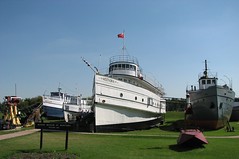
 The M.S. Keenora

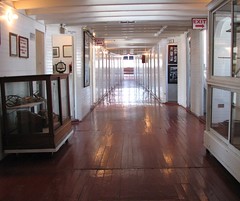
The ship replaced the M.S. Keenora which carried passengers from 1897 to 1966 before finally being retired in 1973. It is now restored and part of the Marine Museum of Manitoba, just a few minutes away from the Selkirk Park slough that the Lord Selkirk II calls home.

July 31 1971, Winnipeg Free Press

In June 1969 the M.S. Lord Selkirk II offered a variety of cruises, its signature outing was the four-day Adventurers' Cruise that left Selkirk Dock and sailed to the northern edge of Lake Winnipeg, stopping in Warrens Landing, Grand Rapids, Berens River, Matheson Island and Gull Harbor.


April 11, 1971, Winnipeg Free Press

The Lord Selkirk II had ownership difficulties since before her first sailing.

The
Lake Winnipeg Navigation Limited, (Dr. Kenneth McKenzie was president at the time of her launch), built the ship but because she cost over twice the original estimate of $600,000, the company went heavily in debt just to get her finished.

The Manitoba Development Corporation (MDC), a provincial crown entity, had to invest over $600,000 into the company to keep it solvent. In each of her first few seasons, The Lord Selkirk II lost hundreds of thousands of dollars and in 1971 the company failed. The MDC became the new owners.


Unable to find a buyer, the province set up a company called Venture Manitoba Tours to run the ship. It lost
over $1.3 million until, in 1978, it was again put up for sale. This time there was a buyer called Sub-Arctic Expeditions Inc., a consortium of businessmen fronted by Harold Einarsson. They paid just $250,000 for the Venture Manitoba but lost $300,000 in their first year.

By 1983 the new owners were Bill Gauthier and Bill Harris. In 1984 Harris became the sole owner.

May 18, 1990, Winnipeg Free Press

In 1986 she was bought by dentist Dr. Joe Slogan who immediately began to lobby the provincial government, unsuccessfully, for a gambling licence. (These were the days when the only legal gambling in town was the temporary casino at the Convention Centre.)
In a March 11, 1991 Free Press article, Slogan blamed the recently implemented GST, high gas taxes and the scare brought about by Manitoba's new drinking and driving laws for the demise of the business. As for his renewed push for a gambling licence, he said "If it (the response from the province) was no, we'd discontinue operations."

That's exactly what happened. After she was parked in Selkirk Park at the end of the 1990 sailing season, the M.S. Lord Selkirk never came out again.

Ship Graveyard

Eventually, she was put up for sale but because of the transportation costs, it took until
2010 to find a buyer - an overseas company bought her for scrap. According to the ship's memorial site she was resold in 2011 to a new, local owner.

That summer, some of the objects that were to have been removed and donated to the Manitoba Marine Museum were stolen by vandals. In June 2012, her bad luck continued when she burned in Selkirk Park, her home since 1990. 

The ship was again sold for scrap but that company declared bankruptcy in 2014.

Lord Selkirk II links:
For more photos of the ship, including the interior
Remembering the riverboats Manitoba Historical Society
Bon Voyage M.S. Lord Selkirk II Selkirk Journal (2010)
Rusting pleasure craft soon to be no more Free Press (2010)
Lord Selkirk II up in flames W
innipeg Free Press (Jun 2012)
Lord Selkirk II then and now Winnipeg Free Press (Jun 2012)

Removal of rotting ship could become easier... Winnipeg Sun (Mar 2014)
The life and times of the Lord Selkirk II Interlake Journal (May 2014)

In related news:

Ship Graveyard

In Summer 2011 Captain Hawchuk, owner of the Paddlewheel Queen and Paddlewheel Princess, announced that he
was retiring and the ships are still up for sale.

The River Rouge was put up for sale by the owner in 2010 but he announced in 2011 that he had reconsidered and the ship would stay in Manitoba.

Thursday, 23 February 2012

Christie's Biscuit factory's 80th anniversary makeover !

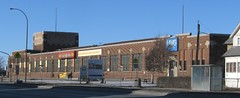
Christie Brown / MWG Apparel Building
Top: Winnipeg Free Press, February 16, 1932
Bottom: ca 2012

On February 15th the former Christie Brown Biscuit factory at 1155 Notre Dame Avenue turned 80 years old and there's some good news for the future of this old building.


Source: WRHA

In August 2010 the Winnipeg Regional health Authority announced that owner MWG Apparel would consolidate its space to allow for a 95,000 square foot Specialized Services for Children and Youth (SSCY) centre that will replace the old Rehabilitation Centre for Children (RCC) on Wellington Crescent.

It's the start of what could be a big transformation for the area. There's a proposed retail development for Notre Dame and Erin, where Abel Wholesale is located, and a proposed residential development across the street where Robin's Donuts is situated.

Christie Brown / MWG Apparel Building

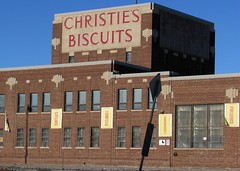
The recent uncovering of the original Christie's Biscuits sign provided a reminder of the building's origins. Before it's covered up again, here's a look back at Christie's Winnipeg history.

I have moved the history of the building to me Winnipeg Downtown Places blog:
 http://winnipegdowntownplaces.blogspot.ca/2016/06/1147-notre-dame-avenue-christie-brown.html 


Tuesday, 21 February 2012

Budweiser's Clydesdales & their Winnipeg origins

© 2012 Christian Cassidy


Each February, Anheuser-Busch's Clydesdales get some pricey air time during the Superbowl. This year was no different.

On a couple of occasions I have come across references to the fact that the original Anheuser-Busch Clydesdale teams came from Winnipeg, most recently in the documentary Beer Barons of Winnipeg. I thought I would dig into the story a little further.


The story begins in the 1880s with a man named Patrick Shea. He was born in Co. Kerry, Ireland on March 7, 1854, and trained as an engineer. He came to North America to in 1870 work on railway infrastructure projects and eventually settled in Manitoba in 1882.

From 1882 to 1884, Shea was in charge of the water distribution system for the railway construction from Oak Lake westward. When that job was completed he decided to put down roots in Winnipeg. 


Shea met fellow Irishman John McDonagh and together they purchased the Waverley Hotel near Higgins and Main. They became well-known for their hospitality and it became a popular watering hole.

Around this time he also met and married Margaret Burns of Winona, Minnesota. They married and had five children together, though only two survived childhood.


Winnipeg Brewery ca. 1886 (Source)
Daily Nor'Wester, September 1887

The two men decided to leave the hotel business in 1887 after purchasing from Sylvester Thomas the assets of his defunct and run-down Winnipeg Brewery on Colony Street at Broadway for $16,000. Others had leased the facility from Thomas to try and make a go of it but couldn't. McDunough and Shea, which is what the new enterprise was called, found success.

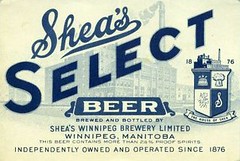
McDonagh died in 1893 leaving Shea the sole owner. Shea kept the "McDonagh and Shea" business name until 1926 when the brewery had to be reincorporated due to the province's new liquor production rules. It then became known as "Shea's Winnipeg Brewery Ltd." (The Winnipeg Brewery was established in 1873 and Shea's would later use that in its advertising and on its labels as the year it was founded.)

Shea's Brewery ca. 1930s

Shea became a well-liked community leader and philanthropist. A Tribune story after his death called him "a smiling, kindly, big-hearted boniface." 

Business was good and in in 1903 the brewery underwent the first of many major expansions at the Colony Street site, eventually becoming the city's largest brewery.


A Shea's team at Legislature (Source: Manitoba Archives)

At the time Shea's was created, the only method of urban transportation for the fire department, streetcars or product delivery, was horse power. Different companies had their preferred breed of horse. Eaton's and Crescent Creamery used Hackneys while Manitoba Cartage and Shea's preferred Clydesdales.

Horses were a major investment for these companies. There could be more horses working for an organization than people and the amount of space needed to keep and care for them often exceeded the footprint of the building that they served. An 1882 Free Press article notes that Manitoba Cartage was building "extensive new stables" for their 42 six-horse teams!

An impressive horse or team was also good for a company's public image. Many showed their best animals and fanciest wagons in competition and a few even became local celebrities in their own right.

Top: Shea's "Warrior", Winnipeg Tribune, Nov 24. 1928
Bottom: November 19, 1926, Winnipeg Tribune

Shea spared no expense when it came to this aspect of the company's image. He was an active Clydesdale breeder and regularly imported champion horses directly from Scotland to keep the bloodlines strong. Shea also had special show wagons built at a cost of $2,000 each. 

The investment paid off as many of Shea's horses and teams won top prizes at horse shows and fairs in Brandon, Toronto, Minneapolis, and Chicago.

"Aladdin", one of Shea's veterans, took top prize in his class and was overall grand champion at the Chicago International Livestock Show of 1927. At the same show, along with another horse called Unity, Aladdin also won top in class for best team. The image above shows "Warrior" who arrived from Scotland in March 1928 and took top honours in his class at Brandon and Toronto in years to come.


Another Winnipeg firm, Manitoba Cartage, took similar interest in their Clydesdales and Manitoba's Clydesdale industry had a stellar international reputation. In fact, the Brandon Winter Fair's Clydesdale show was considered one of the best on the continent.


Delivery truck at Shea's ca 1917 (Source)

The era of the horse-drawn wagon began to give way to motorized vehicles after World War I and  hundreds of horses were put out to pasture each year. Companies such as Eaton's, Manitoba Cartage and Shea's kept their best teams 'on the payroll' and continued to show them.

In the early years of the Depression an aging and ill Patrick Shea decided to sell off his prized teams. He accepted an offer for one of them while at the 1933 Toronto Winter Fair. A brief Free Press story noted that the purchaser was "a St. Louis brewery."

That St. Louis brewery was Anheuser-Busch, North America's largest, and brewers of the popular Budweiser beer. "Bud" had been available in Winnipeg since around 1904 when the Hudson Bay Company began distributing it in Western Canada.


Anheuser-Busch's team in 1934 (source)

At the Clydesdale section of the A-B website, it notes: "Realizing the marketing potential of a horse-drawn beer wagon....on April 7, 1933, August A. Busch, Jr. and Adolphus Busch III surprised their father, August A. Busch, Sr., with the gift of a six-horse Clydesdale hitch..."

The website does not mention the Winnipeg connection, though many news stories about the Clydesdales on tour, such as here, here, and here, contain a paragraph similar to: "The Cyldesdales became part of the Budwesier and Anheuser-Busch Brewing story in 1933. August A. Busch Jr. bought the first team of Anheuser-Busch Clydedales from Patrick Shea of Shea's Brewery in Winnipeg, Manitoba, Canada. Jr. then hitched the team up and brought them to the family brewery in St. Louis to greet his father, August Anheuser Busch, Sr...."

This suggests that company news releases about their appearance do mention Shea.

The A-B website goes on to say that August Sr. was pleased with the gift and the following year his company purchased more Clydesdales. This was likely more of Shea's Clydesdales and wagons that were sold off at the 1934 Royal Guelph Winter Show.

July 10, 1933, Winnipeg Free Press

Shea spent most of the early months of 1933 travelling to various U.S. clinics in the hopes to find a cure for what newspapers would only describe as a "lingering illness". He died at his home at 140 Colony Street on July 8, 1933 at the age of 80.

Shea's funeral at St. Mary's Cathedral drew hundreds of mourners. Winnipeg beer parlours closed in his honour on the morning of his funeral.

Top: Pat, Margaret Shea. Bottom: Frank Shea, John Boyd

Control of Shea's Brewery went to his widow, Margaret, and their only surviving child, Frank, who had worked at the company since 1904. (Their other son, Paul, died from a burst appendix whilst a student at Fordham University in New York in 1917 at the age of 21.)

Frank became company president though his tenure would last just a few months.  He
had long suffered from a from a "nervous condition", which was usually code in those days for mental illness. (One researcher told me that alcoholism may have been an issue as well.)

In early 1932, Frank had what was described in newspapers as a "severe nervous breakdown" and the strain of losing his father had just worsened matters. At the end of July 1933, he was sent to the U.S. and admitted to Johns Hopkins Hospital in Baltimore for treatment. 


Frank Shea died suddenly at the hospital on October 20, 1933, at the age of 44.

sheas beer

Margaret Shea then became the majority shareholder in the company. By this time, though, Shea's was a mature business with a full executive team and over 100 staff, and the transition from her son to hers was an easy one.

The brewery was run by John T. Boyd from 1934 to 1950. He was a long-time executive who started out as an office boy when the brewery first opened. During his tenure, Shea's assumed control of two other local breweries - Pelissier's and Kiewel's. It also ran the beer distribution firm Brewery Products Ltd. and had a controlling interest in 41 of Manitoba's 260 hotels.


April 14, 1950, Winnipeg Tribune

Margaret Shea kept up her husband's philanthropic ways by donating to many funds and hosting many events to raise money for hospitals, schools, and charities. For instance, in the 1930s she largely funded the construction of a new hall (named for son Paul) for high school students at St. Paul's College on Ellice Avenue and there was the Lady Margaret Shea scholarship at St. Mary's Academy.

When Margaret died on April 13, 1950 at the age of 91, she bequeathed over $50,000 to various charities, including St. Paul's and St. Mary's.


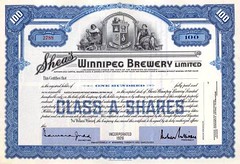
Shea's Brewery Bond

Upon the death of Margaret, the Shea estate was left to Frank's widow, Ethel Shea.

Initially, it appeared that Ethel got a windfall as the estate was valued at $3 million. Most of that, however, was in company stock and the federal government claimed half of it in succession duties, (now called inheritance tax). There was only around $300,000 in cash which meant Ethel probably had to sell off a lot of stock and any real estate in the portfolio.

When Ethel died in 1952, she left 33,000 shares each to the General Hospital and Misericordia Hospital. This put the institutions, particularly the Catholic-run Misericordia hospital, in the uncomfortable position of being the brewery's largest combined shareholder. When added to the shares owned by the Boyd estate, the three had controlling interest in the company.


The hospitals were eager to divest themselves of their shares and the Boyd family also wanted to sell up. That's when Labatt's was called on.  (I have been told that it was the family's expressed wishes that if the shares were ever to be sold, it would be to Labatt's and not a competitor.)

December 12, 1953, Winnipeg Free Press

I
n December 1953, Hugh Labatt announced that his company's offer to purchase the 91% stake in Shea's Brewery owned by the hospitals and Boyd family was overwhelmingly accepted. Manitoba's oldest and largest brewery was now in Eastern hands.

Each hospital ended up making over $1 million, (about $8.5 m in 2012 dollars). The General Hospital put its funds toward the construction of a new
Children's Hospital in 1956. The Misericordia put its money toward the construction of its Cornish Wing in 1957.

The Shea's Brewery building on Colony Street (located in what is now the rear parking lot of Great West Life) was converted to a Labatt Brewery facility. It suffered a major fire in 1975 and was
torn down in 1979.

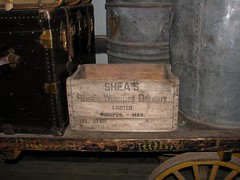
Winnipeg Rail Museum

Related:

Most of the above information was pieced together from a few dozen newspaper articles. Here are some online sources pertaining to Shea's:
- Alcohol and temperance in modern history Blocker, Fahey, Tyrrell
- Brewed in Canada A. W. Sneath
- Shea's Winnipeg Diamond Jubilee Booklet
- Horse Show Memories Winnipeg Diamond Jubilee Booklet
- Thanks to beer historian Bill Wright who is writing a book about the history of Manitoba's breweries.

 
September 21, 1926, Winnipeg Free Press


 November 20, 1930, Winnipeg Free Press

Saturday, 18 February 2012

If Day: The Nazi invasion of Winnipeg

February 19, 1942, Winnipeg Tribune

On February 19, 1942 at 6:00 a.m., air raid sirens sounded over Winnipeg. An hour later, aircraft swooped overhead while anti-aircraft guns fired back. Explosions and small arms fire could be heard around the city. 

Soon, "Nazi" troops in convoys of armoured vehicles began to seize key points in the city. By 9:30 a.m., they had reached City Hall and arrested Mayor Queen and other city officials. Next, it was to the Legislature and the arrest of Premier Bracken and the Lieutenant Governor.

By lunchtime the city was under Nazi control.


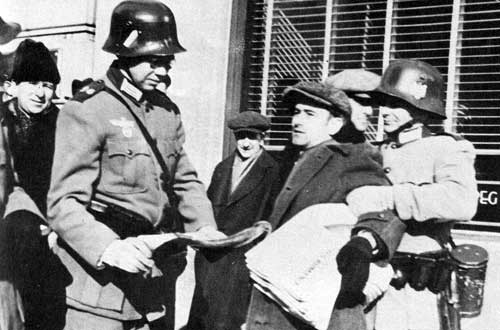
Top: Nazi soldier arrests news agent (Source)
Middle: Charleswood bus stopped, searched (Source)
Bottom: Winnipeg Tribune, February 19, 1942

The "Nazis" set up roadblocks to stop buses and streetcars and demanded that passengers showed identification papers. The Carnegie Library on William Avenue was sacked and hundreds of books were burned on the front lawn. Churches were barricaded with notices on their doors that religious services were no longer allowed.

Even the Winnipeg Tribune was targeted. On the morning of February 19, 1942, a special German-language edition of the newspaper is distributed.


Just before sunset, the troops gathered on Portage Avenue and began making their way to the city limits. As quickly as it began, the Nazi invasion of Winnipeg was over.

German tanks on Portage Avenue (Source)

The "invasion" was called "If Day", as in what might happen IF the Nazis weren't stopped overseas. It was a  publicity stunt involving thousands of volunteers and meant to raise funds for Manitoba's Victory Loan campaign.

The campaign was a huge success. In the 24 hour period after IF Day, the Manitoba Victory Loan campaign raised over $3 million, (that's almost $43m in 2011 dollars).

It also received worldwide media attention from outlets like
British Pathé, the New York Times, Christian Science Monitor and LIFE Magazine, which gave it a three page photo spread.

Related:

When War Came To Winnipeg Free Press (Feb. 2017)
The Day the Nazis Took over Winnipeg Maclean's Magazine

If Day Manitoba Historical Society
Winnipeg is conquered LIFE Magazine
If Day Special (pg 3, 17, 27, photo page) Winnipeg Tribune
Nazi army's invasion of Winnipeg Leader Post (1984)

Video:
If Day: The Nazi Invasion of Winnipeg Documentary trailer

If Day in Winnipeg  British Pathé newsreel
CBS Morning News (2011)