Local News Links:... .........................
Showing posts with label West End. Show all posts

Monday, 9 November 2015

Manitoba's WWI Fallen: Private Arthur A. Taylor of Winnipeg

To commemorate the 100th anniversary of the start of the First World War, I am working on a series of blog posts and radio shows that will look at 100 Manitobans who died in action. For more about this project and links to other posts, follow this link.


British-born Arthur Anderson Taylor lived with his parents at 543 Home Street and worked as a printer for the Northwest Laundry Co. on Main Street and York Avenue. In the summer of 1915 he joined the 106th Regiment, Winnipeg Light Infantry reserve unit as a drummer.  

On December 1, 1915 he enlisted with the 101st Regiment, Winnipeg Light Infantry. The following week, a brief item in the Winnipeg Tribune noted that his parents said that "(he)... was anxious to go to the war when hostilities started" and was now getting his wish.


Taylor’s age is unclear. The Tribune item noted that he was one of the city’s youngest soldiers, enlisting at 16 years of age. Calculating his age based on the birth date he used on his attestation papers, however, would have made him 17 years, 8 months old.

There was a loophole in the Canadian system that allowed child soldiers, some as young as 13, to go into battle. 

It was commonplace for battalions to have boys serve as buglers or drummers. When the unit got called up, some of them enlisted using a false birth date. This allowed them to stay with the unit through their final training and, if their parents agreed, over to England.

There, some units took their boys over to mainland Europe and into battle with them. Some did not, but with attestation papers showing they were of age, it was easy to find a unit that would be happy to sign them up.

Taylor went missing in action in October 1917. In May 1918 his parents were notified that he was presumed dead. 

His remains were eventually discovered and he is buried at Passchendaele New British Cemetery, Belgium.

Related:

Sunday, 23 January 2011

West End History: 667 Ellice


Before (source)

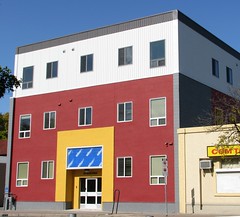
The building at 667 Ellice Avenue has been part of the community for over 50 years and is getting quite the re-do.

It was built in the early 50s when the YMCA decided to expand programming into the community, rather than have everything at one central location. A number of 'Community Ys' were established during this time including St. James, St. Vital and North Winnipeg.


The Ellice facility was built with an eye to expansion - two more floors could be added and an elevator shaft was roughed in. Things didn't turn out for the West End Y, though. By 1968 it was closed.


ca. Jan 2011

The space was subdivided into seperate office and retail space and housed many tenants over the years. Examples: The Liberal Party (68-69); the Manitoba Sports Federation and the Manitoba Film Classification Board. In 1981 the building was the Christmas Cheer Board headquarters.

In the 1990s it held mostly community offices, including a YMCA daycare program on upper floor. Controversy erupted in 1997 when a massage parlour was allowed to rent the main floor section. After a brief uproar the parlour moved out.

Last year the building
went up for sale for $550,000.


Proposed design (source)

The new owner is
the Native Women’s Transition Centre, who will relocate their offices from Aikins Street.

The upper floors will be Kihiw Iskewock (Eagle Woman's) Lodge, a "long term transitional facility for Aboriginal women who have experienced incarceration and/or have been in conflict with the justice system". It is a partnership between the Transition Centre, C.L.O.U.T and the Elizabeth Fry Society. There will be 15 rooms, 35 beds, and clients and their children will be able to stay for up to three years while they integrate back into the community.

It is expected to open by summer 2011

Related:
Interior photos of the renos see Three Way Builders.
For more on Kihiw Iskewock

Updates:
The building reopened in Summer 2011

667 Ellice
October 2011

Monday, 17 January 2011

A sad anniversary for the West End

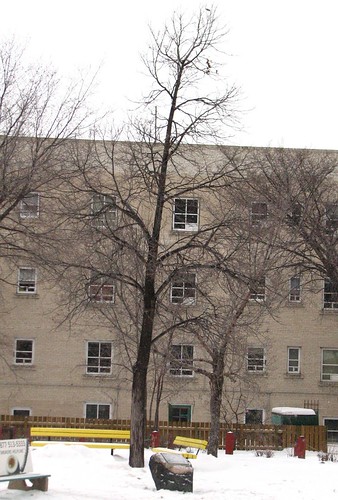
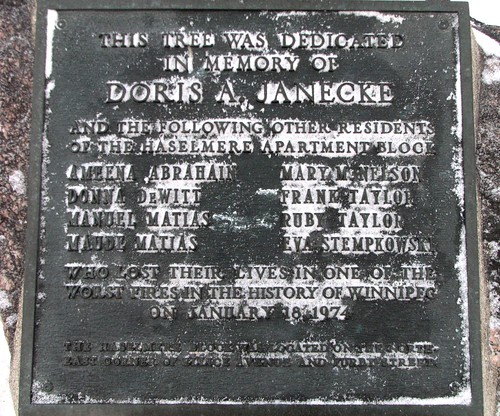
If you've been past the University of Winnipeg's Ellice Avenue entrance you may have noticed tree and stone in the park across the street. It is a memorial to the nine people who died in the Haselmere Apartment fire of January 18, 1974.

In terms of loss of life, it still stands out as one of Winnipeg's most devastating fires. There was the St. Boniface College dorm fire in 1922 that killed ten and the Medway Court fire in 1943 that claimed nine. I cannot find an equal since 1974.

Two years ago I did a feature post about the fire to mark the 35th anniversary of this forgotten tragedy. If you happen to drive or stroll past today, take a moment to remember.

Thursday, 16 December 2010

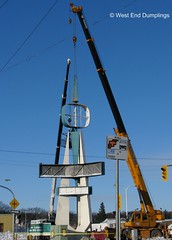
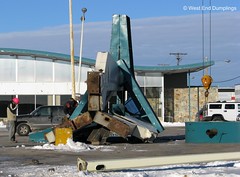
A West End landmark gone ! UPDATED NOV 2011

(See below for the transformation of the Safeway Store.)

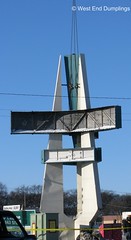
Marina Safeway Sign, Ellice and Wall

Safeway Inukshuk
The way it was - courtesy buflyer

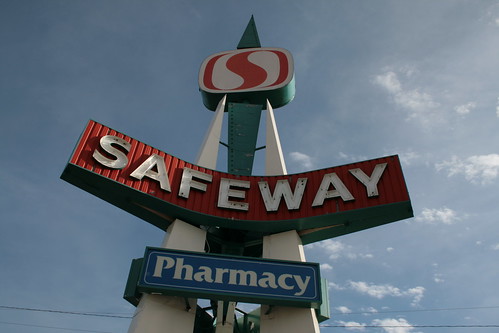
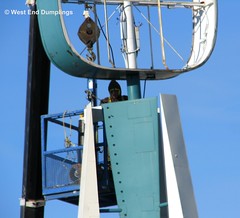
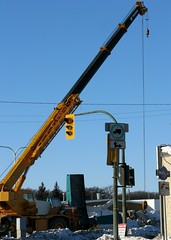
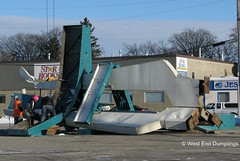
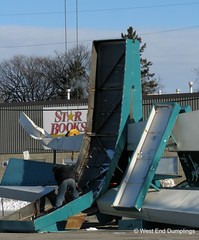
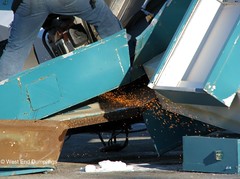
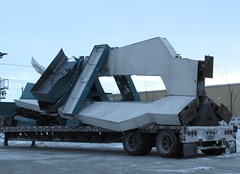
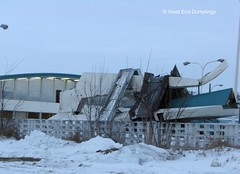
It was one of the tallest, free-standing landmarks in the West End for 46 years. In December 2010 the Safeway sign at Ellice and Wall came down. (Thanks for the folks at DigginIT for letting me know !).

Here's how the day went:

Safeway Sign Demo 1
Safeway Sign Demo 3
Safeway Sign Demo 4
I actually liked the version below - a West End inukshuk:
Safeway Sign Demo 5
Safeway Sign Demo 7
Safeway Sign Demo 8
Safeway Sign Demo 9
Safeway Sign Demo 10
Safeway Sign Demo 11
Safeway Sign Demo 12
Safeway Sign Demo 13
Safeway Sign Demo 15

Marina Safeway Store, Ellice and Wall

Old Safeway
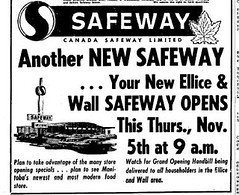
November 4, 1964, Winnipeg Free Press

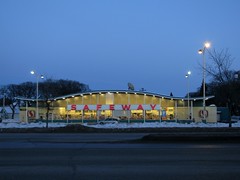
The sign was original to this, Winnipeg's first 'Marina Style' Safeway, which opened in 1964. The style was named for
the prototype store on Marina Boulevard in San Fransisco.

Former Safeway
Old Safeway
Old Safeway

This
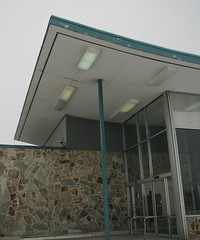
was for Safeway, and many retailers, their 'golden age' in terms of architecture. Suburban stores were now set behind acres of parking off of increasingly busy thoroughfares and needed a little something extra to stand out. Safeway had a number of designs in the late 50s and 60s to give their stores 'curb appeal'. (For more on these designs)


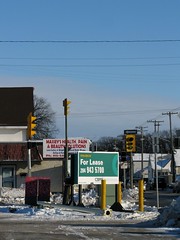
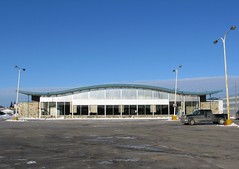
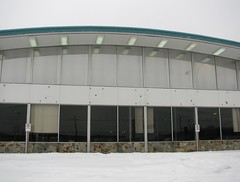
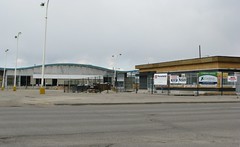
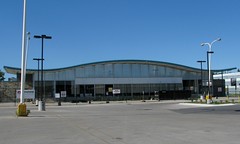
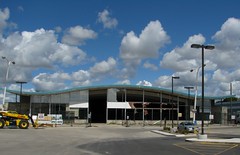
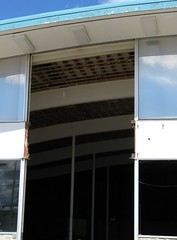
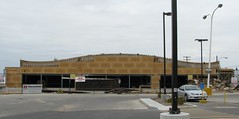
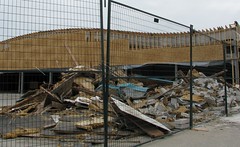
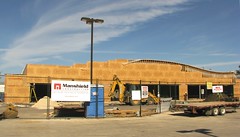
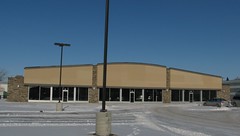
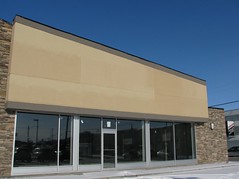
The store at Ellice and Wall has sat vacant for over a year, ever since Safeway moved to a new store on Ness Avenue. It will soon get a major revamp that will remove the trademark roofline and subdivide it into three retail units. The parking lot will be home to a couple of retail outlets (one a Cambrian Credit Union, the other undetermined). (For more on the plan)

Old-School Marina Style Safeway
Old Safeway

The only operating Marina style store left in Winnipeg is on
North Main Street. The sign is original, but it's the more common 'one dimensional' version, not the flared, two sided model once at Ellice and Wall.

Related:
See my four-part 'Safeway in Manitoba' series:

- Safeway in Winnipeg Part 1 - Setting Up Shop
- Safeway in Winnipeg Part 2 - The Boom Years
- Safeway in Winnipeg Part 3 - 1939 to 1949
- Safeway in Winnipeg Part 4 - Sweeping Styles

- Related Safeway Maps

UPDATE:

Wall Street former Safeway
Construction of Credit Union on site where sign was.

Starting in August 2011 the renovations on the store began:

Former Safeway
Former Marina Safeway
Former Safeway
Former Safeway
Former Marina Safeway
September 26, 2011, the curved roof line disappears:
Safeway, Allice and Wall
November 2011
Former Marina Style Safeway

Thursday, 9 December 2010

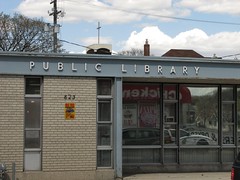
Former West End Library rises again !

West End Library

The former West End Library at 823 Ellice near Arlington is getting a second lease on life as a community resource centre ! Here is a look back at the history of the building.

Monday, 6 December 2010

Repealing Rapelje

A little item in the Free Press notes that Rapelje Avenue in St. James will likely be renamed Jack Blick Avenue this week.

Jack Oliver Blick was a Manitoba media pioneer, (he's the J-O-B in CJOB), who is credited with innovations such as FM simulcasts and news-on-the-hour. (More about Blick and CJOB at my This Was Winnipeg post about him).

I am all for remembering our pioneers but, as One Man Committee - not the Free Press, asks: what about Rapelje ?! The name rang a bell for me so I thought I would go back and look him up.

I can't find a direct reference for whom the street was named but it certainly has to be one (or both) Rapelje brothers of Fort William, (now Thunder Bay), Ontario.


Rapelje, Montana (source)

Older brother Jules M. Rapelje led the very first train west from Fort William to Winnipeg, (circa 1882), but soon left the CPR for Montana to work on the Northern Pacific Railroad's Yellowstone Park Line. A smart man, he soon climbed the ladder to be a supervisor, and eventually Vice President, of the NP.

Rapelje, Montana is named for him.


Winnipeg Free Press, Jan. 21, 1925

J.M. died in 1925. A few days later the Free Press interviewed Joseph Fahey, a friend since their CPR days. J.M. returned to Winnipeg every year or two to inspect the NP's Winnipeg properties, which included their repair shop - now the Children's Museum at The Forks, and always visited Fahey.

J.M. was well liked by his men and had a knack for remembering names. Even thirty years later, if he spotted someone who he had worked with he would go over for a chat. Fahey summarized:
"He will be a great loss to the railway and a very heavy loss to the employees of the road".

It does not appear that J.M. ever lived in Winnipeg. His connection to the city would have been driving that first CPR train into the city.


Port Arthur train ca 1886 (source)

The other brother was Charles Park (C.P.) Rapelje (1864 - 1942).

He also worked for the CPR, starting off as a brakeman in 1885. His very first run was the
Fort William to Winnipeg leg of the CPR, the route his brother took and the route that he would work exclusively throughout his career. One exception was his first arrival in Winnipeg. His crew was sent on a special mission - to go west to pick up soldiers returning form the 1885 Northwest Rebellion.

C.P. married Agnes in Fort William in 1890, became a passenger train conducto,r and by 1906 settled in Winnipeg. For a few years 445 Elgin Avenue was the home of C.P., Agnes (b. 1872) and children Muriel (b. 1891), Etta (1895) and John (b. 1897). Newpaper accounts indicate that he lived in Winnipeg up until his retirement.

Manitoba Free Press, June 29, 1928

C.P. retired in 1928 after an amazing 43 year run with the CPR ! He and wife Agnes retired in Winnipeg but wintered in California where their son and daughter Muriel had moved. In 1940 the two celebrated their golden wedding anniversary and relocated to California full time.

On July 11, 1942 Charles Park Rapelje died of a stroke. He is buried in Forest Lawn Memorial park, Los Angeles.


(circa 1910, click image for source)

What of Rapleje Avenue, then ? As I mentioned above, I cannot find a direct reference to the naming of the street. The land would have been part of the R.M. of St. James, not the City of Winnipeg, which usually makes it harder to trace street name origins.

The name first appears in a "land for sale" classified in the Winnipeg Free Press on May 20, 1907:

" St. James - ON RICHMOND between Rapelje and Calder,
three hundred feet; want offers BOX 884 Free Press."

The first mention of the street in the Henderson Directory comes in the mid 1940s as a marker for a section of Empress Street. It seems nothing lists a Rapelje Avenue address until Moffat Communications in the late 1970s.

Looking at McPhillips' map of 1910, the major streets in the vicinity don't indicate any local flavour: Richmond, Surrey, Dundas, Empress, St. James. Some of the small cross streets, though, may show a local transportation link.

There is Calder. That could be named for
Alexander Calder, the first merchant on Portage Avenue. After a few years of retailing, in 1883 he went to work for the CPR as one of their first ticket agents. He eventually spun that off into a successful travel agent business.

Griggs - could that be for Alexander Griggs ? He, too, was a transportation pioneer but in the steamship industry. He carried cargo up and down the Red River for the HBC and convinced a couple of partners to introduce steam-powered boats to the route. The group soon had a dozen steamboats that ran from lake Winnipeg down to the Dakotas. Griggs, who captained the S.S. Selkirk for a time, is considered the founding father
Grand Forks, N.D..

Given the 1907 reference, it would likely be J.M. Rapelje that the street was named for. He would certainly fit in with that group.


This again brings up the question that always comes up when a street gets renamed: what's the criteria ?

In this case one of the difficulties with changing a name - appeasing landowners that must change their address - is not an issue as the applicant is the only addressee.

There is a difficulty that didn't exist with recent name changes. This isn't
"Water" or "Arena", this street has already been named for someone. If it can be renamed by because of a request from a new building owner, can others get the same treatment as well ?

Related:
A Fleeting Tribute, Indeed - One Man Committee

Sunday, 28 November 2010

Farewell to West Central STREETS

Farewell to a West End institution !

West Central Streets community newspaper has been around for fifteen years chronicling the lives of those living in the section of the West End stretching from Arlington Street east to Carlton. The mandate was not to cover the neighbourhood 'news' but "to give voice to the interests, struggles and strengths of the people in the community". That it did.

St. Paul Street, Winnipeg

Produced by a revolving team of neighbourhood volunteers under the editorship of Erica Wiebe, each edition had a different focus both in terms of subject matter and the part of the neighbourhood covered.

Artists, community volunteers, 'old timers', new immigrants, first time West-Enders, recovering addicts, even yours truly, have appeared in the pages.

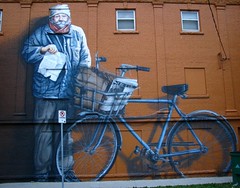
West End Mural

Over the years it has covered numerous workshops and community meetings on issues such as youth recreation, crime and prostitution. They began celebrating the murals of the West End, (years before Where Winnipeg caught onto them), talked about the history of some of the streets and introduced new institutions such as the Ellice Cafe and Theatre to West-Enders.

It's not always pretty. Stories of triumph and interesting characters shared space with those about life on the periphery of society and the victims, and sometimes the perpetrators off crime.

Central Park, African Market
The November / December 2010 edition is typical example. Features include:

- A woman from Nelson House who uses the West End Women's Resource Centre (which just moved to 640 Ellice).

- An editorial from a Cumberland area resident questioning whether it is violent crime, or the perception of violent crime, that's running rampant in parts of the West End.

- A 'streeter' on what residents think of the 'new' Central Park.

- In the 'New Neighbours' section, a former Winnipegger who returned from Ottawa after getting her degree. (She finds that "There are more people walking around ....Neighbours know each other and talk to each other. That's different from other neighbourhoods")

- A woman who moved into a 'pocket suite' five years ago and the adjustments that she had to make.

- A newly arrived family from Congo trying to find their way in a new country.

- A daycare director retiring after 31 years, interviewed appropriately by one of her former charges !

- In a Central Park focus, a profile of three of the people responsible for the African revival in the area.

It ends, as always, with a Community Exchange feature. A combination want ads / skills bank where you can find everything from a tree pruner to a jewelery maker to interpreter services.

Ellice Street Festival 2008

Unfortunately, West Central Streets never made it on-line. During the ups and downs that the West End has had in the past few years it would have been nice to have it out there to counter the 'it's all going to hell' stance that most media have taken at times to the area.

The main funder of West Central Streets was LITE and their funding, ($6,000 in 2009), has ended. The current edition, (November - December, available at a number of agencies and retail outlets in the area), is their penultimate one. A final edition will be available at the end of January.

It's a little piece of the West End that will be missed.