Thursday, 31 January 2013
February 14: Sherbrook Pool Community Meeting
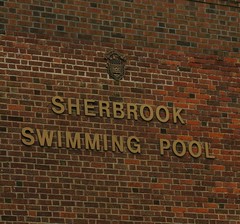
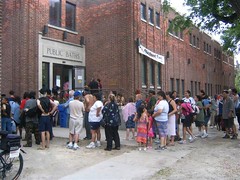
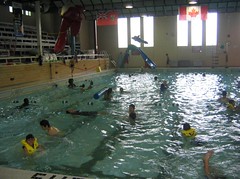
Coming up on February 14, 1913 Spence Neighbourhood Association and Friends of Sherlock Pool will hold a community meeting on the future of the Sherbrook Pool which was closed suddenly on November 29, 2012. For more details.
You can check out my four-part history of the pool.
Related:
Sherbrook Pool Historic Buildings Committee
A Community Development Vision for Sherbrook Pool CCPA
My Flickr album of the Sherbrook Pool
Recent Media:
City's aging pools struggling to stay afloat Free Press (Jan 26, 2013)
Sherbrook Pool stuck in drainage cycle Winnipeg Sun (Jan 26, 2013)
Sherbrook Pool might stay afloat Free Press (Jan 24, 2013)
City gets Olympic push to fix pools Free Press (Jan 23, 2013)
Many Woes at Sherbrook Pool Free Press (Jan 21, 2013)
Maddin to mayor: keep pool in picture Free Press (Jan 12, 2013)
Sharks to fight for Sherbrook Pool Winnipeg Sun (Dec 2012)
Sherbrook Pool to remain closed Global (Dec 2012)
Sherbrook Pool closure worries community group CBC (Dec 2012)
Monday, 28 January 2013
A history of the Sherbrook Pool. Part 4: The last chapter ?
A four part series on the history of the Sherbrook Pool
Part 1: Conception and Construction (1930 - 31)
Part 2: The glory years (1931 - 1970)
Part 3: A New Era (1971 - 1991)
May 19, 1992, Winnipeg Free Press
In April 1992 a community group called the Friends of Sherbrook Pool was formed under the direction of Christine Common Singh, a co-founder of the Coalition to Save the Elms, and about 100 members. Their role was to take the city up on its offer to find new programming and other ways to increase attendance during the Sherbrook Pool's last two years of guaranteed funding.
Before the two years was up, though, the pool and its $430,000 operating budget was back on the chopping block. Parks, Protection and Culture commissioner chairman Lorne Reynolds said that it cost the city $8.90 per swim at the Sherbrook Pool while the Pan Am and BoniVital pools cost $3.24 and $2.48 respectively. He said that the actual demolition of the building could be held off if the community came up with ideas for increasing usership and new programming, (source: December 3, 1992, Winnipeg Free Press.)
March 15, 1993, Winnipeg Free Press
After a familiar debate and push-back (including a protest) by the community, the pool was granted one more year of guaranteed operating funds, again, with the increased attendance caveat.
In January 1994 the FOSP announced the first of these programs. Kidswim took 94 kids, (their slogan was '94 in '94), chosen by the administration of three area schools, and provided them with free swim lessons. The idea was that offering free lessons would not only provide recreation and life skills but would, in turn, keep the kids coming back. The FOSP raised funds from community grants, private companies and groups such as the Winnipeg Foundation.
The initial set of 94 lessons grew and between 1994 and 2009 FOSP estimates that it put 2,500 kids through Kidswim between 1994 and 2009, (source, p17.)
The following year, the Sherbrook Sharks Swim Club was created under coach Brandee Alexander. It allowed the most promising swimmers who graduated from Kidwim a place to carry on with their swimming. It is now an independent, non-profit organization.
In 1994 the FOSP received permission to apply to the Canada Infrastructure Works Program for a capital grant for major renovations to the Sherbrook Pool. The following year they received $500,000 based on the commitment that the city would have to match the funds. (According to FOSP the city committed to spend $1.2m as its share.)
In 1996 Phase One of the renovations was completed. Repairs cost about $600,000 and included:
Mechanical - humidity control and fire alarm upgrades;
Structural - underpinning of foundation walls;
Envelope - repair or replacement of exterior windows, masonry and signage;
Creation of a gym area inside the old caretaker’s suite.
Most noticeable was the reintroduction of windows along the Sherbrook Street main level which overlook the women's changing room. They were removed in the late 60s or early 1970s to stop "Peeping Toms." Also, the long neon sign that hung out front of the building was removed and replaced with a bronze civic crest and lettering, (that blend into the colour of the brick !)
Phase Two of the renovations, which dealt with interior renovations and upgrades, never took place. The city did not include them in its capital budget and therefore the federal funds were not released.
July 14, 2004, Winnipeg Free Press
The Sherbrook Indoor Pool is deemed surplus for the following reasons:
• Built in 1930 (Facility is 74 years old).
• Preservation needs are approximately to $4,000,000. Facilities condition index is 0.53. This only retains the current functionality.
• Urban Oasis is proposed within two blocks of the existing Sherbrook Pool with frontage on Portage Avenue.
• 2nd lowest attendance for indoor pools (only Bernie Wolfe Indoor Pool was lower).
• Built in 1930 (Facility is 74 years old).
• Preservation needs are approximately to $4,000,000. Facilities condition index is 0.53. This only retains the current functionality.
• Urban Oasis is proposed within two blocks of the existing Sherbrook Pool with frontage on Portage Avenue.
• 2nd lowest attendance for indoor pools (only Bernie Wolfe Indoor Pool was lower).
On June 4, 2006 the Sherbrook Pool celebrated its 75th anniversary with an open house, free swim and a barbecue.
Though the pool remained open, the 00s were not good ones for youth recreation in the west central part of the West End. In December 2006 Orioles Community Centre was amalgamated with Isaac Brock. On June 3, 2007 the Winnipeg Roller Rink / Galaxy Skateland closed. In 2009 the West End Library on Ellice relocated to the newly rebuilt Cindy Klassen Recreation Centre nearly 3 kilometres away.
Community organizations continued to find additional ways to bolster pool use and programming. In 2009 the Canadian Centre for Policy Alternatives released A Community Vision for the Sherbrook Pool outlining additional ideas.
Our West Central Times, p.1 (Credit: Joel Penner)
The Sherbrook Sharks scrambled to find space and are temporarily operating from the Cindy Klassen Recreation Centre.
Though the engineer's report has not been completed, on January 23, 2013 the Executive Policy Committee approved a one-time $200,000 grant from the Mayor’s a Civic Initiatives, Promotional and Protocol Fund that will, presumably, go toward the cost of the report.
Related:
Sherbrook Pool Historic Buildings Committee
A Community Development Vision for Sherbrook Pool CCPA
My Flickr album of the Sherbrook Pool
Media:
City's aging pools struggling to stay afloat Free Press (Jan 26, 2013)
Sherbrook Pool stuck in drainage cycle Winnipeg Sun (Jan 26, 2013)
Sherbrook Pool might stay afloat Free Press (Jan 24, 2013)
City gets Olympic push to fix pools Free Press (Jan 23, 2013)
Many Woes at Sherbrook Pool Free Press (Jan 21, 2013)
Maddin to mayor: keep pool in picture Free Press (Jan 12, 2013)
Sharks to fight for Sherbrook Pool Winnipeg Sun (Dec 2012)
Sherbrook Pool to remain closed Global (Dec 2012)
Sherbrook Pool closure worries community group CBC (Dec 2012)
UPDATES:
Friday, 25 January 2013
A history of the Sherbrook Pool. Part 3: A new era.
A four part series on the history of the Sherbrook Pool
Part 1: Conception and Construction (1930 - 31)
Part 2: The glory years (1931 - 1970)
Part 3: A New Era (1971 - 1991)
© 2012 Christian Cassidy
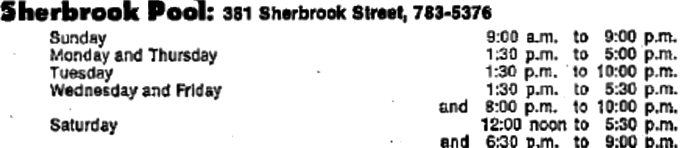
Sherbrook Pool Schedule, December 1972
Through the 1970s it offered a full slate of Red Cross swimming lessons and special classes for seniors and the disabled. It was also home to provincial lifeguard training programs. In the summer, special kid swims were held each afternoon and in the late 1970s came the early bird swim featuring the 100 Mile Club.
August 1, 1972, Winnipeg Free Press
On August 1, 1972 the pool was the scene of an important milestone: the 10-millionth visit to a city pool !
The Parks and Recreation department averaged out the number of daily swimmers dating back to the opening of the Cornish Baths in 1909 and determined that the 10-millionth visit would happen around 12:40 on that day. The Sherbrook Pool was chosen because it was the city's oldest.
Shortly before 1 pm Sandra Lloyd, an eight year-old who lived on Agnes Street and attended John M. King School, was the lead person in a group of friends coming for an afternoon swim. When she passed through the doors she was greeted with jubilation by the mayor and a number of city officials. When told that she was the 10-millionth visitor to a city pool she looked at the ground shyly and said " 'kay". She eventually warmed up to the attention and for her troubles received a certificate and an annual pass to the pool.
Also that day, Mrs. Dorothy Lloyd received a special award for her 41 years of teaching at the pool. She worked there from the day it opened in 1931 and created the Maple Leaf Swimming Club in 1933.
March 19, 1981, Winnipeg Free Press
In March 1981 the pool celebrated is 50th anniversary with an open house, lifeguard competition and free public swims. It was a happy time for the pool but its fortunes would soon change.
In September of that year the city was looking to make major cuts to the 1982 operating budget, initially requesting that departments come up with a 10% savings. The recreation department offered up the Sherbrook Pool and its $360,000 operating budget as part of its share. The cut was ruled out in short order, but it marked the first time that the pool was publicly on the chopping block.
October 8, 1985, Winnipeg Free Press
In August 1985 the pool had to be closed when water began leaking through the roof and ceiling. Repairs were estimated at $20,000 - $30,000 but the Recreation and Social Services Committee voted in October not to repair it, but to instead to generate a list of everything that needed repair and get an estimate for a complete fix. The estimate was in the range of $250,000.
Councillor Helen Promislow voted against the motion claiming that mixing long term repairs, including a sinking west wall, with the immediate repairs was an attempt to create "sticker shock" and an excuse to close the pool for good. She said "We're getting ready to close the pool and keep it closed and I don't see anybody who is going to admit that," (October 8, 1985, Winnipeg Free Press, p. 11.)
The pool did have a number of things going against it.
Compared to just 20 years earlier when it was the city's only indoor pool, there were now 12 others including inner city "neighbours" like Centennial Pool (1969), Sargent Park (1976), and suburban cousins like BoniVital (1974), Elmwood Kildonans (1975), Seven Oaks (1977).
The 1970s era pools boasted spacious lobbies, exercise areas, saunas and separate children's ends. Councillor Don Mitchelson, chair of the recreation committee, referred to the Sherbrook Pool as "...a glorified wading pool" (November 28, 1985, Winnipeg Free Press, p. 3.)
It was also pointed out that the Sherbrook Pool only had 58,000 visits per year versus 70,000 at St. Vital's Margaret Grant Pool. In fact, from 1978 - 1988, attendance at all pools fell. it averaged 13% but the big losers were the Sherbrook (a 32% drop) Civic Centre Pool (a 47% drop) and Centennial Pool (a 46% drop.) Some of the credit was given to continually rising swim fees throughout the 1980s.
The lower operating costs of the newer pools and fewer socio-economic problems in suburban areas combined to make the Sherbrook Pool costlier to run with just 13% of its operation costs made back in fees, (other pools were in the 27% range.) In a September 26, 1991 Free Press article, a city official said that in 1990 the Sherbrook Pool cost taxpayers $10.33 per user versus an average of $3.86 per user at other facilities. The 15,000 free swims provided at the Sherbrook Pool that year was a major factor.
November 2, 1985, Winnipeg Free Press
Options for what to do with the pool were presented to council in February 1986. They ranged from spending $112,000 to fix the leaky roof to extend the life of the pool for a couple of years, spending $360,000 for a 10-year fix or spending $3.6m to build a new pool on another, unnamed, site.
The Sherbrook Pool did have its supporters, both on council and in the community. They argued that the unique circumstances of the pool's catchment area made comparisons with suburban pools unfair. The Sherbrook's clientele were mainly small children, seniors and low income people who did not own vehicles. If the pool closed most would not make their way to the nearest recreation centre, they simply would stop participating.
September 27, 1986, Winnipeg Free Press
In the end, the recreation committee voted to leave the final decision in the hands of the City Centre-Fort Rouge Community Committee. It voted on March 3, 1986 to reopen the pool. On April 9 city council approved $405,000 for the repairs, including underpinning the west wall and $45,000 to make it wheelchair accessible.
The Sherbrook Pool reopened on September 27, 1986.
September 16, 1991, Winnipeg Free Press
In 1988 the city and a West End residents' group were working together on a plan to expand a park in the Spence neighbourhood. The project did not happen, so the group set its sights on adding amenities to the Sherbrook Pool instead. Ideas ranged from tearing out the bleachers for an exercise area to expanding the footprint of the facility.
The city agreed to renovate the pool and expand it to include a leisure centre at a cost of $1.46 million. It would be a test model for revitalizing other community pools and recreation facilities.
In advance of the renovations an engineer's report was done. It claimed that the pool was in such bad shape that the money set aside for its expansion, and more, would be needed just to shore up the failing foundation.
The city concluded that the cost of the renovation and expansion would be in the range of $3.5 million and that the best option would be to tear it down replace it with a $1.46 million recreation centre and outdoor wading pool.
In the midst of all this, on June 6, 1991, the city declared the Sherbrook Pool a municipal heritage site.
September 24, 1991, Winnipeg Free Press
The city held an open house on September 25 and 26, 1991 to present this new plan. As expected, there was opposition from individual pool users, neighbourhood organizations, Swim Manitoba and Manitoba Special Olympics.
That October the pool got a reprieve of sorts. The $1.46 million that was to be spent to expand the pool into a leisure centre instead went to creating the Magnus Eliason Recreation Centre at 430 Langside Street. The city agreed to keep funding the Sherbrook Pool for just two more years and would only consider an extension if the community came up with ideas on how to increase its usage.
Related:
Sherbrook Pool Historic Buildings Committee
A Community Development Vision for Sherbrook Pool CCPA
My Flickr album of the Sherbrook Pool
Media:
Sherbrook Pool stuck in drainage cycle Winnipeg Sun (Jan 26, 2013)
Sherbrook Pool might stay afloat Free Press (Jan 24, 2013)
City gets Olympic push to fix pools Free Press (Jan 23, 2013)
Many Woes at Sherbrook Pool Free Press (Jan 21, 2013)
Maddin to mayor: keep pool in picture Free Press (Jan 12, 2013)
Sharks to fight for Sherbrook Pool Winnipeg Sun (Dec 2012)
Sherbrook Pool to remain closed Global (Dec 2012)
Sherbrook Pool closure worries community group CBC (Dec 2012)
See the end of part four for the latest media links
Tuesday, 22 January 2013
A history of the Sherbrook Pool. part 2: The glory years.
A four part series on the history of the Sherbrook Pool
Part 1: Conception and Construction (1930 - 31)
Part 2: The glory years (1931 - 1970)
Part 3: A New Era (1971 - 1991)
The Sherbrook Pool served a number of important functions in its early years besides just being a recreational oasis for a Depression-weary city.
As an unemployment relief project, it provided much needed income for dozens of families. As Winnipeg's only Olympic-sized pool, some histories say it was the only indoor pool of that size in the West at the time, it served the local and national competitive swimming community.
Numerous swim clubs began operating from the here soon after it opened. The Maple Leaf Club, Women's Amateur Swimming Club and Victoria Ladies' Swimming Club (VLSC) being the main ones. The VLSC was created in 1916 at the Cornish Baths by Miriam Tauntin and moved to the Sherbrook by 1932 under new coach Vera Tustin.
Each of these clubs held regular competitive swim meets and an end of season gala.
March 30, 1935, Winnipeg Free Press
At the end of the gala season the Manitoba Chapter of the Canadian Amateur Swimming Association (CASA) put on a swim carnival that was part competition, part fun. Often a headliner, a synchronized swimming team or acrobats, would start the show. This was followed by a meet that brought together the best swimmers from across the province to face off against each other and try for provincial and national records.
May 21, 1935, Winnipeg Free Press
A woman who wowed the crowd at those championships was Moose Jaw's Phyllis Dewar, fresh from her quadruple gold medal performance at the 1934 Empire (now Commonwealth) Games. At the Sherbrook she broke the Canadian record for the one-mile event in a time of 23:32, the world record at the time was 23:17 (source.)
Winnipeg Tribune, April 29, 1939 (source)
In April 1939 the Sherbrook Pool again hosted the national swimming championships.
Over the two days of competition, five national records were broken, three of them by Winnipeggers. National record breakers included Margaret Taggart (220 yards and 4 x 100 relay) and Freddy Carter (100 yards). The darling of the meet, however, was Manitoba Sports Hall of Famer Cay Gordon Kerr.
The Free Press wrote of the young swimmer:
Catherine Gordon stepped over a high threshold into the realm of aquatic greatness. Friday night, with the most splendid exhibition of controlled power ever witnessed by a Winnipeg swimming audience.
Gordon thrilled the crowd in the 100-yard freestyle. She was in fourth place after 75 yards but powered through the field in the last 25 yards to break the provincial record and fell just 1.25 seconds shy of the national time. She was also a member of the national record-breaking 400-yard freestyle women's relay that included Ethel Gilbert, Margaret Taggart and Grace Dick. To round out her achievements, she also set the provincial record in the 220-yard freestyle.Other champion swimmers that came out of the ranks of the Sherbrook Pool in the 30s and 40s included Ethel Bieber and Vivian King.
March 7, 1942, Winnipeg Tribune (source)
Another couple important in the early history of the pool was Mr. and Mrs. George Harrison. They came from Britain via the U.S. and he was hired in 1914 as the city's first superintendent of public pools, (and of "public comfort stations" as for the first few decades the baths fell under the jurisdiction of the health committee.)
It was Mrs. Harrison had the higher public profile, though. She was the founder of the Women's Amateur Swim Club and created the swim program Mrs. Harrison's Water Babies, who performed at the opening of Sherbrook Pool. It is thought that she taught thousands of Winnipeggers to swim in her 30-year career.
When the Sherbrook Pool opened the Harrisons moved into the upstairs suite, now a gym. She is listed as matron of the pool in early phone books and in 1933 had to retire from swimming due to ill health. Mr. Harrison retired in 1942.
June 6, 1936, Winnipeg Free Press
There was also a more serious side to the pool. In the 1930s the Royal Life Saving Society began holding water safety and life saving courses. In the 1940s the Canadian Red Cross did the same.
The national arm of CASA was also pushing to have swimming and lifesaving made part of public school programming across the country. The first two cities to sign on were Winnipeg (in 1943) and Ottawa. The importance of teaching theses lessons were driven home just months before the 1943 school year began.
Roper Philpot, a 13 year old student at Pinkham School, went to the pool with friends on Saturday, June 5, 1943 for the hour-long public swim session. Toward the end of the session the boys reconvened at the lockers but Roper could not be found. Pool staff were notified but with 200 children in the water, no one could see a body at the bottom of the deep end of the pool. The boys left assuming that Roper would catch up with them later.
They reported Roper's disappearance to his parents. His mother called the pool and another search ensued. Mr. Philpot drove to the pool and arrived just moments after his son's body had been pulled from the deep end. It had been under water for almost three hours. Despite this, the inquest exonerated pool staff as the famously cloudy water of the Sherbrook Pool prevented them from finding him in time.
Sadly, it was not the last drowning. In 1956, six year-old Kenneth Johnson of Hector Avenue was attending a Scout event at the pool. Similar to the Philpot case, despite there being a pool full of children, two lifeguards and, in this case, sixteen chaperones, nobody noticed him slip beneath the deep end's cloudy water. That inquest also cleared pool staff.
A third child, eleven year-old Elizabeth Rose Kopeschney, fell off the diving tower in August 1967 and landed on the tile deck. She died of head injuries in hospital two days later.
Lastly, Craig Hutchinson, 17, drowned on February 6, 1988. Despite being rescued quickly, he could not be revived.
1947 ad
In 1944 the Sherbrook Pool itself had a near-death experience. It was closed on September 11th for an annual inspection and minor repairs that were expected to take a couple of months. Weeks into the work, the city received word that the pool had been condemned by engineers. Similar to what may have happened in 2012, the build-up of humidity had corroded the steel frame at the roof and the finance committee was told "The roof may cave it at any time and short circuits are everywhere...", (Winnipeg Free Press, Oct 21 1944.) The initial estimate was that it would cost more than $60,000 to repair.
While the city decided what to do, the local swimming community was thrown into chaos. The Sherbrook Pool had over 100,000 visits per year, including soldiers who were allowed in free of charge and children involved with school programs. There were also hundreds who were members of elite swim clubs and needed to train daily.
The only alternative at the time was the aging Pritchard Baths which was in its final years of life, and the Sargent Park outdoor pool that was built the same year as the Sherbrook.
September 28, 1945, Winnipeg Tribune
A newly renovated pool with a repaired frame and a hi-tech ventilation system reopened to the public on September 29, 1945. In its first three weeks of business 6,937 people passed through the doors.
1946 ad
The Sherbrook Pool, now the city's only indoor public pool, was stretched beyond capacity for the next two decades as its programming and the population of the city both grew. On top of the swim clubs and public swims, there were now high school and junior high swimming leagues, a church league, the Winnipeg Water Polo League, boat safety courses and a growing number of school children. The YMCA and U of M held their swimming galas there and even the Jehovah's Witnesses sometimes used it for mass baptisms.
June 17, 1966, Winnipeg Free Press
Relief was soon on its way, though. For the 1967 Pan Am Games the city built a state of the art facility with numerous amenities not seen before at local pools, such as a weight room and saunas. The Centennial Pool opened in the North End in 1969.
These new facilities took the pressure off the Sherbrook Pool and on July 5, 1970 closed for an extensive refurbishment. The roof deck, ceiling, lighting and water heating system were all replaced.
When the pool reopened on September 21, 1970 it was a different facility in a different era. It was no longer Winnipeg's premiere aquatic facility and many of the clubs, leagues and gala events relocated permanently to the Pan-Am.
The pool was now a community facility lacking some of the extra amenities like saunas and weight rooms that would become the norm at aquatic facilities built throughout the 70s and 80s.
Related:
Sherbrook Pool Historic Buildings Committee
A Community Development Vision for Sherbrook Pool CCPA
My Flickr album of the Sherbrook Pool
Media:
Sherbrook Pool stuck in drainage cycle Winnipeg Sun (Jan 26, 2013)
Sherbrook Pool might stay afloat Free Press (Jan 24, 2013)
City gets Olympic push to fix pools Free press (Jan 23, 2013)
Many Woes at Sherbrook Pool Free Press (Jan 21, 2013)
Maddin to mayor: keep pool in picture Free Press (Jan 12, 2013)
Sharks to fight for Sherbrook Pool Winnipeg Sun (Dec 2012)
Sherbrook Pool to remain closed Global (Dec 2012)
Sherbrook Pool closure worries community group CBC (Dec 2012)
See the end of part four for the latest media links
Monday, 21 January 2013
Remember those car window frost shields ?!
November 7, 1940, Winnipeg Tribune (source)
Here's a test to see how old you are: do you remember car window frost shields ?!
For those that don't, they were rectangles of plastic with a raised adhesive strip around the entire edge. You stuck them to the inside of your car windows and they prevented condensation from forming and becoming frost. If you want to get technical about it, here's a 1941 patent for a frost shield that explains how the work in excruciating detail !
The first winter: November 25, 1926, Manitoba Free Press
Soon a way of life: October 24, 1952, Winnipeg Free Press
Frost
shields burst onto the automotive scene in the winter of 1926 - 27, long
before front and rear window defrosters were a gleam in the eye of automotive engineers. They were soon a standard part of your basic winter
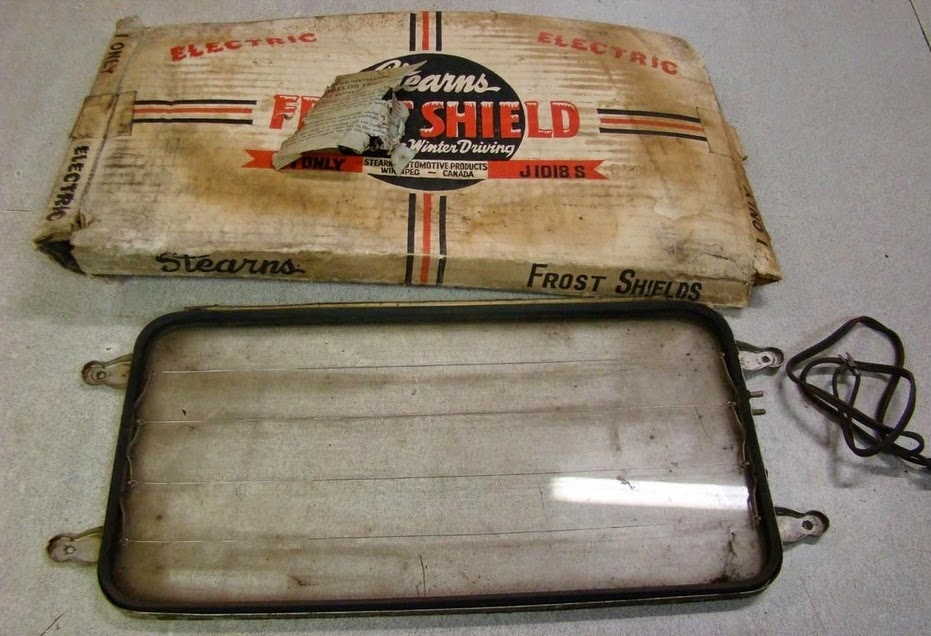
tune-up, along with radiator grill covers and winter anti-freeze.The first shields were actually a thin piece of glass that came with a rubber gasket and a jar of adhesive. It wasn't until the late 1940s that celluloid versions were advertised. Soon after, there were electric versions that used heated wires running through the glass to keep them frost free, (see the image of the Stearn's electric frost shield below.)
November 6, 1948, Winnipeg Tribune
November 30, 1955, Manitoba Free Press
In 1937 it became law in Manitoba that your windshield, rear window and front-row side windows had to be fitted with frost shields from December 1st to March 31st. The law was updated a number of times to tinker with the size and placement of the shields. When spring came, the car owner had the unenviable task of trying to remove what was left of the shield and its adhesive residue.
As windshield defrosters became more commonplace in the 1950s and rear window defrosters in the 1970s, the demand for frost shields diminished. You might be surprised to know, though, that their use is still mandated in Manitoba's Highway Traffic Act:
Frost Shields Required
57(2)
The windshield, rear windows, and windows at both sides of the driver's
seat, of every motor vehicle at all times between the first day of
November in each year and the thirty-first day of March next following,
both dates inclusive, shall be equipped with adequate frost shields of a
size and type that will prevent or minimize the condensation thereon of
moisture in the atmosphere and allow the driver to have a view
sufficiently clear and unobstructed to permit him to operate the vehicle
with safety to other persons and vehicles on the highway, unless the
vehicle is otherwise so equipped or constructed as to secure a like
result.
November 24, 1959, Ottawa Citizen (source)
As you might suspect, Winnipeg
was a hub for the manufacture of frost shields.
Until 1934 frost shields were imported to the province, mainly from the U.S.. That year, the Electric Heating and Manufacturing Company of Winnipeg showed off their patented Ful-Vue Glass Automotive Frost Shield at the Industrial Exhibition.
In the mid-1940s there were at least four
companies that made them. James B. Carter Ltd. (above) was likely the
largest and sold them across the country. Through various mergers the
company became Temro Phillips which still manufactured car interior heaters
in Winnipeg until the plant was closed in 2012.
April 10, 1962, Winnipeg Free Press
In 1951 Del Richardson purchased the name and equipment from the defunct Stearn's Automotive Products of Minnesota and set up shop at 666 Arlington Street. Within a decade they were selling frost shields around the world and considered themselves the largest manufacturer of the product, anywhere. In 1962 the company moved to larger premises at 92 Gomez Street to keep up with demand.
In case you think that frost shields have disappeared into history, they haven't. They are still used in construction equipment, helicopters and out-buildings. The only company I could find that still manufactures them is, of course, right here in Manitoba. Check out Custom Tarps and Filters in Brandon !
Stearn's electric frost shield from ebay
Stearn's frost shield for Mini Cooper from ebay
Subscribe to:
Comments (Atom)