Local News Links:... .........................

Monday, 29 April 2013

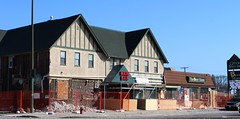
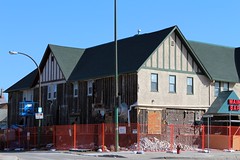
Green Brier Inn getting a makeover

Green Brier Inn renos

Another north Main Street building is getting an exterior fix-up. The Green Brier Inn's location and appearance makes it hard to tell what era it is from so I thought I would take a look back at its history.

It was constructed in the summer of 1930 in what was the Municipality of West Kildonan, just on the edge of Winnipeg city limits. Its original address was 1589 Main. Fred Hammer and Sam Diner were the owners / proprietors.

Green Brier Inn renos

Hammer was owner of the LaSalle Hotel in Elmwood in the 1920s and 30s and a well-known sportsman. Active with the Elmwood Hockey Club, the city's Senior Amateur Hockey League trophy was the known as the Fred Hammer Trophy. He was also long-time president of the Winnipeg Driving Club (harness racing) and ran a winter harness racing track on the Red River behind his hotel in the winter.

Diner was owner of the Nugget Hotel at 711 Main Street and active in many local sports organizations.


May 29, 1926, Manitoba Free Press

The name of the hotel comes from the fact that Frank Shea, of the brewing family, is likely the man who bankrolled the venture. His father Pat bred Clydesdales that not only pulled his beer wagons, but won championships around North America (and were sold to Budweiser shortly before his death)

Frank's passion was racehorses. Through the 1920s and early 1930s his Green Brier Stables dominated the local horse racing scene and won many races around North America, (also see here and here). 


 1935 Manitoba Amateur Diamond Ball Assoc. program (source)

Though the stables and hotel were spelled Green Brier, it is often be found spelled Briar in media articles and sometimes even their own classifieds and other ads as above.

In the early 1940s the address was changed to 1611 Main Street as a service station was added to the property called the Green Brier Service Station.


January 9, 1965, Winnipeg Free Press

In 1965 the hotel was renovated to include a new Briar Patch Room and larger coffee shop.

Tuesday, 23 April 2013

A new approach to Winnipeg's SROs ?

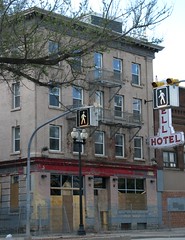
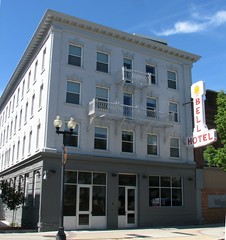
Bell Hotel1b043

Three years ago today it was announced that the empty Bell Hotel on Main Street would undergo a $6m renovation.

Built in 1906, it was spared during a purge of many Main Street's single-room occupancy (SRO) hotels in the late 1990s which saw places like the Leland, Brunswick,and Savoy closed and torn down. The belief was that if you simply removed the number of bars and undesirable residents then the area would rejuvenate. That, of course, did not happen.

Cities like New York, L.A. and Vancouver have been taking different routes in dealing with SROs. Realizing that they were an important part of the housing market, they worked with non-profit organizations to renovate them into assisted housing and in place of the hotel bar offer social or community services. (For more on this read my 2008 post The Winnipeg SRO Hotel.)

Despite the fact that in 2005 there were about 1,000 people living in Winnipeg SROs, many of them by choice, we've been late to catch on to this ... until the Bell.

The hotel reopened in April 2011 as 42 residential units for people at high-risk of becoming homeless with social service offices on the main floor. Since that time, the Merchants Hotel was closed and is expected to return as a mixed-use development. Also, the St. Regis was taken over and continues to operate without a liquor license.

Maybe we're catching on that there's a better way of dealing with our SROs.

Related:
A history of the Bell Hotel Winnipeg Downtown Places
The Winnipeg SRO Hotel West End Dumplings

Thursday, 18 April 2013

These lights made me do a double take


Union Tower
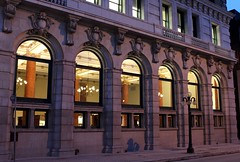
I was leaving the Winnipeg Architecture Foundation's website launch at city hall last week and had to do a double take when I saw a fully lit (and functioning) main hall at the Union Bank Tower, now the Paterson Globalfoods Institute.

Union Bank Tower
The hall was a Union Bank, then Royal Bank, branch until about 1992 when it moved to a newly built location at Main and James. For a couple of decades it sat in darkness and is now Red River College's Jane's restaurant.

Related:
RRC's old gem a beauty Winnipeg Free Press (April 2012)
Union Bank Tower Historic Buildings Committee Report

Sunday, 14 April 2013

47 Arlington Street is up for sale !


Every building has a great story (or two or 5) to tell. When I learned via the Twitterverse that the  unique looking house at 47 Arlington Street is up for sale, I just had to dig in.

Its appearance suggests that it once was a grocery store. For whatever reason, that clay tile roof motif was used throughout Winnipeg by grocers in the 1920s, be they independents or part of a chain. In fact, when Safeway set up shop here in 1929 they adopted it as well.


In the first week of January 1922 a building permit was granted to Arni Eggertson for the erection of a $5,000 brick store on the east side of Arlington Street just south of Wolseley Avenue. You might think that this is an odd location to put a store and 101 years ago Wolseleyites felt the same.

A "large delegation of residents of the district" turned up at the January  25, 1922 Public Safety Committee meeting of council to demand that construction be stopped and that this portion of the street be declared a residential zone. The city couldn't do either on the spot so the community mobilized.


March 23, 1922, Manitoba Free Press

Residents created a petition and submitted it at the following week's city council meeting demanding that a bylaw be passed to make Arlington Street from Wolseley Avenue to the Assiniboine River a residential zone. They ensured that delegations showed up at each committee along the way and they finally go their wish on the evening of May 22, 1922.

As for the construction, residents went to court and got a temporary injunction against Eggertson. On March 15 the Manitoba Court of Appeal held a special session to rule on the issue. I cannot find newspaper coverage of the outcome but, as you will see below, the store eventually got built. 

 
 January 24, 1924, Manitoba Free Press

George Capatas' Arlington Grocery opened - without fanfare - in late 1922 or early 1923. The Capatas family also lived on-site. Perhaps because of the hard feelings, the store barely lasted a year and by December 1923 it was up for sale. 

In the years to come, others would try and fail to make a go of it. In 1924 it was Getty's Grocery, in 1925 it briefly became part of the local Neals Foods chain, in 1929 - 30 it was B. Wing's Yorkshire Grocery, in 1931 Victory Tailor Shop and in 1932 Roy's Handy Shop.

Osmond ca. 1959

In the late 1930s one man finally found success. Harry Osmond opened Osmond's Grocery and his family lived on-site. His son, Harry Jr., was an award-winning science grad from the U of M and daughter Harriet ("Babe") worked in the store with her father.

By the early 1950s Harry was in his 70's and retired. Harriet took over the store and she and husband Henry Michaelis moved in with Harry. 

In the mid 1950s the store became Osmond's Solo Store and by 1960 it was back to Osmond's Grocery. It was operated by Harriet and Harry until at least 1985. The store had been held up six times between 1978 and 1985, twice with knives.

I can't find when Harry died. Harriet died in 1987 and Henry in 1993.

As Neals Store ca. 1925


As Solo Store ca. 1954

So, there you go. If you want to own a house that's not only super-funky but has also changed the nature of the street that it sits on, be sure to check it out !

Thursday, 11 April 2013

Winnipeg Architecture Foundation website launch


Tonight the Winnipeg Architecture Foundation will be launching their website. It will focus on the modernist era architecture and architects. 

The launch party takes place at City Hall at 7 pm. For more info check out their Facebook page!

Monday, 8 April 2013

50th Anniversary: Margaret Konantz O.B.E., Manitoba's first female M.P.


1962 election campaign, Winnipeg Tribune Archives

On April 8, 1963 Manitoba elected its first female Member of Parliament in the riding of Winnipeg South. Margaret Konantz (née Gordon) was born in Winnipeg in 1899 and grew up on Nassau Street in a household dedicated to volunteer work and public service. There was also a political twist; her mother Edith Rogers was elected Manitoba's first female MLA in 1920.

George and Margaret Konantz ca 1944, Winnipeg Tribune

In 1922 she married American businessman George Konantz and the couple settled in Winnipeg. Margaret dedicated herself to volunteer work with organizations such as the Junior League of Winnipeg, Community Chest and Winnipeg General Hospital. (She also became a top-level amateur golfer and skier.)

It was during World War II that her knowledge of volunteer organizations and interest in international affairs took her to the global stage.

In 1940 she organized Winnipeg's wartime Central Volunteer Bureau. Two years later she created the "Block Plan", a system by which salvage metals and other scrap was collected from Winnipeg homes for the war effort. Winnipeg's program received accolades from around North America and became the prototype for a Canada-wide system. (For more on this see Perrun.)


Konantz was sent to Britain by the federal government in 1944 to study both wartime and civilian volunteer services in that country and bring ideas back to Canada. 

For her body of wartime service she was awarded the Order of the British Empire

In 1961 she became the Canadian vice-president of the United Nations Association, an organization that she would remain involved with for the rest of her life.

1963 election ad, Winnipeg Free Press

Konantz's first run at federal politics was in the June 1962 general election against Gordon Chown, the Conservative incumbent who won the previous election by 20,000 votes. The campaign was a folksy one, full of photo ops and upbeat rallies. Big policies and the names of party leaders Pearson and Diefenbaker were barely mentioned.

On election night Konantz and Chown traded the lead a number of times. By 10:00 pm the numbers had turned in favour of Chown and he took seat by a 500 vote margin.

1964 election ad, Winnipeg Free Press

John Diefenbaker led his conservatives from the largest majority in Canadian parliamentary history to a minority. Konantz kept up her political profile by speaking publicly on national issues, knocking on doors and holding regular meetings with her campaign team. It paid off as less than a year later Canadians were back at the polls.

This time around Konantz's campaign tackled bigger issues. She called for more scholarships and bursaries, greater foreign aid and a national welfare program. She used her connections with Winnipeg's volunteer organizations to speak at dozens of luncheons and special events during the campaign period.

This new strategy brought her a great deal of positive press. Just four days before the election the  Winnipeg Free Press carried a column on their editorial page by Ellen Simmons:

Behind the showmanship is a serious, dedicated woman whose record of public service  - for her community, her city, her province, her country – has long been recognized…. Her record demonstrates with unmistakable clarity her concern for people…. She wants to see Winnipeg take its rightful place in national affairs and Canada its rightful place in international affairs.

April 9, 1963, Winnipeg Free Press

The race was a tight one but this time Konantz beat Chown by less than 500 votes. She became the first woman in Manitoba's history to take a seat in the House of Commons and just one of four women elected across the country. 

As a rookie M.P. she stayed on the back bench but sat on high profile standing committees, including External Affairs, Agriculture, and Banking and Commerce. 

In 1964 Konantz was a member of the high-profile and controversial "Flag Committee" tasked with recommending a new flag for the country. While there was strong national sentiment to retain the red ensign, she put her support behind a red and white design featuring a single red maple leaf.


It was her work with the UN that kept Konantz in the national spotlight. She toured the country speaking about UN initiatives and in 1963 went to New York to address its Economic and Social council. In 1965 she was part of the delegation that went to Oslo, Norway to receive the Nobel Peace Prize on behalf of the organization. 

Canadians were back at the polls in November 1965 and Konantz lost her seat to Conservative Bud Sherman. She told reporters that she was done with politics and would instead concentrate her efforts on her international work.


Konantz became the chair of Canada's United Nations Committee which took her around the world. When back in Canada she toured the country speaking about the organization's work. On May 11, 1967, while in Fredericton, New Brunswick preparing for a radio show, she died of a heart attack at the age of 68.

Margaret McIntyre Konantz O.B.E. was predeceased by her husband in 1954 and survived by two sons and one daughter. She is buried in St. John's Cemetery.

Tributes:

Her death came just days before she was to receive an honourary doctorate of law from the University of Manitoba. It was presented posthumously at their May convocation.

A Free Press editorial of May 12, 1967 stated: The world would be a much better place if more of us put as much dedication and energy into trying to improve it as did Margaret Konantz

On the floor of the House of Commons Bud Sherman, the man who defeated her in the previous election, rose after the reading of the Throne Speech to pay tribute to his one-time opponent: I had the privilege of running against Margaret Konantz in the autumn of 1965 which resulted in the myth that I defeated Mrs. Konantz.... No member who served with her in this House or in any capacity in the community or in the nation during her lifetime would say that I or anybody else ever defeated Margaret Konantz.

Related:
Margaret Konantz Fonds University of Manitoba (which includes a detailed biography)
Margaret McTavish Konantz Parliamentarian File
Women and Elections Simon Fraser University
Women in Parliament Parliamentary Library of Canada

Friday, 5 April 2013

Home Maintenance Services for Seniors

Minnedosa, Manitoba

Spring is coming and that means dozens of little jobs around the house and yard. Here's a program that you, a neighbour or a loved on might benefit from: Good Neighbours Active Living Centre Home Maintenance Program

It is a city-wide program aimed at those 55+ who need assistance at reasonable rates with a range of tasks including: housekeeping; meal preparation; painting; carpentry; yard work; minor electrical, plumbing and handyman jobs. Even in-home computer lessons !

I also see that the city has an index on its website dedicated to their Age Friendly Services, including snow clearing, walk-up garbage collection and home-bound library visits.