............................

Saturday, November 28, 2009

The More Things Change ... Cycling Paths in Winnipeg

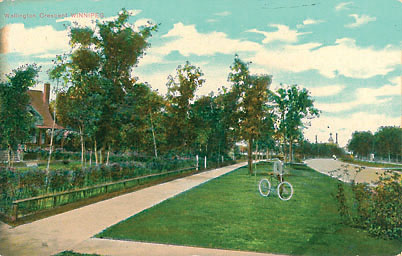
During our first Cyclovia this summer it struck me that when it comes to the issue of bike lanes and paths we must be reliving the past given that bicycles predate automobiles. Here's what I found...

The first group dedicated to cycle paths was 1898's Cycle Path Association. The above notice is from the Morning Telegram March 29, 1899. That's not a bad lineup of prominent citizens !


Edward L. Drewery & Frederick W. Drewery

The first president of the Cycle Path Association was Frederick W. Drewery. He and his brother Edward, both of Drewery's Brewery fame, believed in the benefits of outdoor life in the city regardless of what area you lived in. Edward was chair of the first parks board and is credited with establishing many of Winnipeg's first parks from tot lots to St. John's and Central Park. Frederick also chaired the parks committee and was an avid cyclist.

The executive committee of the Cycle Path Association met each Friday night at 8 pm in the curlers' area of the Criterion Hotel restaurant on McDermot Avenue. The committee had a lot of work ahead of it. In a rapidly growing city where newcomers sometimes resorted to living in tents until housing and related city services could catch up, paths for cyclists were not on the agenda.


Jarvis Ave between Main and King c.1908

Many roads were little more than trails ravaged by cart wheels and the annual freeze-thaw. Even on roads that were maintained, little thought was given to creating a smooth finish to the outside of the kerb lane. Often it was a place to pile construction debris and items that fell, or broke, off of passing carts. Telephone and hydro poles were often haphazardly installed along the roadside where cyclists wanted to travel.


Unknown Manitoba cyclist looking tweedy ca.1900

Here are some 1900 biking terms as used by the media of the day. Bicycles were referred to as 'wheels'. Cyclists were referred to as wheelmen or wheelwomen. The term for an arsehole cyclist was 'scorcher', i.e. "it's the scorchers who cause a danger to everyone on the paths". A bike thief was a 'picker'.


Wheeling past debris, McDermot Ave c.1900

In their first year of operation the Cycle Path Committee spent nearly $800 on paths and $300 on related greenery. They also lobbied the city and provincial governments for better standards and guidelines for paths.

Most of the start up money came from donations and, later that year, from the selling of 50 cent 'membership badges'. The thought behind the badge as introduced at their March 1899 meeting:


'With thousands of wheelmen and wheelwomen in the city it was thought that much in the way of improving roads and constructing paths could be done if those interested could be induced to act in unity, and at a very small cost to any one person'.
Manitoba Free Press, Mar 24, 1899

Aside from improving conditions for cyclists the badge would also act as a combination licence plate / 'CAA-type' membership. If a bike was stolen or being driven improperly you could track it using the badge number. Badge owners were entitled to discounts at certain businesses and could offer a reward of $10 for information leading to the conviction of someone caught stealing a bicycle or $5 for someone caught stealing part of a bicycle such as a bell, basket, pump or wheel (source).


Wheelwomen ca. 1900

The year 1900 was a big one for the Cycle Path Association.

A number of trails were in progress or set to be worked on: Kennedy Street to Osborne Street Bridge; at the CPR tracks on Main Street; on Silver Heights Road; one extending from the foot of the Norwood Street bridge; one from the CPR to St. John's College in the North End.

The long-term goal was to see separated, 14 foot wide paths with gas lighting throughout the city and marked paths that extended out to to Selkirk, Birds Hill and St. Norbert.


In 1900 the Cycle Path Association sought to institutionalize the bicycle 'tag'. Rather than just rely on fee from association supporters they knew that it had to be city-wide to have an impact. The scheme would be similar to what Minneapolis had done the year before: a mandatory bike 'tax'.

The next general meeting of the Cycle Path Committee was on April 12, 1900 at the Council Chambers of city hall. It was noted by the Telegram that only 19 people showed up. Here the committee presented their cycle tag plan to the public.

The debate that followed on the floor, in the papers and among council members was similar to what you would see today. Some felt that they already paid taxes so why should they have to pay more - they were being discriminated against as bicycle riders. Others felt that taxing all bikes was unfair as many used them simply to get to work and back on existing roadways, not for pleasure rides on fancy trails. Still others felt that it was a necessary evil to allow the work that had already gathered momentum to continue.

Drewery defended the paths pointing out that this was not going to be a network of pleasure paths. They were intended to accompany major traffic routes and into industrial areas of the city as well. He gave as an example Logan Avenue which would have a separated path running down each side "
...so that the working man could go to his work on them.... In twenty-five trips he could save, by (street) car fares, the price of the tax". Another member pointed out that if all bicycles were licenced "...then when a hunch backed scorchers came along at a pace dangerous to everyone, his number could be taken and the owner fined."

In the end, the committee approved a motion to approach council with the tag idea.

The next day the Morning Telegram scoffed at the thought that the city's 8,000 cyclists would bother to pay a 'tax' but did concede that they were not getting treated equally by the city. Actually, reading the Telegram's editorial about the debate it could have been written in 2009 !

The debate moved to city council but a motion to create a Cycle Path Board failed in 1900 and again in 1901. A second attempt in 1901, with a simplified version of the scheme, worked. The city agreed on April 15, 1901 to create a cycle path board, similar to the parks board. They would provide a small office office at city hall, a special constable (Warren Biggs) and authority to spend the fees collected from the cycle tax to improve cycling in Winnipeg - an expected $3500 per year.

The board members included the likes of T. G. Mathers, F. W. Drewry, A. M. Gossell, W.G. Bell, G.F. Bryan and a council members Alderman Caruthers.

With that vote the original Cycle Path Committee effectively ceased to exist.


Tag receipt (City of Winnipeg Archives)


1902 'tag' for more see manitobaplates.com

The sale of tags went well but took some work. In 1902, 6300 badges were issued. That rose to 8370 in 1903. Not bad considering that the board estimated there to be around 10,000 cyclists in the city.


Enjoying a 'wheel', Market Av c 1900

In 1904 sales lagged. By April only 4500 badges had been sold. The board decided to hire Thistle Curling Club skip L.R. Mackenzie on a part-time basis to free up Constable Beggs, the 'Terror of the Scorchers', to "
...be freed from the office to round up dilatory wheel owners and other delinquents against the laws of Winnipeg regarding fast riding, traveling on sidewalks and other overt acts against the public safety" (source). Some of Beggs' stories of investigatory intrigue can be read here and here.

It worked. By the end of the cycling season 1904, a record 8541 tags were sold and 200 stolen bikes were recovered.


Morning Telegram, December 31, 1906

The committee continued on the creation and maintenance of cycle paths through to the summer of 1906. That year city council made the decision to begin the wide-scale paving of roadways. Pavement made the need for much of the board's work redundant. It was felt that the trails they had built from scratch, being mostly on city owned greenspace, could be handled by the parks board. The Cycle Path Board dissolved itself.

One thing that wasn't dissolved was the bicycle tag. The city maintained the tag and fee until 1982.


Warren and Mary Beggs in 1943

Warren Beggs, the 'Terror of the Scorchers', would continue with policing and from 1908 to 1920 was chief of the St. James police department. After retiring from the law the Northern Ireland native went back to work for various departments within the city and retired in 1946. Beggs, a resident of Atlantic Avenue, died in King Edward Hospital on September 29, 1957 at the age of 91.

3 comments:

Buflyer said...

awesome reseach and article!

DMSMCA said...

I love this article, and your whole blog! Your research, perspective and style are truly appreciated.

mrchristian said...

Thanks guys. I enjoy doing them. So much history, so little time to research !