Local News Links:... .........................

Tuesday, 29 May 2012

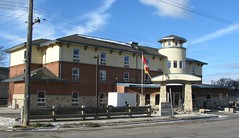
Selkirk Avenue's Bell Tower

Selkirk Square

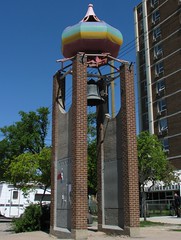
Selkirk Avenue's bell tower has been receiving a lot of attention lately. In late 2011, following a series of violent incidents in the area, Aboriginal Youth Opportunities began holding Meet Me at the Bell Tower events every Friday at 6 pm. It's been the scene of speeches, rallies, memorials and musical performances every week since. (Also see Winnipeg Free Press' Bell tower ringing in change and Metro's Youth Group Puts Out Challenge.)

The bell tower as a symbol of rejuvenation and change is nothing new. When it was first created back in 1984 that's exactly what it meant to be. Here's a look back at the tower and the very historic bell that's likely two decades older than the record states !

Winnipeg Free Press, February 28, 1984

In 1985 Winnipeg's Core Area Initiative (part 1) was in full swing. It was a five-year, $100 million program funded by the three levels of government to tackle social, housing and economic development issues in inner-city Winnipeg. Under its Main Streets Improvements initiative, Selkirk Avenue was chosen for a $685,000 restoration, (after matching grants to landlords was included the total was over $800k.)

The money went to everything from exterior fix-up grants for landlords to the widening of sidewalks and the replacement of street furniture such as benches, light standards and planters. The most ambitious project, though, was Selkirk Square.
Selkirk Avenue, Winnipeg
 South side amphitheatre (demolished 2011)
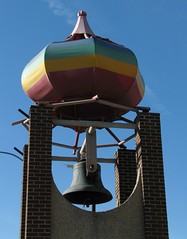
Selkirk Avenue Bell Tower, Winnipeg

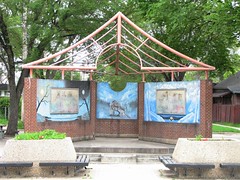
Selkirk Square required closing off Powers Street at Selkirk Avenue (Google map) and created a pedestrian plaza area. The south side of Selkirk  became an amphitheatre and seating area while the north side featured a bell tower to act as a landmark and meeting place.

It's one thing to build a bell tower but another to find a large bell lying around to use in it. Planners went on a hunt that ended in the basement of the Museum of Man and Nature (no Manitoba Museum) where one of the most important bells in the city's history was in storage.

City Hall 2 ca. 1900. Source: Winnipeg Tribune Archives
Newspaper accounts from the time said that the bell was cast in 1889 and installed in Winnipeg's City Hall (number 2), the Gingerbread House. That is only partly true.

When I looked back to find a story about the bell's installation there were none. This is odd considering that any small town or church getting a new bell made the newspapers. City Hall was built in 1886 so installing a 1,600 lb bell into the tower three years later would have required some very conspicuous work to be done. I dug back further into the news archives and found that this is actually the city bell from 1877.


A city bell acted first and foremost as a fire alarm. Winnipeg did not get a full-time fire brigade until 1882 so it relied on volunteers, property owners and the public to be alert and to help save lives, livestock and property. The city did have a fire bell of some sort previous to this but in May 1877 council passed a resolution for the clerk to order from St. Paul, Minneapolis a 1,200 lb fire bell that cost no more than $220. 

On June 23 1877 a 1,600 lb bronze bell cast by Meneely and Kimberly of Troy, N.Y. arrived aboard the steamship International.
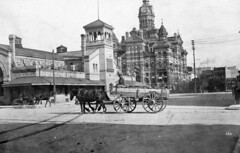
 Old Market and City Hall
Market Building (foreground), City Hall at back (source)

The bell was first installed in the Market Building behind city hall and used for much more than fires. For over two decades it rang at noon time, fifteen minutes before stores closed (on weekdays by 7 pm for dry goods merchants and 8 pm for grocers, Saturdays at 6 pm for everyone), and fifteen minutes before school started. There were also special occasions such as when the funeral corteges of prominent citizens passed city hall on the way to or from the train station and when political figures (like John A. McDonald) died.

There was even an official bell ringer ! The first was Harry Kirk, a jack-of-all-trades at city hall (caretaker, repairman, gardener, security guard) and a cleaner at the Market Building. He had to live on-site 24/7 so was given the responsibility of making sure that the the bell rang on time.

April 15, 1903, Manitoba Free Press

In 1889 the bell was removed when the Market Building was being rebuilt but re-installed afterwards, which is likely why 1889 is said to be the year it first arrived, but it was the same, old bell.

In 1903 the bell's main function as a fire alarm was made redundant by a full-time fire brigade and the increasing numbers of telephones in use. That same year the city was doing some major construction in the city hall tower: they were finally installing a clock. While the tower was open the bell was inserted. The much anticipated and expensive clock installation overshadowed coverage of the bell's new home. (To find out what happened to the clock and its chimes !)

The bell was seldom rung from its new location as someone had to climb the 150 - 200 steps to the tower to ring it.The idea of an electric bell-ringing switch was considered in 1903 but I can't find any evidence that one was ever installed.


When city hall was demolished in 1961 - 62 the rickety dome was the first thing to go. The bell was saved and ended up at in storage at the museum. The clock mechanism was saved and after decades in storage was installed in Edmonton Court at Portage Place.

May 12, 1991, Free Press Weekly

Back on Selkirk Avenue, the bell was installed into the new bell tower and on Friday June 21, 1985 Don Durchak, 86, who lived in the adjacent seniors housing tower at 145 Powers Street, rang it to signal the opening of Selkirk Square.

The Selkirk Avenue Business Association (SABA) sponsored Friday farmers markets and weekend events such as walking tours and concerts at Selkirk Square until 1991.

In 2010 the city put out a tender to have the farmers market / amphitheatre structures demolished in order to eliminate blind corners and to prepare the area for a new bike / pedestrian path.

Sunday, 27 May 2012

This Doors Open I visited a Martyr !

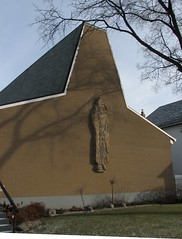
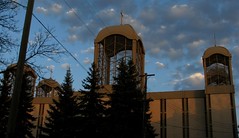
North End church bell tower

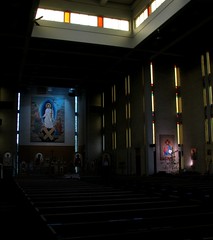
A limited amount of Doors Open time this year so I went to St. Joseph's Ukrainian Catholic Church on Jefferson Avenue. I drive by it often and on a couple of occasions have pulled over to get a photo of its domes but had never been inside.

This year is St. Joseph's 60th anniversary so I thought I'd see it from the inside and find out more about Bishop Velychkovsky Martyr's Shrine located there, (and celebrating its 10th year.)

St. Joseph's

The church was constructed in 1962 and is a beautiful, peaceful space. What I found most interesting is that rather than being filled with relics of old, this church is still a work in progress.

St. Joseph's

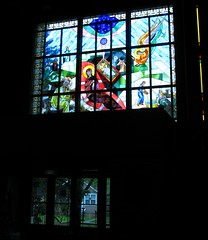
Many of the mosaics date to 1987 (its 25th anniversary), the Iconostas are just a couple of years old and the large stained glass window of the nativity over the entrance is from 2010. Over the next year the inner dome will be replaced with a stained glass skylight.

Velychkovsky ca. 1973 (source)

St. Josephs is also home to the Bishop Velychkovsky Martyr's Shrine.

Vasyl Velychkovsky was from Ukraine and jailed numerous times by Soviet authorities for practicing religion. He was banished from his homeland in 1972 and came to Winnipeg but died after just a year due to lingering injuries resulting from the torture he received while in prison.

St. Joseph's

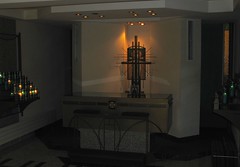
He was buried at All Saints' Church but after being beatified as a Martyr in 2001 by Pope John Paul II, his body was exhumed and enshrined in the chapel in St. Joseph's. The small museum next to the chapel provides detail about the mans life.

It's an interesting look back at a brief piece of Winnipeg's Ukrainian not-too-distant past. I'm definitely glad I went !

Thursday, 24 May 2012

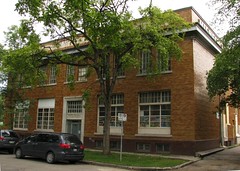
Kelvin High School turns 100 ! A look back.


This weekend is Kelvin High School's 100th anniversary reunion ! Here's a look back at the original Kelvin Technical High School.


Source

Until the early 1900s most Winnipeg collegiates (known as technical schools or institutes) operated out of existing schools that served a wider range of grades. For the older students, the curriculum combined traditional education subjects with basic technical training for boys and domestic sciences for girls.

As these existing schools became overcrowded and the technical requirements of the workplace increased, it was decided that a stand-alone, technical collegiate was required. In January 1909 Winnipeg's school board voted to spend $200,000 for a facility that would serve the entire city. The favoured location was on the site of the Victoria School on William Avenue, (where Victoria Albert School now stands.)


Winnipeg Free Press, March 10, 1909

The plan immediately ran into opposition. Some felt that two smaller schools would provide a better education environment. Others were concerned about transportation issues for children coming from far-flung areas of the city. Parents in the south end were also concerned with the types of people their children would have to encounter:

"Strong representation was made on the grounds of the moral welfare of the children, special emphasis being laid on this point. The class of buildings in the immediate vicinity of the site chosen, the presence of so many undesirable persons in the district immediately to the north..." 
Winnipeg Free Press, March 10, 1909

By the end of the summer the school board gave in and voted to construct two identical buildings, one on Machray Street in the North End and one on Academy Road.

Under construction, Winnipeg Free Press, Nov. 11, 1911

The 160,000 sq ft, four storey red brick buildings were designed by provincial architect J. B. Mitchell. On June 16, 1910 the $200,000 contract (plus $65,000 for heating and plumbing work) for the Academy Road school was awarded to Tremblay and Company which had recently built Greenway, Lord Roberts and St. Boniface schools.


Winnipeg Free Press, September 20, 1910

As for naming the new collegiates, tradition dictated that they should be named for a saint or British Lord. There was, however, strong support for choosing a local such as Daniel McIntyre  or Robert Cochrane. In the end, the school division stuck with tradition: the north end collegiate would be St. John's and the south end's Lord Kelvin.


Sir William Thompson, or Lord Kelvin, was a pioneering British physicist and mathematician who had visited Canada on a number of occasions, (though, it appears, not Winnipeg.) Though his body of work was wide-ranging, today he is best known as the man who founded the absolute temperature scale or Kelvin Scale. The Free Press wrote of Thompson:

"He was considered the highest type of physicist, since he combined the powers of mathematical reasoning with the inventive faculty and manipulative skill of the experimentalist."
Winnipeg Free Press, September 20, 1910.


By December 1911 the first floor of the school was ready for students. It was decided that the eight senior classes from Laverandrye School, then known as Laverandrye Collegiate Institute, would move in over the Christmas holidays. David M. Duncan, Laverandrye's principal became Kelvin's first principal, (though by the time the school's first full year began in September he had been appointed Assistant Superintendent of public schools under Daniel McIntyre. His successor was Elwood Garratt.)

The remainder of the school was completed over the summer. The main floor contained offices and shops for carpentry, mechanics and electrical with a small foundry in the basement. The top floor was the home economics area with rooms for sewing, cooking, food laboratories and typing.

Winnipeg Free Press, October 1 , 1964

By the mid 1950 the school was entering its final phase. It had fallen into disrepair to the extent that the tower was removed in 1957 due to concerns about its stability. In 1963 an addition was added to provide more classroom space but plans were already underway for a new building, (the 1963 addition was incorporated into the new school.)

On October 28, 1964 a $2.7m money referendum to replace both St. John's and Kelvin passed 16,274 to 12,032. Construction began on the new buildings soon after and the new Kelvin officially opened on November 19, 1965.

 Winnipeg Free Press, October 23, 1965

The final event held in the old Kelvin Technical High School was a tea for students, staff and alumni on October 21. 

After that, parts of the memorial alcove were removed: a memorial book, guard rail and stained glass window that reads "Courage, right. love of truth." On the alcove's walls were painted the names of every students who served in the World Wars with gold stars next to those who did not return, (55 of 527 in WWI and 225 of 2,640 in WWII). The walls came down with the building.

Winnipeg Free Press, April 23, 1966

In December 1965 the $34,500 demolition contract was awarded. The building was torn down in the late winter and spring of 1966. 

For more about Kelvin's history:
Kelvin High School History Wpg School Division (pdf)
Kelvin High School Manitoba Historical Society

Wednesday, 23 May 2012

Let's blog a 150th birthday gift to Portage and Main ! UPDATED

UPDATE: The intersection DID have a 150th birthday party after all ! Gordon Sinclair Jr. of the Winnipeg Free Press picked up my blog post and wrote Shouldn't we get the party started ? Creswin Properties, owner of 201 Portage Avenue on the corner where it all started, stepped up and served cake and a musical interlude over the lunch hour to celebrate !

Portage and Main
Last week I asked people to post birthday wishes, images etc. for the famous intersection's 150th birthday. Here are the results so far.

From bloggy types, staring with mine:
- 7 stories about Portage and Main West End Dumplings
- Happy Birthday Portage & Main Love Me, Love My Wpg
- Portage and Main Turns 150! Slurpees and Murder
- Happy Birthday Portage and Main Winnipeg O' My Heart
- Happy Birthday Portage and Main the cold cold ground
- Portage and Main ca 1881 Rise and Sprawl
- Portage and Main 150 years strong Observations, Reservations, Conversations

From media-y types:
- Portage and Main turns 150 Breakfast Television (includes interview with me!)

From other groups, institutions:
- Heart of City turns 150 Heritage Winnipeg

Some oldies but goodies:
All roads lead to Portage and Main Wpg O' My Heart
Check out my Portage and Main Flickr set ! 

Original post (from May 23, 2012)

Portage and Main ca. 1872 (Heritage Winnipeg / J. Penrose)

The intersection of Portage and Main turns 150 on Saturday, June 2, 2012 !

It was on June 2, 1862 that Henry McKenney and John Christian Schultz finalized the deal for an out-of-the-way patch of land at the north -west corner of the intersection of two cart trails. They built their commercial establishments there, others built around them, and the rest is history !

So what birthday gift do you get for an intersection that has everything, (except pedestrians ?) How about something of the online variety?

Portage and Main
Street Hockey, May 31, 2011

Fellow bloggers - and other online types - how about we blog some birthday wishes?  

On Friday, June 1 post about Winnipeg's most famous intersection !

Post photos, historic images, tales from the past, a favourite story or perhaps what you'd like to see happen to it once the 40-year deal that closed it to pedestrian traffic expires in 2017, (which, in public works terms, is just around the corner.)

Also see: Shouldn't we get the party started ? by Gordon Sinclair in the Free Press

Tuesday, 22 May 2012

Burnell Street and St. Paul Avenue, building by building

This is part three of a three-part series on the history of Burnell Street in Winnipeg. I am looking at the section from Portage Avenue north to Ellice.

Part 3: Buildings and sites along Burnell and St. Paul


Above is a map of these locations or, if you prefer, follow along on Google Street View.

Portage near Burnell
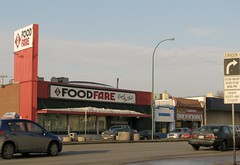
Safeway / Harry's Foods / Food Fare (1951)

Old Safeway
The Portage and Burnell area had a long association with Safeway. When the U.S. retailer came to Canada, (first setting up shop in Winnipeg), it opened dozens of stores from 1929 - 31, including one near Burnell and Portage.

In 1950 the chain announced the introduction of new "ultramodern" stores with adjacent parking lots to replace them. Both eras of Safeway stores stand almost side by side on Portage near Burnell.(For more on Safeway's history in Winnipeg.)

In October 1985 Safeway closed this location and moved to Polo Park. It was sold to a Safeway store manager named Harry Halbesma who opened Harry's Foods. In 2007 Harry's closed and it became a Food Fare.

255 Burnell Street
Nairn Motors / Burnell Motors (1946, 1979?)

In July 1946 Nairn Motors Ltd., which began on Nairn Avenue in the 1930s, opened a dealership and service centre at 255 Burnell. In 1959 the name changed to Burnell Motors: "Your British Car Care Centre".

Bill Brown Bill Brown was the owner from 1964 until 1971. He then left to buy Motor Sales Ltd. In 1979 Motor Sales and Burnell Motors merged and the Burnell Street location closed.

Over the years Nairn / Burnell was an official dealership of Rootes / Hillman, Triumph, Austin, Leyland, Rover and in in 1964 became Manitoba's authorized dealer and service centre for Rolls Royce

By 1979 the site was almost an acre in size, consisting of a sales building (now demolisehd) and lot. The current building was likely built in 1979. It was a Minit Tune garage until 1982 then Colony Auto Propane and Car Service until 1989.


Soon after, Harry Halbesma of Harry's foods bought the site. It was storage and for a brief time Harry's Urban Market. In 2005 Harry's offered to purchase the lane way between the store and 255 Burnell to allow for a store expansion but that was rejected by the city.

The building is back to its automobile roots as Terra Auto.

258 Burnell Street
Former Canada Bread Bakery (1912)

Former Canada Bread Plant
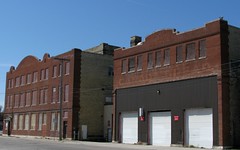
In 1911 the Canada Bread Company based in southern Ontario began an expansion spree to become a national bakery. This plant (left) and stables / garage (right) opened November 1912 and baked bread, buns and cakes until October 1988. It is now vacant. For more on the building see Burnell's Bakeries.

270 Burnell Street
Canada Bread Field (1926 - 39)

North of the stables from 1926 - 1939 was a baseball diamond called Canada Brad Field. It was home to the Winnipeg Commercial Diamond Ball League, Canada’s largest commercial baseball league with 17 teams. (Commercial leagues as in company teams played each other: Eaton's vs Dingwall Drugs etc..

280 Burnell Street
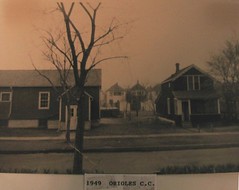
West End Orioles Athletic Club (1936 - 1947)
Valour Memorial / Thistle Curling Club (1948)

The Forerunner to Orioles Community Centre began as a single rink with two old boxcars as a clubhouse. Despite these humble surroundings they became a provincial hockey powerhouse thanks to coach Hoss Nicholson. (For more on the early Orioles and Nicholson.)

Thistle Curling Club
In 1948 the land was sold to the Valour Road Legion for them to create a new hall and curling club. Construction began in June 1948 and it opened on December 15. When the Thistle's club burned down in 2005, Valour and Thistle merged under the Thistle name.

290 Burnell Street
Winnipeg Builders Exchange (1957)

Former Winnipeg Builders Exchange
This building was designed by Wasiman, Ross and Associates. Its original features included an open air courtyard, (now filled in), and a 12 x 12 foot mosaic by artist Takao Tanabe, (sill there.) For more on this building.

301 Burnell
White's Trucks (1920s - 1940s)
Grey Goose Bus Lines (1952 - 2008)

The first ad to appear at this address was for White's Trucks, which existed from the mid 1920s to late 1940s. They serviced trucks and built truck bodies.

In 1952 Grey Goose, along wither her sister bus lines Thiessen and Transcona, moved in. The building has been renovated and rebuilt in stages over the years and it is unclear if any of the existing buildings exist. When Greyhound, owner of Grey Goose, was purchased by First Bus in 2007 the Goose name was amalgamated and the garage closed. The fate of the building, still owned by Greyhound, is uncertain.

I will have more on Grey Goose and this building in a future post.

310 Burnell Street
Kivalliq Inuit Services (2003)

Kivalliq Inuit Centre
This is a 128-bed boarding house for people from Nunavut coming for medical treatments. It's privately owned but operates under contract to the Nuncvut and replaced an existing facility on Stradbrook.

The architect, Robert Wrublowsky of MMP Architects, traveled to the north to look at examples of northern buildings before designing the space. Inside and out it is supposed to allow people from remote communities to feel that they are coming to a familiar place.

320 Burnell Street
Bryce's Bakery (1930 - 1967)

John Bryce and his sons opened this large bakery in 1930. The family ran a small bakery in Dauphin before coming to Winnipeg in 9122 to open their original commercial bakery at Nassau and Gertrude. For more on Bryce's Bakery.

365 Burnell
St. Anthony of Padua Church (1964)

St. Anthony of Padua Church
The original St. Anthony of Padua church dates back to at least 1951. In 1964 the church and rectory were sold, moved off-site and this church built. Over 500 people attended the dedication on December 20, 1964. It was (is ?) the only Hungarian Roman Catholic parish in the city.

372 Burnell Street
New Method Laundry (1923 - 1957)
Canadian Linen and Uniform (1958 - 1998)

In 1923 New Method Laundry opened on this site. In 1958 it became Canadian Linen Company. The site is part of what is now the Greenway School playing field.

390 Burnell Street
Greenway School 1 (1909 - 1997)
Greenway School 2 (1919 - 1997)
Greenway School 3 (1997)

The original Greenway School was built in 1909 and faced St. Matthews Avenue. In 1919 the building was expanded and a single-storey addition ("Number 2") was built on the grounds making it the city's largest elementary school. For more on the history of the Greenway Schools.

In the 1930s teacher Louise Staples was responsible for putting together a "school patrol" program to ensure that children were safe crossing the street in such a busy industrial area. The program quickly caught on with other schools and it was the nucleus for the national school patrol program. (For more.)

444 Burnell
Orioles Community Centre (1948)

Orioles Community Centre

The West End Orioles was offered a new site by the city but in order to receive funding needed to fall under the city's new Community Centre program. They left their boxcars behind for a war-surplus hut moved from the airport grounds. For more Orioles history.

488 Burnell
Crescent Creamery Ice Cream Plant (1913)
Hignell Printing (1942)

This building was built by the Crescent Creamery as their central ice cream plant. At peak capacity it could produce 10,000 gallons a day. Crescent interned to move their main dairy facility from Lombard to this site, as shown in the above drawing, but soon after they merged with Carson's Dairy which already had a newer plant elsewhere in the city.

West End Winnipeg
In 1942 Hignell Printing took over the space. The company, created in 1908 by Albert Hignell, was bought out in 1989 by Unigraphics. I will have more on this building in a future post.

519 Burnell
Thelmo Mansions (1914)

Thelmo Mansions
Thelmo Mansions was built in 1914, the last building constructed by Thorsteinn Oddson. After being close for a number of year, it is currently being renovated back to rental apartments. For more on Thelmo Mansions.

From the 1930s to 1950s it was home to Eva Leadbetter, a Salvation Army woman who worked amidst the city's slums during the Depression. She ran a workshop out of her small apartment producing blankets, quilts and clothing for the poor.

Intersecting Streets:

St. Paul Avenue (1910)
St. Paul Avenue
Thorstein Oddson was responsible for constructing four buildings along the north side of St. Paul Avenue. Check out my post on Oddson's apartments, another from a couple of years ago on the "Triplets of St. Paul" and one from late last year on the fire that destroyed one of the buildings on December 28, 2011. As this is the 100th anniversary of the remaining Oddson Buildings I will be bringing them together under one post in the near future !

Livinia Avenue (1881 - 1913)
St. Matthews Maryland Church
Livinia was named in 1881. West of Arlington it was little more than a mud access road to the idustrial Burnell Street and Minto Armouries. In 1913 the street was renamed for the new St. Matthews Church, but ti took a few more years for the western sections to get aligned with St. Matthews and become one through street.

Einarson Avenue (1890s)

This street is named for Helgi Einarsson, (not the missing 's'). He owned a acreage with a dairy operation at this site from the 1880s to early 1900 then subdivided the land for housing.