Local News Links:... .........................

Friday, 29 April 2011

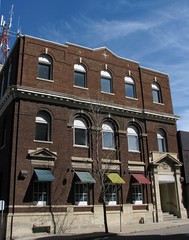
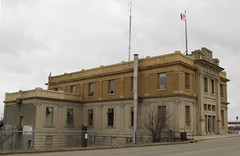
Telephony and the Government Telephones Building in Brandon

© Christian Cassidy, 2011
Former Government Telephones Building, Brandon

This is a part two of my post about
Brandon's New City Museum which recently opened
Manitoba Government Telephones Building at 19 - Ninth Street.

Brandon Daily Sun, December 28, 1901 (source)

Telephone service first came to Brandon in 1882 when Bell Telephones set up shop on the prairies. That first year, it boasted a whole 51 customers clustered in the centre of the Wheat City. The expense of the new technology limited it mainly to business users.

By the turn of the century the telephone was being marketed to households as lines began to run to some rural centres around Brandon. To help the growth of the system, Bell dropped the price of a phone unit to about $6 per set and introduced half-price phone rates outside of business hours.


Jan. 30, 1908, Manitoba Free Press

The province found itself constantly butting heads with Montreal-based Bell over prices and the slow rate of expansion of its network. It soon realized that the only way they could keep up with the rest of the country, especially when it came to delivering service to thinly populated rural areas, was to do the work themselves.

In 1908, the Manitoba Government bought out Bell Telephone's holdings in the province, something that was also done by provincial governments in Saskatchewan and Alberta.

In Brandon, Manitoba Government Telephones (MGT) inherited 722 subscribers and the Bell telephone exchange building established around 1905 in a rented building at 31 – Ninth Street, just south of where the current building is.

The rapid expansion of the network required the construction of a larger, permanent telephone exchange building. The years came and went with no firm date set for construction.

There were a few reasons for MGT's delay. One was the sheer size of the project that they had taken on. Another was political meddling which sometimes influenced what communities got service improvements first. MGT was also keeping its eye on an emerging technology: the automatic telephone exchange.


Top: Paris, Ont. Telephone Exchange 1909 (source)
Bottom: Brandon Sun, September 1907 (source)

Until this point, to make a telephone call you picked up the receiver and waited for the operator, (or "Hello Girl"), to answer and put your call through to the receiving party. For phone companies it meant that a small army of women were needed on-site at all times.

As an example, in 1913, when an arsonist set fire to the Brandon telephone exchange sometime around 2 a.m., there was a chief officer and forty women on duty at the time. All escaped safely.

The above Brandon Sun story from September 1907 describes a typical day at the exchange, where 7,000 calls would be put through, as resembling a giant cribbage game.


To keep up with the demand of the growing phone system in Brandon, MGT could wait no longer to act on a new telephone exchange building. A site was chosen immediately to the north of their rented premises and it bought 54 additional feet of land, (at an impressive $207 per foot), belonging to local real estate developer O.L. Harwood.

The contractor who won the bid to build the three-storey, $50,000 building was Hazleton and Wallis of Winnipeg.

The two men met and began building in Chicago before relocating to Winnipeg and had an impressive track record. They built a number of Winnipeg's iconic buildings, the YMCA on Vaughan (1913) and the Hamilton Bank on Main (1916-18), are just two examples that are still with us today. They pair also ventured outside the city, as far away as the Waddell Memorial Hospital in Canora, SK.

On August 2, 1916, work got underway on Brandon's new Telephone Exchange Building and it was completed sometime in December.

Lobbyist ad by Automatic Telephone Mfg. Co., Liverpool England
March 11, 1912, Winnipeg Tribune

By the mid 19-teens, a couple of the automatic telephone systems being marketed around the world had stood the test of time and were becoming industry leaders.

In 1917, MGT finally decided that it would take the plunge and announced on April 20 that Brandon would be the first site in Manitoba to receive automatic telephones. They purchased a system by the Automatic Telephone Manufacturing Company of Liverpool, England. The equipment would be built in their Chicago facility and shipped to Brandon.


Left: Ad for old-style phone (source). Right: The dial phone

In late 1917, MGT went about the business of preparing the 1,794 Brandon and 497 rural customers for the changeover.

The most obvious difference would be in the telephone set itself. Instead of lifting a receiver that connected you to an operator there was now a rotary dial. At the exchange, a series of switches and relays would 'read' the number you dialed and patch through your call. (For an engineering manual on how an automated telephone exchange worked see Automatic Telephony from 1921).


Instructions  appeared in telephone directories and the Brandon Sun did its part to let readers know how to handle the coming change. The above clip is from a November 1, 1917 article.

The Brandon Sun reported that the 1917 phone ownership rate in Brandon stood at 11.3%, which was impressive considering that for the country as a whole the rate was just 7.6%.

The western provinces led the Dominion in phone ownership. For instance, Manitoba's rate was a second-best 10.6% and BC had a country-leading 11.2% (source).

Jan 17, 1918 Manitoba Free Press

The project was completed just a few days later than scheduled.

At 5:00 a.m. on January 1, 1918, the lines were cut to the manual switchboards and thirteen minutes later Brandon customers were on the automatic system. On January 16, an open house was held for civic officials and MGT executives, including Harry Paterson the new Brandon phone superintendent.


Brandon was Manitoba's first 'automatic' telephone exchange city. By summer 1918, there were only a few other centres in the West that could boast the same. 

Winnipeg didn't begin opening automatic exchanges until 1920 and it took six years until it was declared completely automated.

Winnipeg Telegram (Strike Edition) June 20, 1919

Not long after the opening of the new exchange there was labour strife at MGT. 

In 1917, phone staff unionized and began demanding an increase in pay from their current $40 per month (for operators) and a reduction in their work day from ten to eight (source). Winnipeg's operators walked out for three hours but Brandon's stayed on the job.

In 1918, employees did get an increase in pay and changes to their work day.


When the Winnipeg General Strike began on May 15, 1919 it was the "Hello Girls" that were first to walk off the job. When Brandon held a sympathetic strike on May 20, again, it was the phone operators who were first to leave.

MGT threatened the striking workers that if they didn't return to their positions and sign a pledge never to take part in a sympathetic strike again they would be fired. The hiring of replacement workers began and on June 20 and MGT eventually fired all of their staff in favour of the replacements (source).
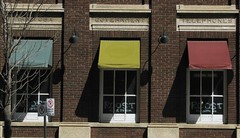
Former Government Telephones Building, Brandon

Phone service continued to expand in the city, but bureaucracy, wartime labour / equipment shortages, and the Depression slowed growth in rural areas. 

The number of telephones in Manitoba, excluding Winnipeg, actually declined between 1920 and 1924, (source). That 11.3% phone ownership rate in Brandon in 1917 was only 53% by 1943, (source: Brandon's Politics and Politicians by W L Clark).

The Manitoba Government Telephones Building served Brandon until the late 1960s.

In 1966, MTS announced that a new $2 million building would be built at 18th and Victoria to house the latest in computerized switching and and microwave technology. When it opened in 1968, Brandon became the first centre in Manitoba to get touch tone dialing !


Top: First MGT car in Brandon ca. 1920s (Source: People of Service - see below)
Bottom: Phone truck in Reston ca. 1923 (source)

Resources (articles)
- A History of the Telephone in Manitoba MHS
- MTS Map of Long Distance Pole Routes (1940)

Resources

- Government telephones: The experience of Manitoba (1916)
- The invisible empire: a history of the telecommunications industry in Canada 1846 - 1956
- People of Service: A Brief History of the Manitoba Telephone System
- Private vs Public Telephones Wpg Real Estate News


For more Brandon history stories.

Wednesday, 27 April 2011

Tearing down skywalks and malls

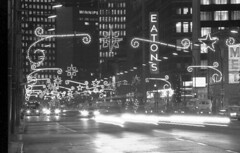
Christmas Lights - Portage 1976
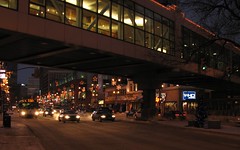
Christmas Lights - Same Spot  2007
Portage Avenue 1976 and 2007

There was an interesting MinnPost.com post back in 2007 about Minneapolis' skywalk system.

In 2007 Minneapolis hosted the International Vital Winter Cities conference and a couple of world renowned architects were invited to take a tour of Downtown Minneapolis and give their impressions. One thing they both agreed on ? Get rid of the skywalks ! An excerpt:
The biggest problem, both said, is that people in Minneapolis don't realize that great cities — even cold cities — are now defined by the vitality of their street life. "People here don't see a crisis," said Gehl. "They don't yet see themselves as behind the times."
Earlier this year Architecture Minnesota Magazine held a video competition to show what life would be like in Minnie without the skywalks, or at the very least how to improve them.

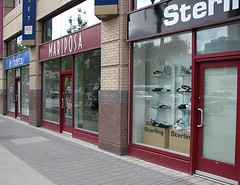
Portage Place
Canada, in general, tends to be a decade behind the U.S. when it comes to bad urban trends (and Winnipeg a few years behind that).

For instance, the idea that downtown malls could combat urban decay reigned in the U.S. through the 1970s and came to us in the 1980s.
In the past few years a number of cities have realized that the downtown mall was a bad idea and centres such as Columbus, Rockford, Green Bay, Sunnyvale, Cleveland and Salt Lake have been demolishing theirs inf favour of, well, what used to be there: storefront offices and shops, smaller scale projects that are walkable and comfortable.

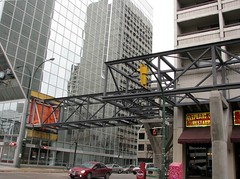
Downtown Walkway
We're nowhere near that point on malls so any discussion about whether elevated skywalks are good or bad for a downtown will take years to reach us. After all, we're still proudly expanding our system with plans to add more.

Portage and Main
One aspect of a walkable downtown that will come up for debate in the next couple of years, like it or not, will be the possible reopening of Portage and Main to pedestrian traffic.

Perhaps then we can begin to make amends for decades of building projects that take people off the streets.

Tuesday, 26 April 2011

Bloggers invade the Exchange tonight

The blogger to people with better thing to do ratio will get all out of whack in the Exchange tonight.


First off, UMFM's Winnipeg Internet Pundits is taping our usual Wednesday broadcast at 7 p.m. in the Free Press News Café at Albert and McDermot. You can still catch us in our regular slot on Wednesday's drive home or, heck, even come see us do the show live - warning: we normally record the show topless and do belly bumps after each segment ;)


Following the show you can see what the next generation of bloggers, journalists and PR hacks look like at the 2011 Creative Communications Media Awards.

Nineteen awards will be presented in a number of categories to first and second year students including Best Print Ad, Best Campaign, Best News Story and, something new, Best Blog !

Red River College's CreComm program had their current batch of students keep blogs on whatever topic they liked for the year. I was honoured to be asked to be a judge for the selections and got to check out some of their work in great detail. There's some great stuff on pretty much every topic imaginable. To see the list of blogs check out the CreComm Blog Network.

The awards begin at 8 pm at the Millennium Centre. Check out the above link for tickets info as they do have to be purchased in advance.

Monday, 25 April 2011

More Manitoba in Film: Mantrap (1926)


1926 movie poster (source)

I've profiled a couple of Manitoba's brushes with early Hollywood in the 1943 film 49th Parallel and 1953s Die Hölle von Manitoba. Now let's go wayyyy back to the '20s !


Lewis ca. 1922 (source)

In summer 1924 the noted American author (and future Nobel winner) Sinclair Lewis came to Manitoba to "regain his mental poise" after writing of a string of popular novels such as Main Street and Babbitt. Some media took that to mean that he suffered a nervous breakdown, one even reported that he had become an invalid, but his numerous appearances around Winnipeg proved the rumours incorrect.

Lewis and his brother Claude arrived in Winnipeg on June 6, 1924 and spent three days at the Royal Alexandra Hotel. While there he gave an interview to the Free Press saying that his intention was to get away to the wilderness. As a native of Sauk Center, Minneapolis, a town north-west of Minneapolis, the outdoors were no stranger to him.


Winnipeg Free Press, May 29, 1924

While in the city
Lewis spoke at a Kiwanis luncheon at the Hotel Fort Garry, visited the General Hospital, got a tour of the Tuxedo Barracks and heard the PPCLI band play. He had a tour of the Legislature that was cut short when he was overhead saying to his guide that 'all buildings looked alike' to him. On his final day in the city he visited Stony Mountain penitentiary (no word if he met with inmates but he did spend 'several hours' there).

It was then off to The Pas by train where he met up with the federal government's Treaty Party Number 10 which was touring central Manitoba and Saskatchewan by canoe. Stops included Lac La Ronge and Prince Albert, a nearly 3,000 km journey !

On July 26, 1924 the Lewis' arrived back in Winnipeg and after a quiet weekend stay set off home to Minnesota.


Promo for Canadian release of the novel, July 1926

The following year Sinclair Lewis released the novel
Mantrap inspired by his wilderness adventure.

The story is set near the fictional northern Canadian village of Mantrap, (that place name actually exists but in rural Minnesota). Most publicity material of the day said that the setting was Northern Manitoba, though some later writings say that it's based in La Ronge Saskatchewan.


The story is that of a burned out New York City divorce lawyer who goes on vacation to the Canadian wilderness to find some peace. On his travels he meets and falls for a lovely woman who was once a 'big city girl' but is now married to a trapper who is happy with bush life. What will our big city boy do ? Which man would she choose ?

Released in the U.S. in 1925 and Canada in 1926 the book was a hit. Paramount bought the rights and wanted to cash in on them right away as Lewis novels did well at the box office.


The movie, also named Mantrap, brought together director Victor Fleming with actors Clara Bow, Ernest Torrence (as the trader) and Percy Marmont (as the trapper).

Clara Bow was one of Hollywood's hottest actors at the time. She was the quintessential 'flapper girl' of 1920s on-screen and off. Wild, fun, sexy and sporting a short bob and skirts. As the 20s went on her party-girl roles became more demanding and Mantrap was considered a 'transition piece' to meatier parts.

The film was shot in California, though
Canadian Literary Landmarks says that cinematographer James Wong Howe did come to Manitoba to shoot some footage.

The film opened in the U.S. in July 1926 and in Winnipeg at The Capitol on September 4, 1926. The film was another hit for Lewis.


Many involved with Mantrap went on to do great things.

Sinclair Lewis won the 1926 Pulitzer Prize (which he turned down) for Arrowsmith. He was awarded the Nobel Prize for Literature in 1930, a first for an American author.

In 1927 Clara Bow starred in "It" and the term "The It Girl" would forever be her trademark phrase. Mantrap did prove a stepping stone to more serious work as she landed the lead female role in Wings (1927) which won the first-ever Oscar for Outstanding Picture. Sadly, Bow's career came to a halt the day the stock market crashed in 1929. The happy, flirty, flapper image that she and her studio carefully cultivated through the 1920s was immediately deemed passé and even vulgar.

Fleming went on to direct a number of Hollywood classics including The Wizard of Oz and Gone with the Wind. For the latter he won the Academy Award for Best Director.

Related:
Video Clip TCM.com (7 min)
Mantrap - the full book online
Mantrap Movie Page Silents are Golden
The Sinclair Lewis Society

Saturday, 23 April 2011

Those Louise Bridge Boats

Most of this post was written in October 2010, it sort of got stuck in my draft folder (just in case you're wondering why the boats aren't under about five feet of water !)

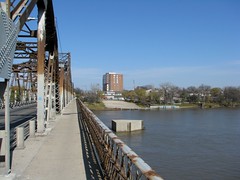
Louise Bridge
Circa 2007 - it took me over three years to get back to it !

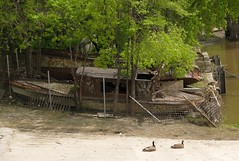
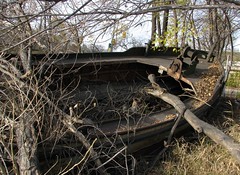
Those two rusting boats tucked away on the north east side of the Louise Bridge. I've passed them hundreds of time over the years and every time I've glanced out at them and wondered what their story was. This autumn I thought I would finally check them out.

Old Boats
Old Boats

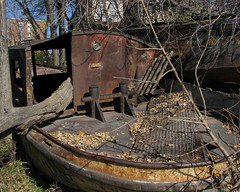
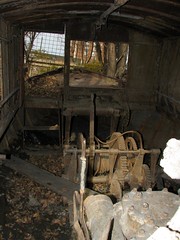
There are two boats, the most interesting is the covered one. It has a cabin with a big winch at the front and motor at the rear. On the engine casing there is a tag for "Russel Brothers Limited, Owen Sound Ontario".

Old Boats B
Old Boats B

The second boat is similar to the first but open. The condition of the interior was pretty rough so I wasn't able to see anything that would identify it.


I found that Russel Brothers Limited isn't around anymore but there is, of course, a fan / corporate archives site based in Owen Sound with records dating back to the early 1900s.

Russel Brothers was established in Fort Frances Ontario in 1907 and moved to Owen Sound in 1937, (which narrowed down my boat search). The core of Russel Brothers' work were 'workhorse' boats. Steel hulled tugs, logging boats, winch boats, fire fighters and ice breakers.

Four of their boats are Canadian icons. The Ancaster and Missinaibi appeared on the back of the Canadian dollar note from 1974 until its discontinuation in 1989. The two "Maid in the Mist" vessels of Niagara Falls fame are Russel Brothers'. All four boats have survived. The first pair are on displays in museums, the two Maids are still in service in Ontario and on the Amazon River.


Checking through their records I could not find a match to any of the numbers that I got off of the motor plate but I saw the above manual and thought that this really must be it !


Old Boats

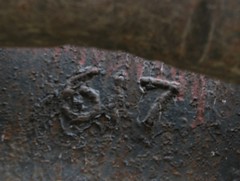
A few emails back and forth with a couple of Russel brother archivists and a couple of return trips to the site to crawl in, around and under her looking for a hull number and voila !
This welded '617' is what we needed to trace the boat's owners. Unfortunately I could not find a similar marking on the open boat.

From this number they were able to confirm that the boat was indeed a Steelcraft Winch Boat. They were built for the logging industry to tow shipments of lumber to their destination. (To see how a winch boat works).

This boat was built in Owen Sound in 1946 and sold to Manitoba Power (presumably that's the Manitoba Power Commission). After that it appears in the Canadian List of Shipping on a few occasions: in 1956 as the steel tug 'Pinawa' owned by Manitoba Paper Co. Ltd; in 1970 again as the 'Pinawa'; in 1997 and 2003 as owned by Abitibi Price (who owned Pine Falls Paper Mill at the time). In 2004 the boat was no longer on the registry.

That final ownership year of 2003 struck me as odd. I'm sure they've been there long before that time. Perhaps they were out of service before that and it just takes time to get struck from the registry ?

Elmwood
Boats are to the left of the two blue squares sticking out of the water.

The next question is why there, at the foot of the Louise ?

At one time Brown and Rutherford had a small fleet of boats that they used to bring lumber to their factory on the other side of the river but they were long gone by the time these boats would have come down to Winnipeg.


Paddlewheel Queen goes through the Louise Bridge, 1969 (source)

In the mid 1960s the site immediately east of the boats was the dock for the Paddlewheel Queen then, from the late 60s to late 80s, the River Rouge. The pilings under the Louise Bridge do collect a lot of debris after the spring melt. Maybe they were once used to help haul items that could have caused damage to the ship(s) and were left behind when the Paddlewheel or River Rouge moved on ?

Newspaper and other searches have brought me no further along. If you have any additional information please let me know !

Related:
A History of the Lumber Industry in MB Province of Manitoba
Remembering the Riverboats MB Historical Society

Wednesday, 20 April 2011

Brandon's new city museum (Part 1)

I've been blogging a lot about Brandon history of late and that's because the Wheat City's built heritage has been on a bit of a roll.


Clockwise from top left: Former CP Depot; Parkland Building at former mental health site; Mackenzie Building; Massey Block; Heritage Brandon website; Dominion Display Building.

Let's take stock of the past few months: Expansion of Assiniboine Community College's programming at the former Brandon Mental Health Centre site continues; the conversion of the former Massey Harris Building into assisted housing is entering the home stretch; plans are afoot to convert the MacKenzie Building into housing; the launch of a Heritage Brandon website; new life for the former CP Station and seed money start renos of the Dominion Display Building.

That's not too shabby for a city that I've poo-pood on in years past about their lack of interest in their urban history.


Now it's time to add another project to the list: an urban museum !

The Brandon General Museum and Archive Inc. was created in 2007 by Brandon City Council with a mandate to "collect, conserve, study, exhibit and interpret historic and heritage materials relating to the city." Over the years the tires have been kicked on a number of possible locations but it wasn't until April 7, 2011 that a location was announced.

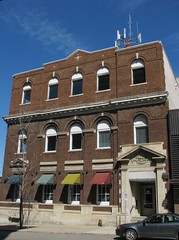
Former Government Telephones Building, Brandon Manitoba

The museum will be located on the main floor of the former Government Telephones / Paragon Lofts Building at 19 - 9th Street. They take possession on May 1 and will have the museum open by summer. The space and timing won't permit for an archives for now.


If you want to support the project memberships are $25 and there is a fundraising dinner coming up on May 12th.

Congratulations to the board and other volunteers. This will add to a number of great museums already in the area.

Former Government Telephones Building, Brandon

I can't let this pass without hauling out an old, dead horse and administer another beating to it.

I've blogged a few times before (including here and here) about the need for a Winnipeg urban museum. With our rich history it's a shame that most of it is left to sit in boxes in a leaky building. Maybe we can learn a lesson from Brandon.

For more Brandon history stuff:
Hillman's Brandon Archive Site
Heritage Brandon
Brandon History on eBrandon


Monday, 18 April 2011

A Brandon Update: Water, water and heritage buildings !

This weekend I went on a bit of a road trip. On the way home I stopped in for a quick twirl around Brandon.

Water Disaster

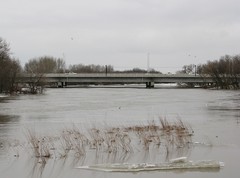
The big story, of course, is the mighty Assiniboine. Over the weekend an ice jam was sending the Assiniboine to record levels. The jam is gone today but the River is not expected to crest there until sometime between April 20 and 28.

Brandon, Manitoba

Brandon, Manitoba
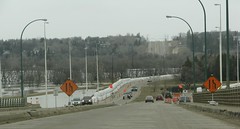
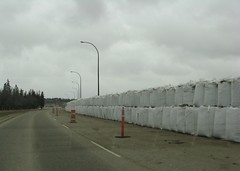
Both of the main drags into town, 18th and 1st, are lined with kilometers of 'super-sandbags'.

Brandon, Manitoba
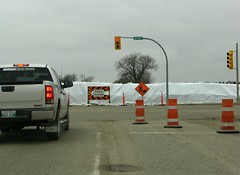
On Saturday Grand Valley Road (which is what Kirkcaldy becomes west of 18th) was sealed off at 18th (see map below)

Brandon, Manitoba
Just opened in the Autumn, the David Thompson (18th Street) Bridge is getting a workout.

Brandon, Manitoba
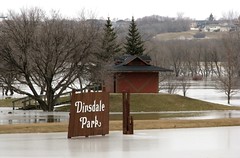
From the 1st Street bridge: Dinsdale Park is looking a bit soggy.

Brandon, Manitoba
Here's a view from the Riverbank Discovery Centre which has a lot less riverbank than usual.


Heritage Disaster

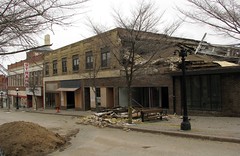
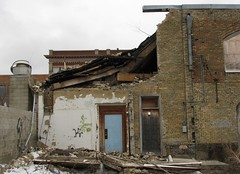
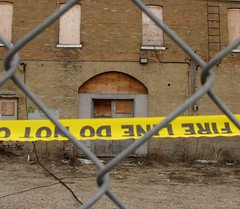
Keeping with disasters, I snapped some photos of the Brown Block which collapsed back in mid March. Engineers are figuring how best to take it down. It became a trickier than usual operation when it was found to share a retaining wall with another heritage building: The former Strand Theatre. In a few days they will know whether the Strand can remain standing.

Brandon, Manitoba

Brandon, Manitoba

sc143


CP Depot's New Life

Within sight of the Brown Block is the former CP Depot. It, too, has sat empty for a number of years.

A happier ending, though, as renovations are underway to make it the new home of Westman Immigrant Services, coming full circle in a way.

Brandon, Manitoba

Brandon, Manitoba

Brandon, Manitoba

Stay tuned for more good news on the heritage front from Brandon !

Retro Fast Food

Is it safe to assume that KFC Inc (or PepsiCo or whoever owns it now) forgot about this this Kentucky Fried Chicken outlet on Princess when it re-branded a decade or so ago ?!

Brandon, Manitoba