I've been negative on the subject of Manitoba heritage lately but Brandon, of all places, has come through with a couple of wins in recent days.
First off, they have increased their online heritage presence exponentially with the Heritage Brandon website. It's still a work in progress but already an impressive index of heritage resources in the city.
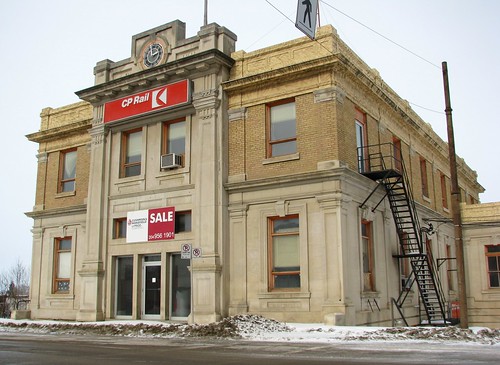
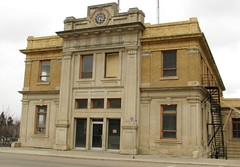
The second bit of good news is that Brandon's CPR station, ca. 1912, has a new lease on life after sitting empty for a number of years.Westman Immigrant Services will be leasing the space which will allow the owner John Hooker (also the owner the now collapsed block just up the road) to renovate it. (See Brandon Sun and eBrandon.ca).
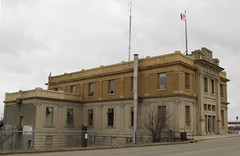
I thought I would take a look back at the building. One of just a few examples of Brandon's grand architectural past that has survived ....
Brandon faced a period of explosive growth as the railway opened up the Canadian West.
Between 1900 and 1914 the city’s population grew from 5,620 to 13,839. The assessed value of buildings went from $9.4 m in 1909 to $11.6 m in 1912, a 23% increase.The Financial Post reported that 1911 would be Brandon's best year ever for new construction. Year on year between 1910 and 1911 the value of permits was up by 192%.
By 1910 Canada’s four major railways, Canadian Pacific; Canadian National, Grand Trunk Pacific and Canadian Northern already had a presence in and around the city. The 27 spur and branch lines running through the vicinity carried 348 passenger and 478 general trains every week.
Above: Prince Edward Hotel and CN Depot (source: Tribune)
Above: Manitoba Free Press, May 18 1912
Rail infrastructure built just a few years earlier was bursting at the seams and desperately needed expansion. CN was first out of the gate in 1910 with a $500k project, (about $10m in 2011 dollars), that included a new depot and the seven storey Prince Edward Hotel on 9th Street.
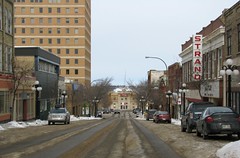
In July 1911 the CPR followed with a more modest $60,000 contract for its new passenger depot. It would be located beside the existing one at the foot of 10th Street.
Source: Brandon Daily Sun. (Above: Feb 17, 1911. Below: May 21 1906)
The firm that built the depot was the Brandon Construction Company. Under General Manager T. M. Harrington it was one of the premiere building firms in the city at the time. Their first large project was the Christie Block and from 1900 – 1911 were responsible for construction of the McKenzie Block, Brandon's Courthouse, the 'Victoria Avenue Methodist Church' and the Asylum Powerhouse. They also worked further west, credited with building the Presbyterian Church in Swift Current SK.
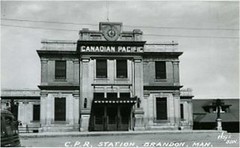
Top: CP Depot, 10th and Pacific (ca. unknown). Source: Peel
The
Winnipeg Toilers basketball team was a powerhouse in the 1920s and
'30s. They won the provincial basketball title thirteen times and became
the first team from Manitoba to win the Dominion (national) basketball
championship in 1926. It was a feat they repeated again in 1927 and 1932.
The Toiler dynasty was cut short on March 31, 1933 when their team plane crashed in a field in Kansas, U.S.A..
The Toilers club was formed in 1909 as part of a YMCA league. Their backers took it to a city league and turned them into perennial city champs.
In April 1926, the team beat the New Westminster Adanacs to take the western championship and earn their tickets to Montreal to play their eastern counterparts, the Montreal Amateur Athletic Association (MAAA).
They beat the MAAA in a two-game series on April 30 and May 1, 1926 by a combined score of 57 to 42 and returned to a hero's welcome. They also created a new level of interest in the sport locally that would help bring new players to their roster for years to come.
The Toilers' last Dominion championship came in May 1932 when they beat the Saint John Trojans in a close contest in their native New Brunswick.
Winnipeg Free Press, March 24, 1933
The 1933 season was promising to be another victorious one. On March 25, they captured the provincial title and had their sights set on the national cup in April. To help them prepare they sought out some international competition.
The management of the Toilers and Tulsa Oklahoma's Diamond Oilmen,
the U.S. amateur champions, worked out the terms for a best-of-five series. The first two games were to
be played in Tulsa and the remainder in Winnipeg. The
Toilers had played against U.S. teams before, but only as friendlies or in
regional tournaments. This series upped the ante as it was sanctioned by
the national amateur basketball associations of each country and the wins
and losses would count toward their respective national records.
Winnipeg Free Press, March 29, 1933
The team were on a train for Minneapolis just 48 hours after winning the provincial crown. From there they would catch a plane to Tulsa.
The trip's sponsor was R. H. Bonynge, a native of Saskatchewan who went on to have a pro-basketball career in the U.S.. The plane was that of J. H. O'Brien of Minneapolis, president of the Mid Continent Petroleum Corporation. Both men accompanied the team. The series was billed as a Canada vs. U.S.A. showdown. After landing in Tulsa, the Toilers received a telegram from Prime Minister R. B. Bennett wishing them luck. Dr. James Naismith, the Canadian who invented basketball, visited the team before the first game. Newspapers from across Canada and the U.S, including the New York Times, provided coverage.
March 31, 1933,Winnipeg Free Press
The tournament was going to be a tough one for the Toilers. They had no time to rest after their long journey and the Tulsa games were to be played under American rules with an American (soft seam) ball. They struggled during their first game on March 29th and lost by a score of 32 -13. In game two the following night, they got off to a good start but faded away and lost 41-19.
It was now back to Winnipeg for the next games, the teams had to await the release of the Canadian championship schedule before setting the dates.
April 14, 1933, Cornell (Oklahoma) Daily Sun
The
Toilers were invited to stay later the next day and be the guests of honour
at a luncheon hosted by the Tulsa Chamber of Commerce. Tired and
anxious to get back to their families and day jobs, the invitation was declined and
plans were made to leave the next morning.
On Friday, March 31, 1933, the ten members of the Toilers organization arrived at the Tulsa Municipal Airport at 7 a.m. for their flight. Despite the weather, heavy rains and gusting winds, the team was in good spirits and posed for one last photo (above) before departing. Bonynge and O'Brein also joined them on return the flight.
Shortly after takeoff, the engine over the left wing of the Ford 4-AT-B Tri-Motor
began sputtering and cut out. The pilot warned passengers that he had
to land immediately and was presumably trying to make it to the Neodesha
(Nee-o-desh-ay'), Kansas Municipal Airport located ninety miles north of Tulsa.
While flying low over a farmer's field, the plane suddenly nose-dived
into the ground.Eyewitnesses in Neodesha said they heard the troubled plane overhead and saw the plume of smoke after it crashed.
First responders described a grizzly scene of a mass of twisted bodies crammed into the forward section of the plane. An excavator was required to reach the remains of the pilots. (For more coverage of the crash see here and here.)
Winnipeg Free Press, April 1, 1933
The dead included all four non-team members: pilot Alvie Hakes of Windom, Minnesota; co-pilot H. E. Eggens of Hendricks, Minnesota; trip sponsor R. H. Bonynge and the plane's owner, J. H. O'Brien of Minneapolis.
Toiler players who died in the crash were star forward Joe Dodds, 21, and Mike Shea. Two others, Ian Wooley, 28 and Andy Brown, 25, were critically injured.
On the morning of April 5, 1933, the bodies of Dodds and Shea lay in state in the Winnipeg Auditorium. Thousands of Winnipeggers filed past the flower draped coffins. Members of the Toilers' youth teams took turns standing as the guard of honour.
A week after the crash, Phillips, Bruce Dodds, Penwarden and Samson were cleared to return to Winnipeg. On April 15 Wilson, Brown and Wooley were released and traveled home together. Silverthorne, the remaining victim, was set to leave in the last week of April but contracted pneumonia which delayed his return until May.
April 1, 1933, Winnipeg Free Press,
A benefit fund was created for the survivors and families of the deceased. Numerous sports events, from bridge tournaments to hockey games, donated proceeds from their gate to the fund. Charity games were played as far away as Vancouver. As for the official cause of the crash, it was deemed a crash upon landing in bad weather after "unknown problems." This goes against some eyewitness and passenger accounts who were certain that an engine had cut out.The Toilers were a well-established sports club with teams in numerous sports and age levels. It carried on operations including fielding three basketball teams for the 1933-34 civic season. Members of the junior teams were called up to fill the roster of the senior team.
The senior team was good, but a shadow of its former self. None of the surviving 1932 players appear to have returned to the roster.
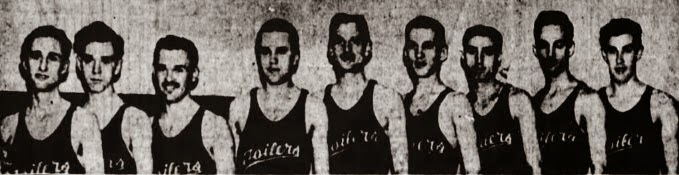
Left to right: R. Pearson, Joe Dodds, Bill Thorogood,Mike Shea, Al Silverthorne, Ron Burgess, Lauder Phillips, Ian Wooley (captain), and Wallace Walkey.
The dead: Mike Shea Jr., 26, was a three-year veteran of the team in his final year at the U of M to become a chartered accountant. He lived with his father, a former Free Press sports editor, on Wharton Road and is buried in St. Mary's Cemetery. Joe Dodds, 21, was the highest scorer in the 1932 national championship series. He worked for Monarch Life Insurance Company and was the older brother of Bruce, also a member of the team. He is buried in Carlyle, Saskatchewan. Critically injured: Ian Wooley, 28, was the team captain and played both guard and centre. He was a five-year veteran of the team and lived on Lyndale Drive. Andy Brown, 25, was the alternate centre. He was single and lived on Langside Street. Seriously injured:
Al Silverthorne, 28, played guard and was a former captain of the team. A Kelvin grad, he worked for the Western Grain Company and was married with 2 children.
George Wilson, 37, was a one-time star of the team who retired in 1930 to become a coach and manager. His day job was President and Managing Director of Wilson Furniture Ltd. on Main Street. He was married with three children.
Hugh Penwarden, 22, was the smallest and fastest member of the team. An all round athlete, he was also a celebrated track, rugby and lacrosse player.
Minor injuries:
A. C. "Colonel" Samson, 44, was the club president. He was manager of the press room at the Winnipeg Tribune.
Bruce Dodds, 18, was the youngest member of the team and brother of Joe.
Lauder Philips, 22, played forward.
Some Footnotes: - Coincidentally, the crash happened two years to the day - almost to the hour - that sports legend Knute Rockne died in a plane crash just 75 miles away.
- Toiler Andy Brown had never been on a plane before. He expressed to co-workers that he had a bad feeling about the trip. He doodled for them fake newspaper headlines such as "Toilers Plane Crashes, Players are Killed" and half-jokingly offered individuals his office ash tray and fountain pen should he not survive.
- In May 1933 UMSU voted to create the Mike Shea Jr. memorial Trophy to be awarded to the junior basketball champions of Manitoba. It appears to have been awarded into the 1950s. - On June 16 1933 the Toilers' organization sent a large thank-you card to the people of Neodesha, Kansas. It was signed by all members of the club, including surviving players and their families. It read:
"We, the relatives, friends and comrades in sports of the Winnipeg Toiler Basketball team members, do hereby extent to you, the citizens of Neodesha, our sincerest thanks, with added thanks to your mayor, the Rotary Club, and those individuals who did all that was possible to relieve the sorrow and pain of we Canadians on the loss and sufferings of our loved ones on and after the terrible catastrophe that occurred near your town at 8:30 a.m., March 31, 1933"
The Bell Hotel doesn't look different from the front but from the back work is ongoing. The latest thing are new windows all around.
On the other side of the subway at Euclid, the former California Fruit Market is being transformed into the new, larger home of Neechi Foods. (Imagine if all the brick buildings along that strip lost their awful paint jobs !)
While I haven't been a fan of every project, as a grouping it's certainly the most development seen on Main Street in a few decades. Importantly, they are bringing more services and retail opportunities to a long neglected area.
I enjoy doing my little history posts, especially ones dealing with families. Most of the time the families already know 'the ending' and I am just filling in the gaps. (In the case of William Harvey it included posting an obit for a man who never had one).
One of the people killed in the fire was Patrick Timmins. He came to Winnipeg, (I now know it was from South Dakota), enlisted with the 78th Battalion (Winnipeg Grenadiers) and went overseas. After being injured in the war he returned to Winnipeg and was a lodger at the Riverview Hotel. On the night of the fire he escaped but ran back in to try and save lives. He never came out again.
Excerpt from Manitoba Free Press Feb 6, 1918
The story of his actions touched the community so much that, despite his being discharged, the 78th gave him a full military funeral and a couple of Returned Veterans' charities picked up the tab. He lies in St. Mary's Roman Catholic Cemetery in Winnipeg.
Timmins' headstone at St. Mary's R.C. Cemetery (photo is (c) A. Riezebos - source)
It turns out that there a modern day twist to the Patrick Timmins' story.
Ruth Zaryski Jackson, a relative of Lena Huckan, tracked down a relative of Timmins on a genealogical site. That relative, after speaking to Timmins' 85 year-old grand niece, said that they never knew what happened to him until that email message !
The relative wrote that he wasn't spoken about much due to the sadness of losing him and not knowing what happened. "The family assumption was that he must have died in action. Mom doesn't even know his name. The story of his death is closure - 90 years in the making."
Since that time the search is on for better photos, his war papers and other articles that we can find. Timmons' grand niece wants to come to Winnipeg visit the grave site while she still can.
So, it seems, there's a part 5 to the Elmwood's Riverview Hotel series is in the making !
Just four weeks later Heritage Voices, the final report from a year long study into the state of heritage conservation in the city of Toronto, was released. Strikingly similar issues to Winnipeg: demolition by neglect, bureaucratic malaise, a lack of any solid policies on how to deal with the issue. Hume sums them up well here.
The report makes a wide-ranging series of recommendations and policy changes. Something I will visit in a future post. (Also see Heritage report paints a bleak picture Toronto Star (Hume)
More online features.
The Globe and Mail had a neat story on how a now-abandoned mining town has been brought back to life thanks to a web page.
The Vancouver Archives now has a blog page that is out to preserve Vancouver's digital heritage. Some great image and video footage has been newly added. This is on top of their pretty nice regular webpage. For more on the story see this City Caucus post and if you have an interest in Van history also check out Past Tense)
The Alberta Advantage.
Yet another example of how Alberta is becoming the best place to go to check out Winnipeg local history.... I was interested in looking up something about the GWG building. Of course, the Royal Alberta Muesum was the place that had information on it !
And finally ....
Built Heritage News continues to be a great place to find urban heritage related articles.
Silver City is continuing on their classic movie series. This weekend is the original Wizard of Oz !
I've had great response to my Elmwood's Inferno series and particularly the Life and Death of Lena Huckan. Starting later this week I will start another, shorter, series on Blake Latta and the Canadian National Express. The Deanna Durbin series will come in early April.
Muppet Theatre is slated for demolition. No, not by 'Crazy Harry' or the equally dangerous 'building owner who lets their property fall to pieces out of neglect'. Instead, it's oil speculators who want to purchase and demolish it in order to drill for a newly found oil deposit in downtown L.A.. (No word if Scooter's uncle is still the owner of the theatre).
The troupe must rally to fundraise the $10m necessary to save it from the wreckers ball.
A look at Muppet Theatre ...
The theatre in question is the circa 1911 Los Angeles Theatre. It was the most expensive theatre on a per-seat basis built in the city at the time. The almost palatial interior put it in the top tier of Hollywood venues for a number of decades.
As L.A.'s downtown began to decline in the 1960s so did the fortunes of the Los Angeles Theatre. It fell into disrepair and eventually closed (of course, that's when The Muppets began using it).
The house has been well maintained. It retains many of the original features such as loges (well, at least one) and orchestra pit. Decorative touches such as velvet curtains and the original plaster work give a sense of the luxury that it was famous for.
Despite the lavish productions put on by The Muppets over the years, the footprint of the stage is surprisingly small. This is likely due to the size of the performers and the stagehands - some of whom are rats - that must work it.The scale, though, gives the audience an intimate setting rare in a theatre.
Back stage the signs of age can be seen.
The original wood interior shows sign of wear and aging infrastructure such as electrical (see over Miss Piggy's shoulder) is in evidence.
The Muppets need to raise $10m for the purchase of the theatre.
(This post was originally written in 2011 for the 65th anniversary of CJOB. It was updated in January 2015.)
The 1940s were a decade of great growth in Winnipeg's radio market. CKRC was already on the air, created in 1940 when the Winnipeg Free Press' Sifton family bought an existing station from the Richardson family. So were CKY and CKX, the Manitoba Telephone System radio stations in Winnipeg and Brandon.
As for the national broadcaster, French-language CKSB began broadcasting in May 1946 and English-language CBW came in 1948 after the CBC bought out CKY and CKX from MTS.
Image of John Oliver Blick (source). Headline Aug. 27, 1945, Winnipeg Tribune
The application for a new Winnipeg radio station was made in August 1945 by an ex-air force flight officer namedJohn Oliver "Jack" Blick. Blick was born in Edmonton in 1915 and got his start in the radio business there at CJCA. When war broke, he joined the Royal Canadian Air Force. No. 4 Initial Training School in Edmonton, a British Commonwealth Air Training Plan facility, and served for four years. Upon his return to civilian life, he decided that the broadcasting business was for him.
He convinced a number of Western investors, including E. B. Osler who became vice president of the company, to put up the $125k required for a licence application and furnishing a studio. It is sometimes said that the J-O-B in the call letters were for Blick's name, something he officially denied. Instead, he said, it stood for "jobs", something that he wanted to create for Veterans and in the community at large by supporting local businesses and initiatives. The fact that the initials were the same as his just "sealed the deal."
Above: March 11, 1946, Wpg Free Press
CJOB's first studios were on the tenth floor of the Lindsay Building. To reduce street noise from such a busy location, a seven inch rubber floor was laid and the studios built on top of it. Sills were refitted with triple-paned windows with each set at a slightly different angle.
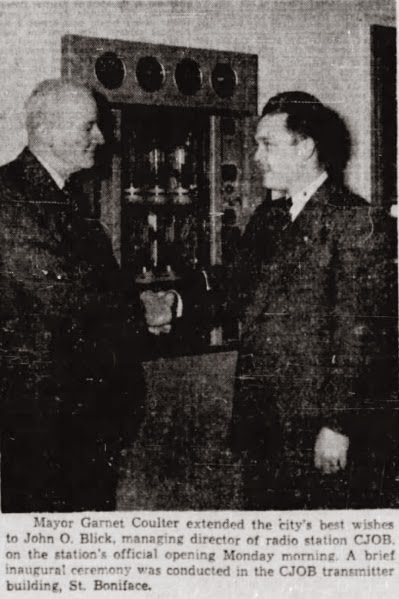
Their 250 watt transmission station was located at the edge of Whittier Park in St. Boniface. It was from there that Mayor Coulter flipped the power switch at 6 a.m. on March 11, 1946 and CJOB began officially broadcasting at 1340 am on the radio dial.
Station manager J.B. Coyne summed up CJOB's mission to a dinner crowd later that month:
"The policy of CJOB has been and is to recruit its personnel so far as
possible from service men and women, to give the best possible service
and programmes, to refrain from spoiling programmes by inopportune
commercial announcements, to give general and local news every hour, and
to forward the interests particularly of Greater Winnipeg" (March 21, 1946, Winnipeg Free Press)
Blick did not just pay lip service to wanting to help Veterans. All of the 36 original employees of the station - average age 24 - were ex-servicemen and women. For the first week, the station played no commercials or syndicated programming, instead dedicating their 20-hour broadcast day to promoting community groups and service organizations working with soldiers and their families.
1946 - 47 CJOB programming
CJOB's early programming did have some syndicated shows but stayed away from musical and comedy variety shows in favour of talk radio, such as Formby or sitcoms like The Smiths of Hollywood. Most of their broadcast day, though, was filled with locally produced content.
There were the typical musical recitals and interview shows and preachers on Sundays. Club 1340 was their dance record club show on Saturday nights. CJOB also broadcast concerts in support of events like the Salvation Army, the anti-T.B. campaign, and the construction of Tec Voc High School.
In 1946, CJOB began a 26-week series called Stars of The Future, a local talent show to showcase young singers and musicians. Acts were pre-auditioned by a panel to ensure that the top entrants made it to the show. Each week, one vocalist and one instrumentalist performed. Contestants were judged and the best from each category made it to the finals. The winners each received $250 musical scholarships. A new series was repeated for at least two more seasons, in 1947 and 1948. To avoid playing commercials each CJOB show was sponsored by a local company.
CJOB ad in Wpg Free Press, October 7, 1957
Blick's vision for local radio included community news. From day one a unique feature of CJOB was "news at the top of the hour". Soon, their reporters were in the field with news cruisers able to broadcast remotely.
CJOB transmitted for nearly two weeks continuously during the 1950 flood despite its St. Boniface transmitter being swamped. A temporary transmitter was set up on the roof of their building and technicians lived in tents next to it to ensure that it remained on the air.
October 7, 1957, Winnipeg Free Press
In 1957, CJOB reinvented itself for a new era in radio broadcasting.
The studios in the Lindsay Building were expanded, (it wasn't until 1962 that they moved to 930 Portage Avenue.) The single St. Boniface transmitter was replaced with three new ones on Highway 75 giving it 20 times the signal strength.
On October 8 of that year they moved to their current home on the AM dial: 680.
From CJOB ad in Wpg Free Press October 7, 1957
CJOB also overhauled their programming and a mix of music and 'easy listening programs' were blended with the harder news and talk shows. A number of their on-air personalities became trusted household names, such as Red Alix, Bob Washington, Cliff Gardner and George McCloy. In July 1961, Blick Broadcasting sold CJOB to Frank Griffiths of B.C. for $875,000.
Jack Blick died at Deer Lodge Hospital on February 20th, 1981. John McManus wrote in the Winnipeg Free Press of February 25, 1981:
Within three years he revolutionized radio. He took it out into the streets and on to the front lines of community happenings. He piped showmanship and professionalism into Manitobahomes and made radio an essential community component. He attracted listeners with an innovative style of broadcasting, staffed by war veterans with broadcast experience.
Blick's pioneering radio ways were not restricted to the AM dial.
In 1948 Blick was granted the first private FM licence in Western Canada and set about creating CJOB-FM at 103.1 FM. At 8:30 pm on May 27, 1948 a ceremony was held of the roof of the Lindsay Building, Mrs. Blick broke a bottle of champagne over the base of the new tower and broadcasting began.
Winnipeg Free Press, July 17, 1965
Initially, the FM station simply simulcast the AM signal. In 1960, the company got permission to move to 97.5 FM and broadcast original programming. They chose a country, folk, ethnic music mix, (at the time, CJOB AM was talk and classical music.)
In 1965, CJOB got new owners and the FM station
was relaunched as "The Town and Country Sound". It was Canada's first FM country music station and featured well known CJOB personalities such Red Alix and George McCloy.
CJOB became CHMM-FM in 1976 and continued on as a country station until 1981
when it switched to adult contemporary. Its call letters eventually changed to CKIS, then CKJR but it always remained CJOB's FM sister, now owned by Corus Entertainment.
The station may come full circle as it is expected to relaunch the station in 2015 as country music station 97.5 Big FM.