Local News Links:... .........................

Friday, 30 July 2010

The Royal Alex reborn in B.C.


Winnipeg Tribune May 1907

If your summer vacation plans take you somewhere near Cranbrook, B.C. be sure to stop in on a grand piece of Winnipeg history - The Royal Alexandra Hotel Cafe !

Royal Alexandra ca.1963 (source)

The Royal Alex, now the empty lot next to the former CPR station at Higgins and Main, was Winnipeg's premiere hotel for decades. Her magnificent ball and dining rooms hosted thousands weddings, dances, royal events, military gatherings and service club luncheons. Meetings such as the ones that created the CFL and deciding the actions to to take against strikers in 1919 were held there.


Royal Alex European Café ca.1910s (source)

When the decision came in 1970 to demolish the hotel the dining room was saved by
the Sterns who had it dismantled, labeled piece by piece and put into storage. Their plans for the re-use of the room did not work out and it eventually made its way to B.C. where the Canadian Museum of Rail Travel purchased it in 1999. By the summer of 2004 the room, built into a brand new building, re-opened as Royal Alexandra Hall.


Royal Alexandra Hall ca.2004 (source)

The website for Royal Alexandra Hall has a great history of the room as well as a great photo collection of the restoration work from the first dig in 1999 to the final touches in 2004.

Related:
New Year's Eve in Winnipeg Wpg Time Machine

Tuesday, 27 July 2010

The Lancaster Bomber - some Manitoba connections


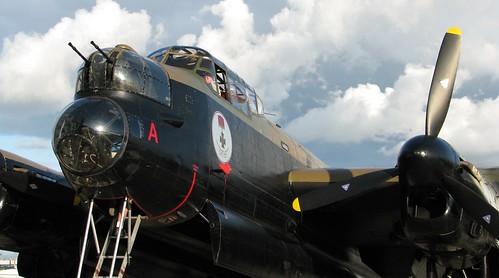
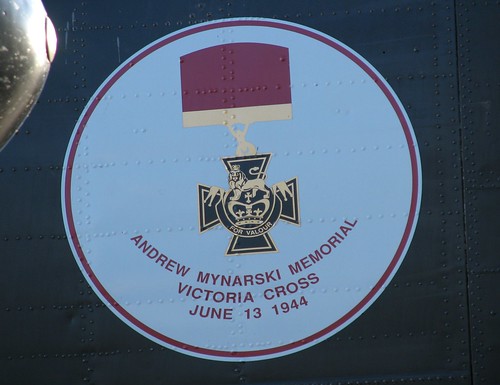
One of the two remaining airworthy Avro Lancaster bombers revisits the Western Canada Aviation Museum in Winnipeg from July 30 to August 2, 2010. The plane is named in honour of Winnipegger Andrew Mynarski, the Lancaster pilot officer who earned a Victoria Cross by giving his life trying to save fellow crew members.

Originally British-built, the decision was made on September 18, 1941 to build the Lancasters in Malton, Ontario, far from the the war zone. The engineering task was immense but in the end Canada churned out 430 of them - almost one per day.


Aside from Mynarski many other Manitobans flew Lancasters. The Ruhr Express was the celebrated first Canadian-built Lancaster to go into service. On her maiden flight in August 1943 was Mike Baczinski of Brandon.

Later, John Astbury of Portage la Prairie was a member of her crew.
Astbury was born and raised in Portage and worked with his father Charles at the Link Manufacturing plant. He enlisted in December 1941 at age 20 and received training in Virden, Paulson and Portage la Prairie, eventually being appointed Flying Officer. He deployed overseas in December 1943 and was part of the Ruhr's crew. Sadly, ten days after the above appeared in the Winnipeg Tribune and just a month after going overseas, Astbury was killed in action.

Plans were to have the Ruhr fly back to Canada to be a permanent museum piece but on her penultimate mission in January 1945 she crashed upon landing. The crew escaped but the plane was destroyed.


Other Manitobans lost their lives on Lancasters: Norman McLeod of Balmoral and Charlie Murray, a tenor sometimes featured on CBC radio, among them.

There were stories of survival as well.


Charles Batchford survived the crash of his Lancaster.


One pilot, Stuart Leslie of Winnipeg, was missing in action when his Lancaster was shot down in March 1944. Incredibly, he appeared again in Britain in September 1944 to relay to his family that he was safe and the only survivor of the crew of seven.

There are 23 known surviving Lancasters, or substantial pieces of Lancasters, around the world but only two that are airworthy.

Source of Tribune articles is Manitobia.ca: Astbury Batchfort McLeod Leslie Murray

Related:

Western Canadian Aviation Museum
The Canadian Lancasters Bomber Command Museum
The Avro Lancaster Warplane Heritage Museum

Thursday, 22 July 2010

Manitoba's Oscar winning past: 49th Parallel

Okay, here's a bit of movie trivia for you. What 1943 Oscar-winning movie was set and had many sequences filmed in Manitoba ?

Claimed at the time to be the the first major motion picture set and filmed in Canada, the British production 49th Parallel, (released in the U.S. as The Invaders), had Manitoba aflutter for a few weeks in the summer of 1940. Leslie Howard, Lawrence Olivier, Glynis Johns, Canadian actor Raymond Massey, (former Winnipegger) Carla Lehmann and Director Michael Powell were just some of the Hollywood elite that stayed at the Royal Alexandra Hotel at Higgins and Main during filming.

The storyline, in a nutshell: a Nazi U-boat ends up in Hudson Bay and is spotted by officials, German crew ditch it and try to make their way south to the 49th parallel and a still-neutral U.S.. Along the way they encounter good, upstanding Manitoba folk including French fur traders, 'Eskimos' and, of course, Hutterites !


Filming near Elie (source)

The film shot in a number of Western Canadian locales, including bits in B.C. and Saskatchewan, but Manitoba was home to most of the action. Locations included the banks of Hudson Bay, a Hutterite Colony near Elie and the area around Lac du Bonnet.

Winnipeg had a role as well. A number of local scenes were shot, including one involving 5,000 extras at Stevenson Field (the Winnipeg International Airport) but in the final version of the film, local media lamented, many of the urban scenes were cut out in favour of the rural ones. (Check out the 3 minute mark and 1h 13m mark for urban footage !)


49th Parallell was nominated for three Academy Awards in 1943 including Best Picture, the first time a British-made film earned that nomination.

On March 4, 1943 at the Coconut Grove of the Ambassador Hotel, Emeric Pressburger won the Oscar for Best Original Screenplay. Not bad considering it was up against the likes of Irving Berlin for Holiday Inn, the Lou Gehrig film Pride of the Yankees and Yankee Doodle Dandy. (The Powell / Pressburger partnership would go on to collaborate on over a dozen films).

It was a propaganda movie for sure but, as director Powell told the Tribune, "...all films, all books are propaganda in a sense. Every creative work of art must take sides on some issue".

It opened locally at the Capitol Theatre on January 15, 1943 to pretty good reviews from local papers despite the loss of local content. 

The film still pops up for discussion on classic movie sites. One calls it "one of the best-formulated propaganda movies of the war" and Movie-Film Review.com put it in their top 100 list of WWII movies.

Footnotes:


- A sad note to the film involves Leslie Falardeau, a local teen with a fascination for photography and filming. He got himself a role as both a camera assistant and a double for Raymond Massey in a few scenes (above).


In the time between filming and the film's premiere, he became Sargent Falardeau and was killed in action in October 1941. He never saw his work on the big screen.

- The sometimes over-the-top French Canadian accent used by Olivier was taught to him by a Quebecois soldier stationed in London who was assigned to the actor.

- Leslie Howard was killed when his plane was shot down by Nazis in WWII just a couple of years after making this film. He was a war correspondent for the BBC but rumours at the time were that he was also working in the higher levels of British Intelligence.

- Winnipeg-born and raised, though British-based, actress Carla Lehmann came to film scenes as an air stewardess. In the end, though, her scenes were left on the cutting room floor.

Related:
 

49th Parallel full movie !
Hutterites Warm up to film folk Winnipeg Tribune Aug. 9, 1940
Film to depict Canada Today Winnipeg Tribune Aug. 9, 1940

49th Parallel Movie Trivia The Powell and Pressburger Pages

Wednesday, 21 July 2010

Take a hike in Manitoba !

Fmr Brandon Mental Health Centre
An interesting site someone pointed out to me. It's for the Prairie Pathfinders Hiking Club. They have regular weekly hikes as well as some upcoming hiking adventures around Manitoba including:

Saturday July 24, 2010 - Hike into History Tour
(Brandon, Wawanesa)


Saturday Aug 14, 2010 - Literary Tour
(Milford, Carberry Sandhills, Neepawa)


The prices include coach transportation and meals ! A nice stay-cation option !

Tuesday, 20 July 2010

Friday, 16 July 2010

Memorial Boulevard's most tired monument

Lord Selkirk Monument
Sticking with the Memorial Boulevard theme, this poor little park could use a bit of TLC. It's actually a ca. 1955 monument to Lord Selkirk but hasn't seen much attention since a 1962 refurbishment.

More on the 'triangle' at my Downtown Places Blog.

Tuesday, 13 July 2010

Sunday, 11 July 2010

How's THAT for traffic calming !

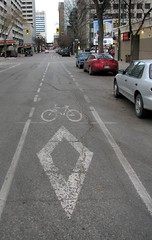
Bike Lane - Hargrave Street

Winnipeggers are easily bent out of shape when it comes to interfering with their right to drive as they please.
Painting bike lanes on roadways, something fairly common in other cities for decades, is looked upon in some circles as a sort of government conspiracy.

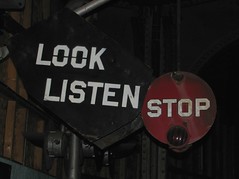
Winnipeg Rail Museum

Last year, anger bubbled over setting lower speed limits in construction zones because, quelle horreur, people might slow down only to find that there wasn't a construction worker that they might have clipped with their side view window. Th
e mere purchase of speed limit signs earlier this year reignited some of that anger.


I can only imagine the shitstorm of protest if we found ourselves in the situation that many U.K. councils are looking at: 20 mph (32 kph) zones !

Concerned with child-car accidents, Britain began experimenting with 20 mph zones (officially called Child Safety Zones) in 1991. A 2009 study found there are now over 2,000 of these zones, many are in the vicinity of schools or residential parks, and that most are created using traffic calming devices such as speed bumps.

The results ? Pedestrian-car accidents in these zones fell by 60%. Those involving cyclists were down 29%. Even in areas where only signage was used to calm the speed, no bumps, there was still a 15% reduction in accidents.

The zones have an advocate in Lib Dem Transport Minister Norman Baker who is among a number of politicians and public groups calling for the zones to be introduced throughout entire urban areas.


Before you think this is some crazy Euro- socialism thing, there are examples of lower speed zones right here in North America. Most are in the form of school speed zones. British Columbia recently expanded the hours of their school traffic zones, which require motorists to slow down 30kph between the hours of 8:30 to 5:00 pm. Alberta is looking at having their 30 kph school zones start at 7:30 a.m.. Vancouver recently considered a recommendation to reduce the speed limit on a stretch of Hastings from 50 kph to 30 kph.

Closer to home, the City and R.M. of Portage la Prairie have applied to be able to post reduced speed zones in schools and playground areas.

Traffic

So where are we in Winnipeg ?

We, of course, do not have any speed reduction zones for playgrounds or school zones. Oddly we've had a speed hump program in place since 2003 aimed solely at residential streets and lanes. Hump programs have had a bad rap of late. Seen as environmentally unfriendly and even panned by CMHC as a band-aid for bad urban planning. (For more on good and bad ways to calm traffic in residential areas from CMHC).

Still, we have seen that speed, even within the speed limit, takes a toll on our streets. In just the past month a girl was hospitalized in critical condition after being struck on Shamrock Drive, outside a greenspace. As well, a boy was killed by a vehicle outside the Pritchard Playground on Charles Street.


It may be time for us to get with it when it comes to having special speed zones around parks and schools. For those of you who think that we could never get used to it, go drive in places like Calgary or San Antonio Texas. People really do get used to them.

Related:
20s Plenty Campaign (UK)
Taming the Flow: Better Traffic and Safer Neighbourhoods CMHC
How London is saving lives with 20mph zones Streetsblog
The day I hit a child at 20mph Independent (U.K.)

Wednesday, 7 July 2010

Remembering our Jewish Pioneers

Yesterday, the federal Historic Sites and Monuments Board of Canada designated A.A. Heaps and Rabbi I.I. Kahanovitch as "individuals of national historic significance".

I have written a bit about Heaps in the past but had never come across Kahanovitch's name before so I thought I would look into the man that the Board says:

...transcended religious and secular Jewish factions to become a community leader throughout the Prairies, encouraging the growth of Jewish educational, social and religious institutions, such as Winnipeg’s Talmud Torah, for the transmission of Jewish life and faith and the betterment of his community. He fostered the unity of Canadian Jews and underscored the significance of the community’s concerns through his active role in the founding of the Canadian Jewish Congress.


Rabbi Kahanovitch (source)

Israel Isaac Kahanovitch was born in Poland in 1872 and emigrated to Russia as a young child. At the age of ten he attended rabbinical school and was ordained at the age of 20. While in Russia he met future wife Rachel. The two married, emigrated to Scranton, Pennsylvania for a year and then onward to Winnipeg in 1906.


Beth Jacob on Schultz Street (source)

Winnipeg’s Jewish community was beginning to grow rapidly. In 1901 there were 1,156 Jews in the city and by 1911 the number was 9,023 making it Winnipeg's largest ethnic group, and it remained so for another 20 years (source). The city had been without a Rabbi for three years and much work was needed to establish services and walk the line between various factions in a not very homogeneous community.

His first task was to build a school and in 1909 the Hebrew Free School was created at Dufferin Ave and Charles St, a larger location came in 1912 Flora and Charles. In the years following, a Jewish Orphanage and Old Folks Home were also created.

In 1914 he was appointed chief Rabbi for all of Western Canada.


Winnipeg Evening Tribune June 25, 1945

When he died in June 1945,
Kahanovitch's funeral procession of hundreds of people went from the Beth Jacob Synagogue on Schultz Street and stopped at each of the above insititutions before finally arriving at the family home on 281 Flora Street where the Rabbi and his (now late) wife raised three sons and five daughters.


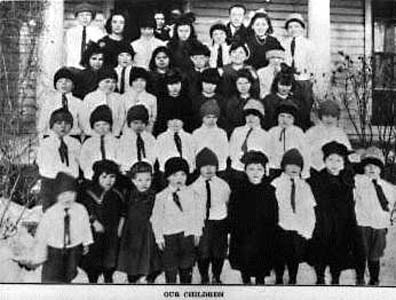
Children at Jewish Orphanage (source)

"The poor and the lonely found in him their champion. All factions and the community at large discovered in him an echo in his great heart” Rabbi Wohlgerlenter at funeral of Rabbi Kahanovich.


Related:

Government of Canada Recognizes the National Historical Significance of Abraham Albert Heaps and Israel Isaac Kahanovitch
(Media Release and backgrounders)

The Growth of the Winnipeg Jewish Community and the Evolution of its Educational Institutions
Manitoba Historical Society

The 100th anniversary souvenir of Jewish emancipation in Canada (1832-1932) and the 50th anniversary of the Jew in the West
Israelite Daily Press, 1932

Monday, 5 July 2010

'Happy Rock' now a stamp !


One of Manitoba's favourite roadside buddies is now a postage stamp !

Over the weekend there was an
official unveiling of the stamp which is part of Canada Post's 2010 series of Roadside Attractions. The eleven meter tall H.R. joins the Wawa Goose, Davidson, SK. coffee pot and Longue-Pointe-de-Mingan's Puffin. (For 2009's attractions).


On another stamp note, today is the official release date for the 100th anniversary Saskatchewan Roughrider stamped envelope. So, if you're a closet (or 'out') Green Rider fan and want to get under the skin of a Big Blue fan, you can send them Leader Post articles whenever the Riders' win !

Related:

2010 Stamp Releases Canada Post
Even More reason to Smile AGCanada
Gladstone Happy Rock stamp unveiled Portage Daily Graphic

Sunday, 4 July 2010

A Royal Visit

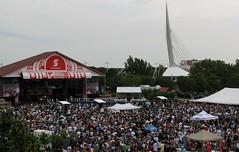
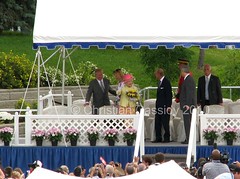
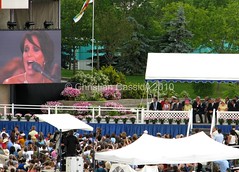
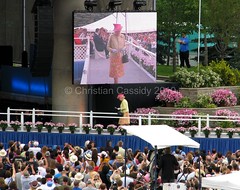
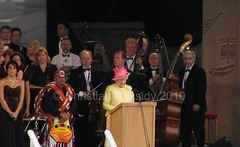
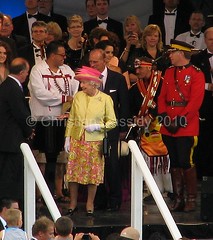
The Queen, of course, was here over the weekend to dedicate the Human Rights Museum at the Manitoba Homecoming Concert for Human Rights at The Forks and do some other Head of State stuff. It was her fifth, and likely, final trip.

Queen, Duke Portage la Prairie, 1970

Personally, I am not anti-monarchy. I don't mind the tie to the past. Besides, we need a head of state and as Peter C. Newman once put it, in the Queen we get a "Cadillac head of state with a Ford Escort price". Some pics from the Forks:
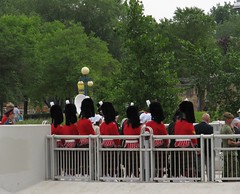
Honour Guard
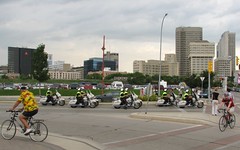
Motorcade up L' Esplanade Riel
Honour Guard
Motorcade
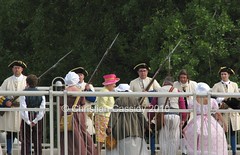
Procession
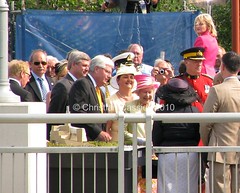
Harper, Queen Checkin' out the Museum for Human Rights
Concert Site
A toodle-ee-doo for the crowd
Kreviazuk and Queen
A Royal Stroll
Addressing the crowd

Related:
Canadian Heritage: Queen Elizabeth
Map: all of QE2's Canadian visits
Photo gallery: Queen in Canada 2010
Video arriving at JAR
Video of Queen's speech from the Forks
Text of Queen's speech form the Forks