Local News Links:... .........................

Tuesday, 31 August 2010

Manitoba's best roads, then and now


I read in the Altona Echo that there is a contest on to find Manitoba's best roads. After a recent trip to Grand Forks may I say that Highway 75 from Morris to Ile Des Chenes won't be getting a vote from me.

The contest is sponsored by CAA Manitoba but the letter mentions an organization that I didn't even know existed anymore: the Manitoba Good Roads Association. Based in Portage la Prairie, they appear to be websiteless right now, but Googling them finds that they are still active in promoting well maintained roads and related matters.


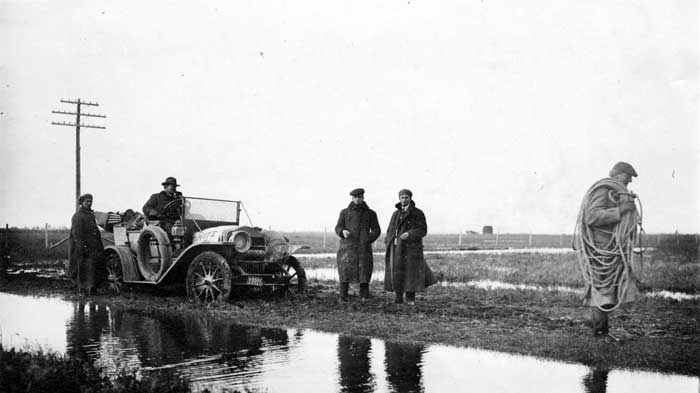
Likely not a winner: Hwy 6 Winnipeg to Souris ca.1922 (source)

The contest is not new. Here are the results from 1939 when the R.M.s of Strathcona and Odanah took top prizes. Pipestone and Hamiota won in 1941.


Winnipeg Evening Tribune, May 31, 1940 (full article)

The association was formed in 1909 and not just to give prizes. They advocated for improved commercial opportunities, road safety and even advocated for a share of gas tax revenue for road improvements as early as 1940 !


The first president of the association was Samuel Robert "S.R." Henderson. The Hendersons were a pioneering family from the North and East Kildonan area. He worked for many community organizations ranging from horticultural societies to John Black Church and served on the municipal council.

He presided over the
Manitoba Good Roads Association for 18 years until shortly before his death in 1928. Fittingly, two roads were named for him: Henderson Highway and Essar Avenue (his first two initials spelled out).

The day after his death, Jan. 28, 1928, the Free Press wrote:

He was always on the side of progress, looking ahead and anticipating good results and general benefits from some project that to others might have seemed without merit".

Related:

'Mr. Highways' Ace Emmett MB Historical Society
AC Emmett and Good Roads in Manitoba MB Historical Society
Movement for Good Roads Rapidly Growing in Popularity Portage la Prairie Weekly Review, June 8, 1910

Monday, 30 August 2010

'Best Mayor of Winnipeg' Poll Two Results !

I created my Manitoba Municipal Elections 2010 blog with the best of intentions but have the feeling that I am not going to be able to keep it going until election time. One thing I will slide from there to Dumplings, though, are the mayoral election polls !


The second question was: which local entertainer would make the best mayor of Winnipeg ? The results are in !


Fred Penner and Little Hawk (Troy Westwood) tie for the top spot with Weakerthans' John K. Sampson nudging out Dancin' Gabe for third.

The winners of the polls will
will square off in October for the title of faux-mayor !


There are more polls to come !
Related:
Poll One Results: 'Which local tv personality would make the best mayor of Winnipeg ?'

Saturday, 28 August 2010

Nothing new: murders of the past

Winnipeg Police Museum
When people talk to me about my daily history blog I usually get a comment about how surprised they are at the crime reports they read about.

It's a sad fact that, like most cities, the good old days weren't always good and street crime, even ones that shock us today, go back a long time.


In just
the past five days I marked the anniversary of Manitoba's first hanging, that of Private Joseph Michaud, for the 1874 unprovoked, multiple-stabbing death of a bystander on Main Street. There was the 1909 hanging of Mike Pidhoney for slashing the throat of a man while he slept in Sandilands. Donald Prockiw went to the gallows for the brutal 1926 murder of "Scotch Annie" Cardno. Today commemorates the sad 111-year old quadruple murder-suicide of the Johnson family in Gilbert Plains.

I don't go out of my way to note crime stories so there are hundreds of murders, rapes, kidnappings and the like that sit in the newspaper archives.

If local true-crime is something that you are interested in there are a few great resources...


There is the Winnipeg Police Museum on Allard. It's only open business hours Monday to Friday but definitely worth a visit. Batons and arm bands used by "Specials' in the 1919 strike, historic wanted posters and even a 1920's Winnipeg Police paddy wagon are included in the collection.

The museum is also a great on-line resource with numerous well-researched stories about notorious criminals, crimes and the (mostly) men behind the badge.

Another site, Manitoba's Buried History, is a fascinating look behind the headstones. The famous, the forgotten and those who lost their lives as victim, or perpetrator, of crime.

Muddy Waters Tours has a great lineup including a Murder, Mystery and Mayhem walking tour. For walking tours better book soon before the summer is done !

Wednesday, 25 August 2010

Celebrating our rivers !


Having been immersed in the Red River, so to speak, for the past couple of months working on the St. Andrews Lock and Dam 100th anniversary celebration I was really struck by how much we used to use our rivers for entertainment.


Heading to Lockport 1952 (Trib Archives)

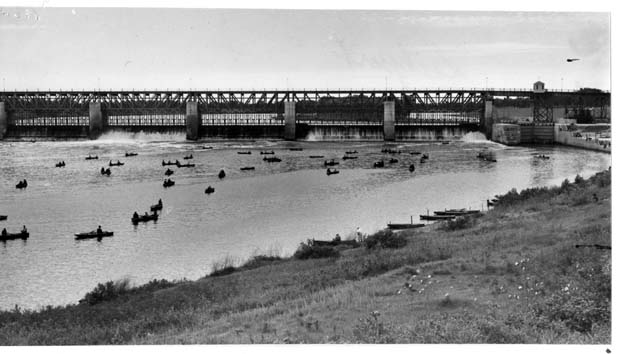
Right into the 50s, (that's as recent as I went into the archives so it could have been into the 60s or 70s), regattas and canoe races were regular weekend features. Hundreds would line the river banks and picnic to watch the show.


Above July 14 1910, below July 16, 1910 MB Free Press

Excursions to locales even as close as Lockport were also a regular getaway for city folk. Sail off to Lockport, Selkirk, Gimli with the family for an afternoon.

Since the 60s we've really neglected our rivers. The Forks reintroduced people to the fact that we do, indeed, have a waterfront that many cities would kill to have right in the heart of the city. For many, though, they know the rivers as little more than a dangerous place that can potentially flood us each Spring and where the odd body turns up.


Lord Selkirk II ca. 1970 (Trib Archives)

The recent news that the MS Lord Selkirk II, the largest ship to sail our rivers, had been sold for scrap brought back the fact that we really did enjoy our rivers at one time.

Red River
A couple of years back I had the opportunity to get a boat tour of the city and it was fascinating. It was like seeing the city for the first time ! I encourage folks to get out in what's left of the summer and do something on the rivers.

The Splash Dash costs little more than transit fare to get from one dock to another. For $15. you can get a day pass and hop-on-hop-off all you like.


The Paddlewheel Queen and MS River Rouge offer afternoon sightseeing cruise for about $20 and have restaurants aboard.


From August 25 to 29 something really cool will take place: a River Barge Festival ! Everyone from Fred Penner to the WSO to Greg MacPherson will be playing over the five days !

Definitely worth checking out
!

Related:
Barge Scale Entertainment - Free Press
MS Lord Selkirk II history page

Tuesday, 24 August 2010

Lockport 100th: wasn't that a party !

Some sights from the Lockport 100th anniversary celebration !

Lane Turner:
Lockport 100th: Day 2 !
St. Andrews Lock and Dam original sign:
Lockport 100th: Day 2 !
The Chickenmobile !
Lockport 100th: Day 2 !
The bridge was spiffed up:
Lockport 100th: Day 1 !
Even the pelicans were having a good time !
Lockport 100th: Day 1 !
George Canyon:
Lockport 100th: Day 3 !
Ending with a bang:
Lockport 100th: Day 3 !

My role was organizing the opening ceremony on Saturday. I've put on events before but never one with a cast of 40. Everyone showed (early !) so the event started on time and it seemed that everyone had a good time !
The heat was the only drawback.

Piping in the speakers:
Lockport 100th Opening Ceremony
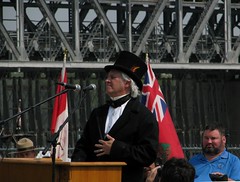
Laurier delivers the speech he first made in 1910:
Lockport 100th Opening Ceremony
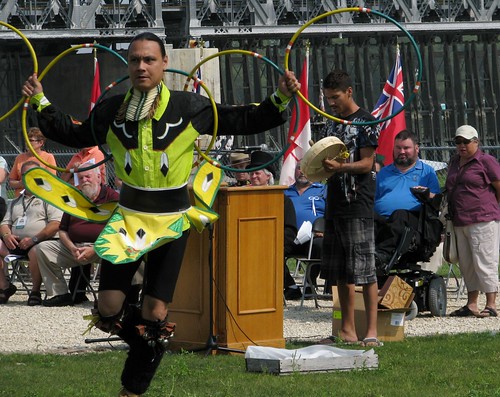
Hoop dance:
Lockport 100th Opening Ceremony
You know, whenever I put on an event it gets raided by pirates.
I'm really getting fed up with that.
Lockport 100th Opening Ceremony
The line-up:
Lockport 100th Opening Ceremony
Actor J Craig Oliphant did a great job as Sir Wilfred !
Lockport 100th Opening Ceremony
Another raid completed, the pirates return north to await my next event.
Lockport 100th: Day 2 !

Related Media:
Lock and dam celebrates 100 years Selkirk Journal
Lockport Dam Marks 100 Years with Wknd Celebration ChrisD.ca
Lockport dam celebrates 100th anniversary Free Press
Lockport’s century party earns calls for encore Winnipeg Sun
Lockport celebrates 100 years CTV.ca August 22, 2010

Reference:
Lockport Manitoba
St. Andrews Locks and Dam PWGSC
Building Lockport's Lock and Dam St. Clements.ca
St. Andrews Locks MB Historical Society

Saturday, 21 August 2010

Lockport's 100th, part three: Laurier's Words

This is a three part series to commemorate 100 years of the St. Andrews Lock and Dam at Lockport, Manitoba !


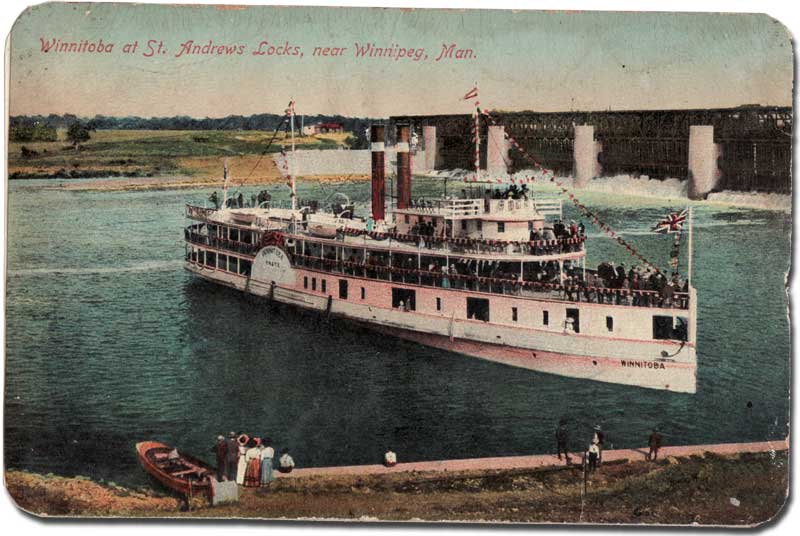
On the afternoon of July 14, 1900, Sir Wilfrid Laurier, his public works Minister Hugh Puglsey and other VIPs stood aboard the Winnitoba in the Lock and Laurier delivered this address.


"I think I shall meet the wishes of those who are before me if I first congratulate my friend and colleague, Dr. Pugsley, the minister of public works, upon the efficient and remarkable manner in which he has finished this structure. I have the testimony of engineers that this is one of the finest works to be found on the American continent, not to speak of the old world.

I also offer my congratulation to the city of Winnipeg that at last a long felt want has been fulfilled. The province of Manitoba has been represented In the House of Commons for more than forty years; I have been there myself for 36 years and during those thirty six years not one session has passed but I have heard of the lock to be built at the St. Andrew's rapids of the Red River.

It has taken you long time to come, but it has come.
5x7 print

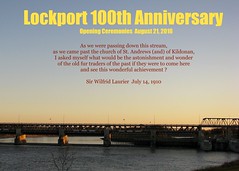
As we were passing down this stream, as we came past the church of St. Andrew's, famous in the annals of this territory of the past, as we passed by the still more famous church of Kildonan, I asked myself what would be the astonishment and wonder of the old fur traders of the past, Mactavish, Alexander McKenzie, and the last of them all Lord Strathcona, if they were to come here and see this wonderful achievement.

Their days were the days of primitive navigation. When they came to this rapid they had to unload their canoes, put the canoes on their heads and take it over to the other side of the rapid to get clear water, but today you can take your boats with a draught of nine feet of water and a clear space of navigation of 300 miles before you. This is some achievement. It is something of which we have reason to be proud. But sir. it is not all - it is only the beginning of what Is to be done.

It is only the commencement of what Is before us. We have opened the Red River up to Lake Winnipeg, and it now remains for my friend, Dr. Pugsley, to open the Saskatchewan River from Edmonton to Winnipeg.

Do not tell me that this is impossible. It is not impossible. One day the great Napoleon gave an order to his general, and the general answered: 'Sir, I cannot do that, it is impossible.' 'Impossible,' said the great Napoleon, 'the word Impossible Is not to be found in the French dictionary.' And I say, the word impossible is not to be found in the language of the West. (Cheers.) Therefore, we shall accomplish this.

Sir, we do not know the possibilities of our country. We do not know yet what we shall accomplish In the future. When French Canada was discovered by the French adventurers In the 16th century, the French crown did not believe that It was worth spending any time and blood to retain the country for the French crown, and when it was lost by the French to the English, notwithstanding the fight of her gallant generals, one of the chief officials of that day said, 'Oh, France has only lost a few acres of snow. We have since found out that those few acres of snow make up one of the most fertile countries under the sun.

When Sir John A. Macdonald acquired these northwest territories from the Hudson Bay, many croakers told us that never a bushel of wheat would, be grown in the valley of the Red River and the valley of the Saskatchewan. Last year the export wheat from the valleys of the two was 75 million bushels, and only

the other day a member of my cabinet speaking in London stated that within 'a few years these western provinces will produce no less than one billion bushels of wheat'. I concur with that view.

This will give the outside world an idea, of the possibilities before the West. At the present we are only on the fringe of it. A motto we have in the East is "Hope on, hope ever” I bring it to you, although I know it is in you more than it is in myself."

Also:
Part One: A Brief History of the St. Andrews Lock and Dam
Part Two: The Creation of Lockport

Related:
Lockport Manitoba
St. Andrews Locks and Dam PWGSC
Building Lockport's Lock and Dam St. Clements.ca
St. Andrews Locks MB Historical Society


Text & Laurier portrait source: Winnipeg Free Press July 15, 1910

Friday, 20 August 2010

Lockport's 100th, part two: The creation of Lockport

This is a three part series to commemorate 100 years of the St. Andrews Lock and Dam at Lockport, Manitoba !

Part Two: The Creation of ‘Lockport’


At the start of construction a settlement nicknamed ‘Kelly’s Siding’ sprang up (named for the initial contractor). In June 1902 the name of the post office was changed to ‘Lockport’.


In 1902, 1600 vessels passed through the lock and Lockport became synonymous with summer getaways, canoe trips, sightseeing cruises, afternoon picnics, and fishing excursions. As the automobile increased in popularity, so did Lockport. Amusement rides, outfitters, hot dog stands, dance halls, and ice cream shops flourished.


St. Andrews Lock and Dam Facts

- It is the only lock on the prairies and is 11m deep, 62m long and 13.7m wide.
- The lock fills by gravity so it takes about 20 minutes to ‘lock through’.
- Each curtain is made up of 50 Douglas fir laths, each 4m long and 2m wide.
- It is a National Historic Site and a Canadian Civil Engineering Historic Site.

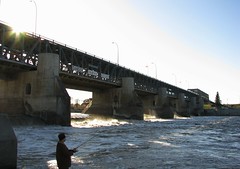
Fishin'

"As we were passing down this stream , as we came past the church of St. Andrews (and) of Kildonan, I asked myself what would be the astonishment and wonder of the old fur traders of the past … if they were to come here and see this wonderful achievement.”

Sir Wilfred Laurier July 14, 1910

Also:
Part One - A Brief History of the St. Andrews Lock and Dam
Part Three - Laurier's words

Related:
Lockport Manitoba
St. Andrews Locks and Dam PWGSC
Building Lockport's Lock and Dam St. Clements.ca
St. Andrews Locks MB Historical Society

Thursday, 19 August 2010

Lockport's 100th, part one: A history of the St. Andrews Lock and Dam

This is a three part series to commemorate 100 years of the St. Andrews Lock and Dam at Lockport, Manitoba !

Part One: A Brief History of St. Andrews Lock and Dam


In the late 19th century Manitoba's economy relied on the lumber, fuel wood and fish supplied from the Interlake region but a series of rapids along the Red River prevented the direct passage of large vessels to Winnipeg. As steamships became larger a permanent solution was needed to save starving commercial development. In 1880, the idea to dam the St. Andrew’s Rapids on the Red River was born.


Winnipeg contractors Kelly Brothers began construction on Oct. 9, 1900. The first few years of construction were difficult as the Red’s powerful current often carried away sections of the temporary dam, washing out the worksite. Floods, unusually cold winters and disease also took a toll. In 1905 the government appointed a new firm, Quinlan & Robertson of Montréal, to complete the dam.

Even with excavation underway, the design for the structure had not yet been finalized.

The type of dams typically built in North America and Britain would not work at this site so the federal government sent architect H. E. Vantelet of Montréal to Europe to find a solution. After two months he settled on a type of dam he saw along the Seine River in France: a Caméré curtain dam, (named for the man who invented it). Vantelet modified the design to fit the Manitoba site and make provisions for an accompanying lock, canal and a last minute addition of a vehicle roadway.

In April 1907 the final drawings were in place for a truly one of a kind structure.


In September 1908 the Free Press wrote: “Construction is now approaching completion and the time is not far distant when Lake Winnipeg vessels will discharge their cargoes of fish, lumber, or cordwood at the docks of Winnipeg.”


The first vessel to pass through the lock was the government steamer Victoria at 2:45 p.m. on May 2, 1910. The official opening took place on July 14, 1910 when the Winnitoba sailed from Winnipeg with guests of honour Prime Minister Wilfrid Laurier and his Public Works Minister William Pugsley, the man many credited for getting the often-stalled project finally on track and completed. Other dignitaries ranging from the President of Winnipeg’s Board of Trade to the U.S. Consul General.


While the Winnitoba was in the lock, Laurier made a short speech and Pugsely declared the St. Andrews Lock and Dam open. This speech will be re-enacted at the Opening Ceremony of the festival on Saturday, August 21 at 11:30 am on the Lock property across from Skinners on River Road !

St. Andrews Lock and Dam Facts

- It is the only lock on the prairies and is 11m deep, 62m long and 13.7m wide.
- The lock fills by gravity so it takes about 20 minutes to ‘lock through’.
- Each curtain is made up of 50 Douglas fir laths, each 4m long and 2m wide.
- It is a National Historic Site and a Canadian Civil Engineering Historic Site.


Also see:
Part Two - The Creation of Lockport
Part Three - Laurier's Words

Tuesday, 17 August 2010
Manitoba highway amenities of the past

More of my 'summer series' of odds and ends....

Yes, there was a day before Highway 1 ! See "We could use the Trans Canada" from the Winnipeg Evening Tribune of July 15, 1940.


Above: Manitoba Bureau of Travel and Publicity
Guide Book to Manitoba 1949 (source)


Above: 'Orbit' ca 1969 (source)

Wednesday, 11 August 2010
...public drinking fountains, too.

Fire Fighters Museum  of Winnipeg
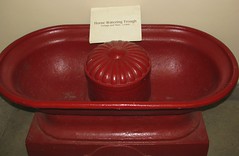
Fire-horse trough from Portage and Main ca.1900

The first round of public drinking fountains, which was usually a combination human fountain and horse trough, went up in the city in the 1881-1882 budget year courtesy of the city waterworks department. In 1902 when the city hall grounds were redone two drinking fountains were installed on what was the most public square in the city.

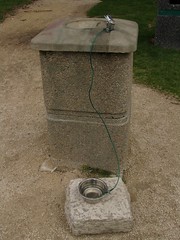
Doggie water fountain
I have always felt that water fountains, almost as rare as public toilets nowadays, should be part and parcel of the toilet debate. In recent years the importance of proper hydration, especially for active kids, has become top of mind while the supply of public water fountains has declined.


Last month the U.K.'s Children's Food Campaign released a study entitled Thirsty play: a survey of drinking water provision in public parks. Their research found that of 140 London parks only 11% of them had water fountains and just two-thirds of those actually worked.

Of course that's where the bottled water industry steps in to save us, right ?

The Campaign claims that by making kids to go to the store to quench their thirst they more often settle for pop and other sugary drinks rather than the plain, old water that they need.


An unrelated study of Philadelphia children in the journal Pediatrics in November 2009 found that when kids go to the corner store they purchase an average of 360 calories worth of food and beverages per visit. A vast majority of it considered junk food.


Boris Johnson's 2008 London mayoral campaign included a pledge to add fountains to parks but nothing has come of it, something pointed out in this 2009 article in the Evening Standard. With the release of the Children's Food Campaign report there is also a coinciding campaign to pressure local officials to fix up existing fountains and provide new ones in public parks.

A bit like the toilet debate. An idea over a century old that needs to make a comeback.

Related
Lack of public water fountains bad for kids health The Guardian
How Water Went on Sale and Why We Bought It N.Y. Times (Review)

'H20 to go'
City of Toronto

Wednesday, 4 August 2010

Manitoba's Bus Heritage

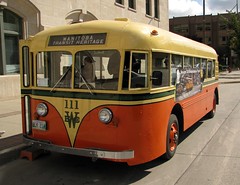
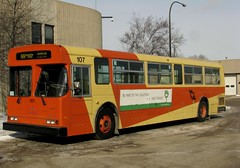
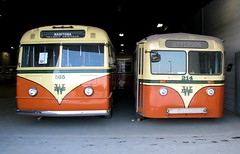
The Manitoba Transit Heritage Association has a great collection of vintage buses. Over the course of the summer you may see them at festivals or events.

Manitoba Transit Heritage Association
Their most popular bus is their oldest one - a 1937 Twin Coach 23R.

MTHA New Aquisition
To make you feel old, the newest bust acquired is over 25 years old ! It's a 1984 New Flyer D901A in the now-retired orange and cream colours.

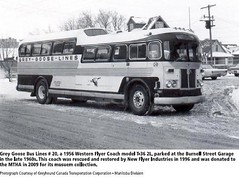
Western Flyer 1954 Scenic Cruiser
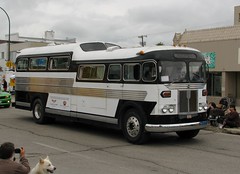
Scenic Crusier ca 1960s above, 2010 below
Western Flyer 1954 Scenic Cruiser
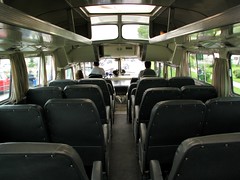
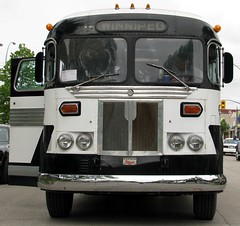
The latest acquisition was a pair of 1950s coaches restored by New Flyer. This 1954 Western Flyer Scenic Cruiser traveled the Winnipeg / Lockport / Selkirk route for Grey Goose for decades.

Western Flyer 1954 Scenic Cruiser
With the great windows and chrome inside and out you could tell that the bus industry was working to match a sense of the style that was luring the traveling public to the airlines.

Manitoba Transit Heritage Association