© 2009, 2017 Christian Cassidy


On September 1, 1929, Medway Court Apartments on Edmonton Street were destroyed by fire. It is tied for being Winnipeg's second deadliest fire with nine dead and at least nine others hospitalized.
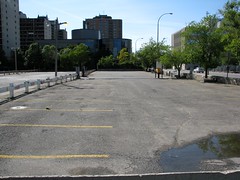
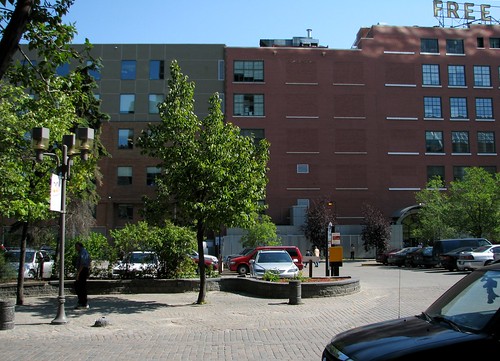

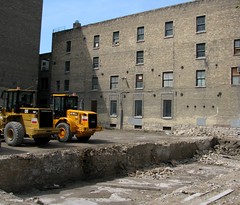
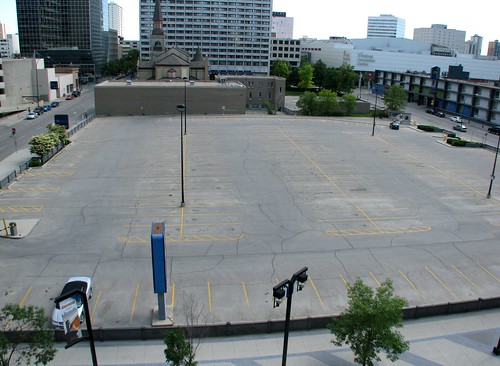
Medway Court was a three-storey walk-up apartment block located at 307-309 Edmonton Avenue near Ellice. Today, it is part of the the parking lot behind the former Free Press Building.
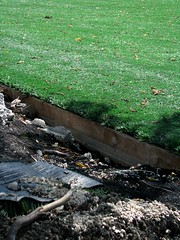
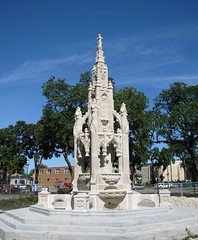
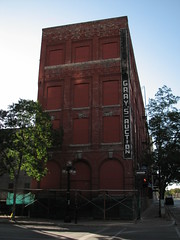
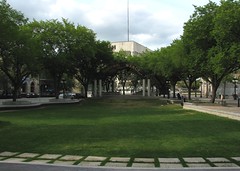
The above photos show where the building once stood and its bustling residential district that stretched from Portage Avenue to Central Park.
The ca. 1914 building's "for rent" classified ads show that it catered to students and single businessmen, but the block also had some spacious five-room suites intended for families. The proximity to Central Park made it an ideal location.

September 2, 1929, Winnipeg Tribune
Just after 2:30 a.m. on the morning of Sunday, September 1, 1929, a pedestrian noticed a fire on the main floor of the building and ran to a phone box to call it in. By 2:45 a.m. it was a two-alarm fire and a few minutes later every on-duty fireman in the city was at the scene.
The fire was centred on the main floor near the front entrance which blocked people from escaping. Flames climbed the building through the back wall which made the metal fire escape ladders unusable.
The only way out was to jump from windows and balconies.

Manitoba Free Press September 3, 1929
Fire Chief Beech later said he arrived on scene at 2:45 a.m., just a couple of minutes after the call was received, and by that time the second and third floors were burning "fiercely".
His men saw a man hanging by his hands from a second floor balcony and called to him to wait for a ladder. By the time his crew made it to the building, the man had already let go. Other people landed on the ground around them.

September 2, 1929, Winnipeg Tribune
Later that morning, another fire chief proclaimed this to be the worst fire in the Winnipeg region's history. Worse than the St. Boniface College fire of 1922 and the previous year's Casa Loma Apartment fire that killed five. (He was mistaken as the St. Boniface fire killed ten, making it the deadliest fire in the Greater Winnipeg area. I have only been able to find one fire since - the Haselmere Apartment fire of 1974 - that equalled the number of nine dead.)
The death toll would have been higher if it weren't for the heroism of onlookers who risked their lives to help.
Fred Prout, a cabbie from Sherbrook Street, climbed a column to the first floor balcony to pull four people out of their burning suite. He also pulled two people out of a basement suite window. Others crawled up next to the burning walls to set up ladders or to drag away those who had jumped.
The block was located behind the Winnipeg Free Press building and the newspaper's night staff triggered their building's internal fire suppression system and dragged hoses across the back lane. They aimed others from upper story windows so they could rain water down on the burning building's fire escape.
Though their efforts did not put out the fire, the staff, George Stringer - night engineer, W. Graham - night fireman, and a trio of night watchmen, Arthur Young, C. Kash and Mike Kegan, later received bonuses from their employer for putting their lives at risk.


Top: Winnipeg Tribune, September 5, 1929
Below: Funeral of Mrs. Gaunt
By the end of the following day, eight bodies had been recovered and nine more were in hospital. The victims, (see below of more information about them.):
- Sarah Gaunt (68) of suite 11, suffocated;
- Ralph Weighton (58) of suite 11, suffocated;
- Madge Edwards, widow, (34) and children Marjorie (9), Gordon (14), of suite 14, burned to death;
- Alfred Appleby and daughter, Irene (11), suite 10, burned to death;
- Mabel Butler (34), suite 14, burned to death;
- William Edwards (adult) jumped and died from his injuries the following day in hospital and was the ninth and final victim.
The injured still in hospital a couple of days after the fire included: Nellie McIntosh (23) with back injuries; Mrs. Edna Applebee (adult) in serious condition with a fractured spine; Alice Applebee (14) in good condition; Mrs. Irene Alsford (adult) with multiple injuries but in good condition.
Funerals for most of the victims took place on Wednesday, September 4 at sites across the city. Many Winnipeggers, still stunned by the tragedy and the fact that three small children died, turned up to join funeral corteges and stand outside churches to pay their respects.

September 7, 1929, Winnipeg Tribune
On September 3, 1929, a coroner's inquest began. The first witness called was the coroner himself who had to identify the body of a close personal friend.
A number of facts came to light during the testimony of witnesses and officials:
- The fire likely began under the main staircase on the main floor;
- Earlier that weekend, painters had varnished the building's entryway. Workmen said that the only items left behind were their ladders - the flammable paint and varnish were taken off-site;
- The Medway's last fire inspection was in 1920 and an electrical inspection took place a couple of years earlier. Neither found major deficiencies;
- Overgrown trees and cars parked next to the building hampered efforts to get ladders to some windows and to properly assist some of those who jumped;
- Not one survivor said that they used the metal fire escape ladders on the rear wall of the building as a means of escape.
The inquest wrapped up on September 11, 1929, after hearing from 62 witnesses. The jury unable to pinpoint an exact cause of the blaze. Subsequent fire investigations came to the same conclusion.
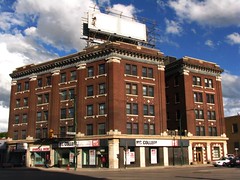
The Casa Loma, Portage at Sherbrook
This was the second disastrous apartment fire in a year. The other was the Casa Loma fire on Sherbrook at Portage which killed five. The city was determined to make a better fire code for apartments, hotels, and lodging houses to prevent future tragedies.
A two-year process involving engineers, architects, and building inspectors resulted in a new fire code and safety by-laws that would apply to both existing buildings and new construction. The application to existing buildings was the key to the new rules as buildings would normally be "grandfathered in" when new fire regulations came about.
The by-laws were fought by the rental industry which warned that new apartment construction would cease in the city forever if they were brought in.
In the end, the code passed but continued industry pressure and the downturn in the economy due to the stock market crash forced council to repeal it in 1931.
It was not until 1943 that many of the recommendations were re-implemented. It took the Haselmere Apartments fire of 1974, which also killed nine people, to make fire code regulations the law regardless of what year a building was constructed.
- Overgrown trees and cars parked next to the building hampered efforts to get ladders to some windows and to properly assist some of those who jumped;
- Not one survivor said that they used the metal fire escape ladders on the rear wall of the building as a means of escape.
The inquest wrapped up on September 11, 1929, after hearing from 62 witnesses. The jury unable to pinpoint an exact cause of the blaze. Subsequent fire investigations came to the same conclusion.
The Casa Loma, Portage at Sherbrook
This was the second disastrous apartment fire in a year. The other was the Casa Loma fire on Sherbrook at Portage which killed five. The city was determined to make a better fire code for apartments, hotels, and lodging houses to prevent future tragedies.
A two-year process involving engineers, architects, and building inspectors resulted in a new fire code and safety by-laws that would apply to both existing buildings and new construction. The application to existing buildings was the key to the new rules as buildings would normally be "grandfathered in" when new fire regulations came about.
The by-laws were fought by the rental industry which warned that new apartment construction would cease in the city forever if they were brought in.
In the end, the code passed but continued industry pressure and the downturn in the economy due to the stock market crash forced council to repeal it in 1931.
It was not until 1943 that many of the recommendations were re-implemented. It took the Haselmere Apartments fire of 1974, which also killed nine people, to make fire code regulations the law regardless of what year a building was constructed.
More about some of the victims:
 Manitoba Free Press September 4, 1929
Madge Edwards and children Gordon and Marjorie all died.
Witnesses say that Marjorie, 9, appeared at her second storey window screaming for help. Firemen called back instructing her to jump into the net below. As she was about to jump, her nightdress caught fire and she fell backwards into the suite. Her body could only be identified at the coroner's inquest by the jewellery she was wearing.
The three were buried in St. Mary's Cemetery.

 Manitoba Free Press September 4, 1929
Madge Edwards and children Gordon and Marjorie all died.
Witnesses say that Marjorie, 9, appeared at her second storey window screaming for help. Firemen called back instructing her to jump into the net below. As she was about to jump, her nightdress caught fire and she fell backwards into the suite. Her body could only be identified at the coroner's inquest by the jewellery she was wearing.
The three were buried in St. Mary's Cemetery.

 Top: Alfred and Edna Applebee, Sept. 2, 1929
Bottom: Dena's death, Winnipeg Tribune, Sept 4, 1943
Alfred Appleby
was a clerk at a veterinary supply company. He and daughter Irene burned to death while another daughter survived. They are buried at Assiniboine Memorial Park.
Edna Applebee, who was left paralyzed from her jump that night, died at the age of 48 on September 3, 1943, almost fourteen years to the day of the fire.
Edna Applebee, who was left paralyzed from her jump that night, died at the age of 48 on September 3, 1943, almost fourteen years to the day of the fire.

September 1, 1930, Winnipeg Tribune
Mabel Butler, who lived elsewhere in the building, was visiting with the Edwards family in suite 14 at the time of the fire. Her body could only be identified by the wedding ring she was wearing.


Manitoba Free Press Oct 15, 1928
Then there was poor Mrs. Sarah Gaunt.
Less than a year before her death, Gaunt appeared in a testimonial ad for a product called KEENO, a sleep remedy for those with "fragile nerves." She is quoted in the ad saying: "I could not sleep soundly and restfully" but "using KEENO for a short time I found my nervous system stronger and I could sleep more soundly and restfully. Continuing the use of this efficient medicine I am improving right along."
At the coroner's inquest, which knew nothing of the ad of course, it was noted that Mrs. Gaunt was found dead lying in her bed. She likely slept through the commotion and died in her sleep from suffocation.
She is buried at Brookside cemetery.
Gaunt's lodger, Ralph Weighton, also died of suffocation.
UPDATE: 2009
There is no marker or memorial to note this tragedy. This is a notice I posted at the site on Sept. 1, 2009, the 80th anniversary of the tragedy: