Local News Links:... .........................

Thursday, 30 October 2008

An Urban Design Icon and Then There's "The W" - Update

I saw an interesting BBC documentary about an unsung hero of modern urban design: Harry Beck, the creator of the famous London Underground map.

Beck wasn't a designer or artist but rather an engineering draftsman who sometimes worked for the Underground. It was during a layoff in the early 30's that he decided to take a shot at improving the increasingly cluttered map used by the company. He revolutionized map making by foregoing actual geography in exchange for ease of use and understanding.

Today, his map is still the basis for not only for London's Underground but for most of the 80 subway systems around the world. Beck's maps have have been shown in modern art exhibitions and was chosen one of Britain's top three design icons of the 20th century, (along with the Spitfire and Concorde), in a 2006 BBC contest.

I've relied on Harry's work in London and Munich's variation as well. I sometimes think about these maps when I see people confusedly walking around in our 'skywalk'. Despite it being a fairly simple system - a mostly straight line with a ball at one end - we've never really done a great job conveying it's simplicity to newcomers.

Initially, the skywalk relied on each building owner to wayfind people in and out of their own section of the system with mixed results as this 1988 Rocki Rolletti skit shows. In the mid 00's a Pittsburgh design firm was hired to create a unified system. The system was rebranded "The W" Walkway System, (a name that 95% of Winnipegger's wouldn't recognize).

Despite it being a single finger stretching from Portage and Main to Portage and Memorial it was given three colour codes:

As the wayfinding firm describes:

Wayfinding within the complex walkway system was conquered by dividing the system into three color-coded “subway lines”, each named for the out-of-doors avenue, which they parallel.

Finding a map for the system is difficult. The Downtown BIZ's site shows "Downtown Indoor Walkway System Map (coming soon)" and explains the system this way:

"When you’re out and about downtown, watch for the “W” signs to show you how to access the system. Signage throughout the walkway will also help guide you. The City of Winnipeg coined the term “The W” as short-form for the weather protected walkway system, simplifying signage and usability".

The city of Winnipeg map page refers you to the non-existent BIZ map. The MTS Centre "Parking Transit and Walkway System Map" does not use the colour coded "The W" system.

Harry's map brought together a complicated system and created a colour coded, straightforward diagram that people could figure out at a glance. Our old system relied on the multiple location sign system that many cities still use. Instead of combining the two into one for our signage, as San Antonio has done below, it seems we've maybe taken the downside from both and combined them into an overcomplicated system for ourselves.
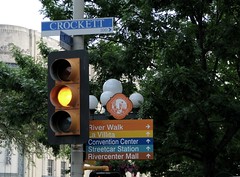
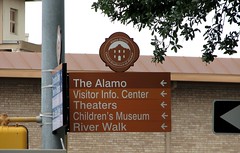
Texas - San Antonio

Texas - San Antonio

Now, it could be a case that I am too familiar with the system and therefore don't see the ease that the now 5 year old wayfinding system offers. I still see a lot of confused faces in The W, though.

Well, here's to Harry and good urban design !

Update: Since posting this I've been a lot more observant about the walkway system when using it. A few weeks on, here are some additional thoughts:

- I still think that using a "W" to mark the system is too simple. The letter is not going to become iconic enough that locals or visitors would pick up on what that means. The word skywalk or walkway should have been incorporated. Even the London underground system, it's logo recognized around the world, uses a word. It also uses the same colours, regardless of what part of the city you're in.

- I think that a rebranding is a failure when the body that commissioned it doesn't bother using it. If you notice in the recent announcement from thh city that the system will be expanded to the Convention Centre it does not refer to "the W" Walkway - it calls it the Skywalk - the name that Winnipeggers christened it long ago.

- From my read of the branding that means another colour will be rolled out for the logo for that stretch of the system.

Sunday, 19 October 2008

Weekend Update: I Love Manitoba (9) - Brookside Cemetery

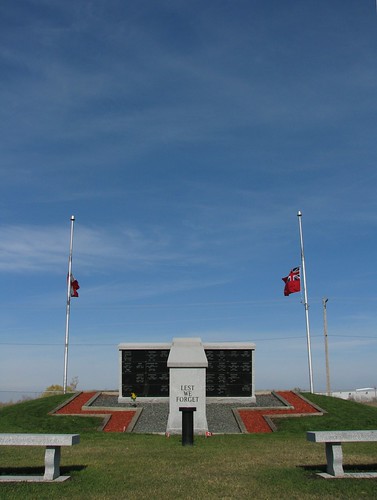
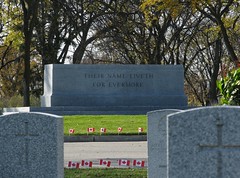
This weekend they rededicated part of Brookside Cemetery - the Teardrop Section in the military Field of Honour.

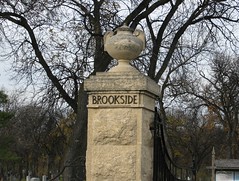
Brookside Cemetary

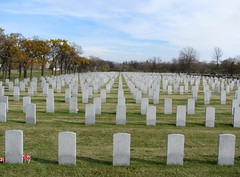
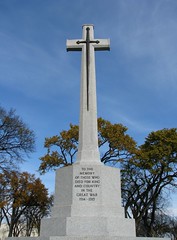
Brookside, located just north of Red River College's Notre Dame Campus, is the largest and oldest military Field of Honour in Canada with 12,000 veterans buried there.

Brookside Cemetary

Brookside Cemetary

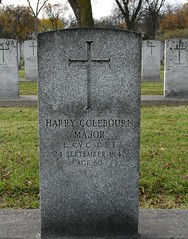
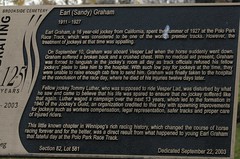
Brookside is home to some of famous Winnipeg servicemen

Brookside Cemetary

Brookside Cemetary

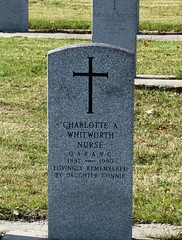
And the less famous
Brookside Cemetary

The Field of Honour is just one section in this vast municipal cemetery. The cemetery is also well signed to point out significant people or historic events related with them.

Brookside Cemetary

It’s a beautiful setting, rich with history. With Remembrance Day approaching, well worth a visit.
Brookside Cemetary

Brookside Cemetary

Wednesday, 15 October 2008

Blog Action Day 2008: The Winnipeg SRO Hotel

I am posting this as part of Blog Action 08. This year’s theme is poverty.
Seen as scary and offensive to many, the Single Room Occupancy (SRO) hotel is disappearing from Winnipeg's downtown landscape. Once numbering over 100, there are now just a dozen left in the Main Street Area.

Places like the Savoy, Brunswick and Leland were closed and torn down in the 1990s with the false hope that by ridding the area of the bricks and mortar, the 'undesirables' and related social problems would disappear with them.


In a 2005 study entitled "Beyond the Front Desk: A Residential Hotel as a Home", Winnipeg's  Institute of Urban Studies found that there were still 1,000 people living in 772 hotel rooms in and around Main Street, (page 27).

There are a host of reasons why people choose SROs as a housing option. 


Many of us would consider them desperate people on the bottom wrung of the housing ladder, perhaps trouble makers or suffering from mental health or addictions issues that preclude them from the regular housing market. Interestingly, though, the IUS' detailed interviews with residents found that many actually chose SRO living, citing the flexibility, freedom and sense of community that a high-rise or social housing doesn't bring. 

A 1991 Illinois study entitled “The use of single room occupancy (SRO) housing as a residential alternative for persons with a chronic mental illness” concluded that SROs allow residents personal freedom and privacy, and they offer a sense of community that is capable of meeting a variety of needs. Proper management of SROs is essential to their success. Overall, SROs are found to be a viable source of housing and should be considered as one of several alternatives available…”

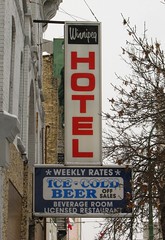
The Winnipeg Hotel

Since there is a demand for this type of housing, is there a way Winnipeg can benefit from their rooms, yet reduce the social ills that make them the bogeyman of the downtown ?

The IUS study looks at a Los Angeles model that encourages non-profits to take over SROs and convert them to offer modern suites upstairs and replace the bar area with social service offices, meal services and the likes.

In 1985 New York put a moratorium on the demolition or conversion of SROs, realizing that if run properly they can be a good housing option. They offered an SRO Supportive Housing Loan Program that has led to a quarter of their hotels being operated by non-profit groups rather than private owners. 

Vancouver has also experimented with similar programs.

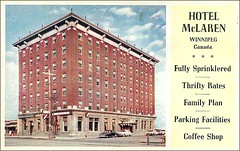
McLaren Hotel Postcard

An important question is where do people go when the SROs are torn down ? 

Many have rejected, or have conditions that prevent them from living in, government social housing. At one time, some may have lived in institutions such as hospitals or mental care facilities, but governments have been pushing care into the community for decades. The city is cracking down on the number and condition of private rooming houses.

Sadly, being on the lowest rung of the housing ladder, many will simply slip right off and become homeless.

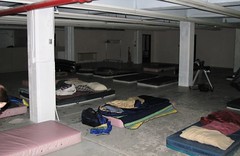
Siloam Mission: Inner City Challenge 4

After many of their SRO hotels were converted into supportive housing, New York found thatNearly 60% of supportive housing tenants in New York City are referred directly from shelters; as a result, the nightly municipal shelter population fell from a peak of 11,000 in 1989 to a low of 5,700 in 1994.” To put that in terms of cold, hard cash: "... the average daily operating cost of a supportive housing unit is $46, compared to a day in a shelter ($68), jail ($129), a psychiatric hospital ($467), or community hospital ($755)."

Point Douglas

SRO hotels are a necessary component of the housing market, whether most Winnipeggers like it or not. We need to come to terms with this and put efforts into improving the conditions and circumstances of SRO living rather than continuing with the wrecking ball mentality of tearing them down hoping that the associated problems go away.

Monday, 6 October 2008

Weekend Update: I Love Manitoba (6) - North End Churches

This weekend I again stayed in the city for a nice long bike ride and ended up getting pics of a couple of North End churches that I have always been interested in. One new, one old.

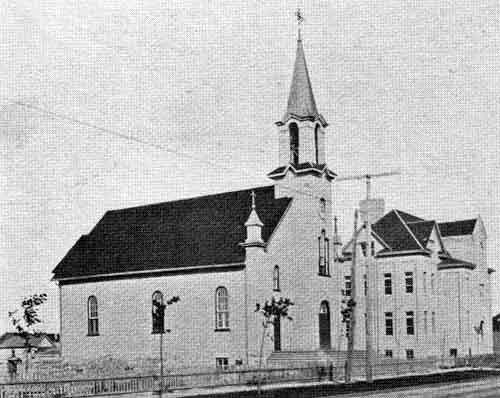
Holy Ghost Church and School 1903
circa 1903

circa 1985

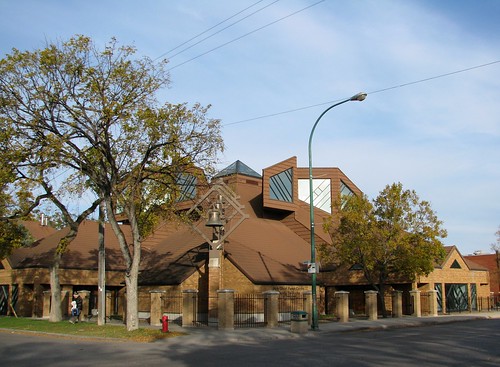
The first is Holy Ghost on Selkirk Avenue.

The original church was built 1898 - 1900 and renovated to a number of times over the years including a being doubled in size in 1905-06.

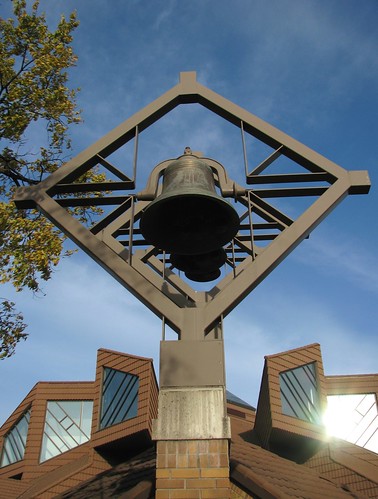
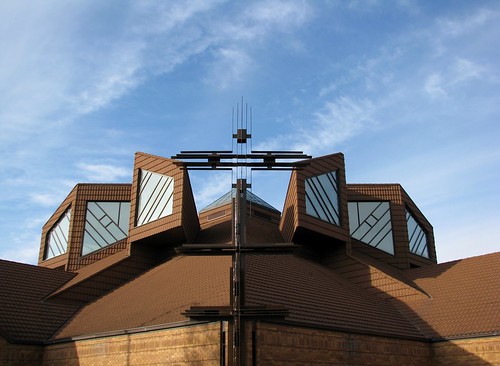
In 1986, Holy Ghost was torn down and a new church built in its place. The church's website has a series of great photo galleries of the old church, demolition and the construction of the new one.
It must have been hard to convince people to tear down an almost century-old structure.

Holy Ghost Parish Holy Ghost Parish Holy Ghost Parish Holy Ghost Parish
What they have now, though, is wonderful. Lots of angles, lots of glass. I had a great time photographing it.


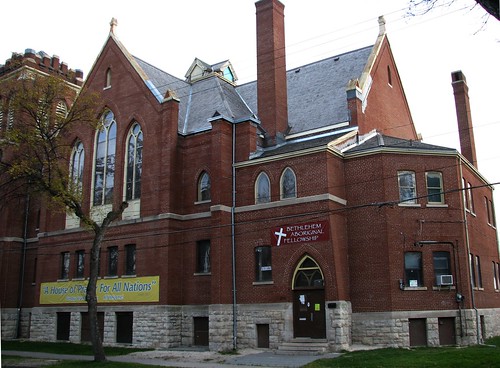
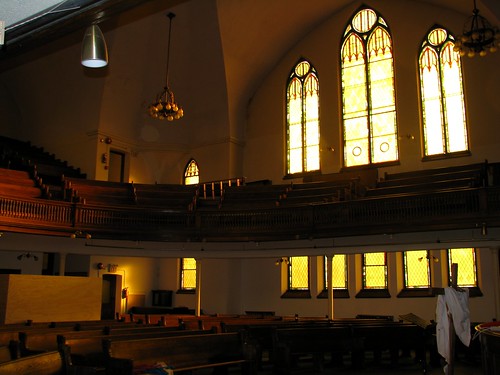
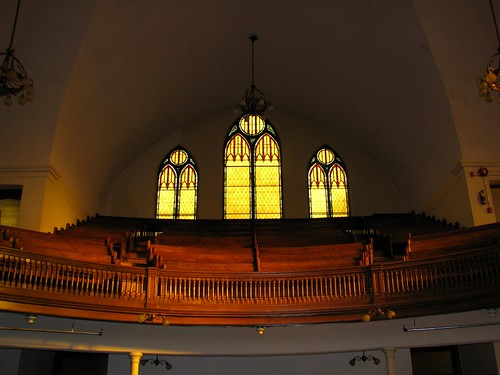
St. Giles / Bethlehem Aboriginal Fellowship Former St. Giles / Bethlehem Aboriginal Fellowship
Former St. Giles / Bethlehem Aboriginal Fellowship Former St. Giles / Bethlehem Aboriginal Fellowship Former St. Giles / Bethlehem Aboriginal Fellowship
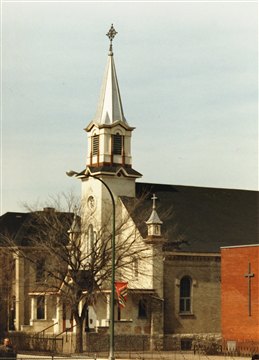
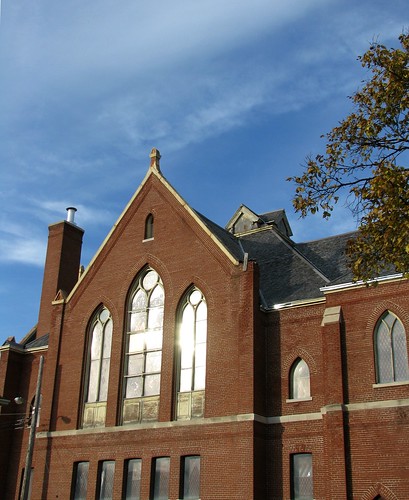
The next church I went to was Bethlehem Aboriginal Fellowship, the former St. Giles Presbyterian, on Burrows and St. Charles.

I was lucky enough to bump into someone who worked there and they let me in to see some of the interior. An amazing building.

I couldn't find photos from way back but if you follow this link to the pdf from the Historic Buildings Committee report you can see some more of the interior and a copy of the floorplan.

Thursday, 2 October 2008

Winnipeg's Darkest Days

Spanish Flu - Winnipeg

Events such as the outbreak of SARS show that even in our technologically advanced age a microscopic ‘bug’ can still create great fear and worry.


Friday, October 3, 2008 is the 90th anniversary of the start of a medical disaster never seen before in Winnipeg and will hopefully never be seen again.

On that day, two soldiers from Quebec returning from the war fell ill near Winnipeg. They were taken to the IODE Convalescence Home in Winnipeg where they died. They would be the first known Manitoba deaths due to the 'Spanish' Flu.

The deaths set in motion
some of the strangest and darkest times the city has ever known.

For more about Winnipeg and the influenza pandemic.